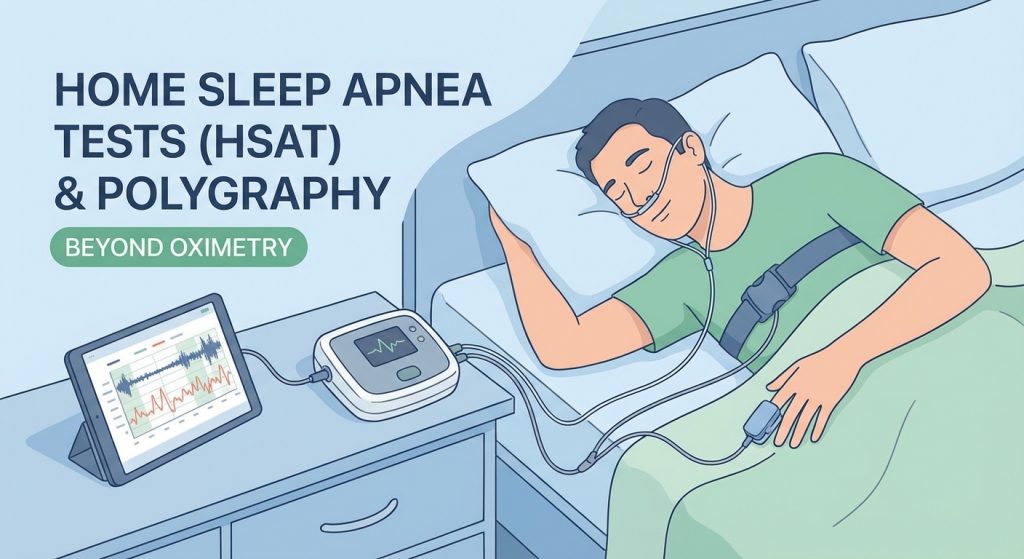
You suspect that you stop breathing at night. Your partner says you snore like a chainsaw, or perhaps you wake up gasping.
You have read about the Wellue O2Ring, but you want something more clinical—something a licensed clinician can review as part of a diagnostic work-up.
Ideally, everyone would go to a sleep clinic for a full Polysomnography. It is the gold standard. However, in the real world, the healthcare system is often clogged. In some countries, the waitlist for a sleep lab is over a year. In others, insurance hurdles make it prohibitively expensive.
This is where the Home Sleep Apnea Test (HSAT) comes in—and it’s best treated as a structured clinical test that’s interpreted by a qualified professional, as outlined by the American Academy of Sleep Medicine.
Specifically, we are looking at Type 3-style HSATs (polygraphy) and closely related PAT-based tests that go beyond simple pulse oximetry. Classic Type 3 setups measure breathing signals directly (often airflow + effort + oxygen + heart rate), while WatchPAT One uses PAT-based autonomic signals plus oximetry and movement to infer breathing disturbances—so it doesn’t always fit perfectly into the old Type 3 vs Type 4 bucket.
This guide explores HSAT accuracy, how WatchPAT technology works, how people typically access these tests when in-person care is delayed, and the critical limitations you should understand before relying on the results.
What is a Type 3 Sleep Study (Polygraphy)?
To understand why these tests are better than a Fitbit or an O2Ring, you have to understand the hierarchy of sleep testing.
- Type 1: In-lab Polysomnography (brain waves, heart, breathing, muscle movement). A sleep technologist attends; a physician interprets the study.
- Type 2: Portable Polysomnography (same sensors as Type 1, but you do it at home). Rare.
- Type 3 (HSAT/Polygraphy): Measures at least 4 channels (e.g., airflow, respiratory effort, oxygenation, and heart rate); examples include ResMed ApneaLink or Alice NightOne. WatchPAT One is an HSAT that uses PAT-based autonomic signals plus oximetry/actigraphy instead of a traditional airflow/effort setup.
- Type 4: Continuous oximetry. This is your Wellue O2Ring. It measures only one or two channels (typically pulse and SpO2).
Polygraphy explained:
A Type 3 test does not just guess that you are having apnea because your oxygen dropped. It looks for the cause. It uses respiratory effort belts(strapped around the chest) or tonometry signals to see if your body is trying to breathe against a closed airway. This distinguishes it from a simple tracker.
The Market Leader: WatchPAT One
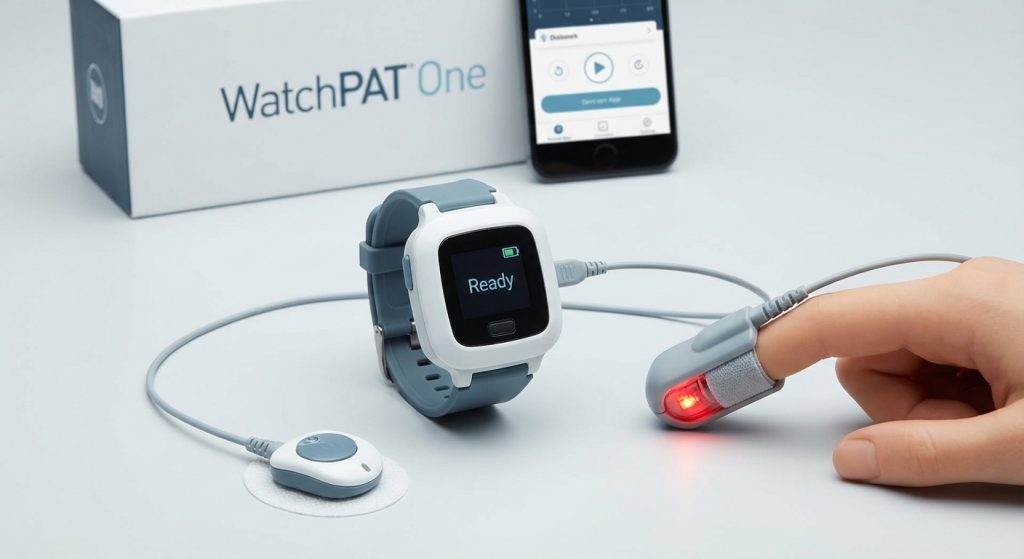
The WatchPAT One has become one of the most commonly used single-use HSAT options in telemedicine workflows, mainly because it’s easy to wear and easy to ship.
How WatchPAT Technology Works
Unlike traditional home tests that require uncomfortable belts strapped around your chest and a cannula up your nose, the WatchPAT uses a different physiological marker: PAT (Peripheral Arterial Tone).
The device consists of:
- 1. A Wrist Unit:Acts as the brain of the device.
- 2. A Finger Probe:This measures the PAT signal. When you have a respiratory event (apnea), your sympathetic nervous system (fight or flight) activates. This causes a vasoconstriction (tightening) of the blood vessels in your finger. The probe detects this change in volume and tone.
- 3. A Chest Sensor:A small sticker placed on the sternum. This measures body position (side vs. back sleeping) and contains a microphone to detect snoring intensity (dB).
- 4. In the FDA clearance summary, WatchPAT metrics like sleep stages and snoring/body-position signals are explicitly not intended to be the sole basis for diagnosis or treatment decisions.
By combining the PAT signal, heart rate spikes, and oxygen desaturation, the device uses an algorithm to calculate your AHI (Apnea Hypopnea Index), RDI (Respiratory Disturbance Index), and ODI.
The Process: How to Get and Use an HSAT
If you cannot get to a doctor, or the wait is too long, you have options depending on your country.
1. The Clinical Route (Prescribed)
If you have a sleep doctor, they may mail you a reusable device (like a ResMed ApneaLink Air). You wear it for one night and mail it back. The clinic downloads the data.
2. The Commercial/Telemedicine Route (Self-Pay)
In the US, UK, and parts of Europe, you can order a WatchPAT One online through private companies (like Lofta, Sleep Doctor, or Intus Healthcare).
The Purchase:You pay a fee (usually $180 – $300). This covers the device and the doctor’s review.
The Tele-Consult:You often fill out a questionnaire to generate a prescription.
The Device:The WatchPAT One is disposable. You do not mail it back.
3. The Night of the Test
Setup:You download the WatchPAT app on your phone. You strap the device to your non-dominant hand. You place the sensor on your chest.
Pairing:You enter a PIN code into the app to pair the device.
Sleeping:You sleep with your phone plugged in nearby. The device transmits data to your phone via Bluetooth all night.
Completion: In the morning, the app automatically uploads the data to the cloud. A licensed clinician typically reviews the automated scoring, adjusts it if necessary, and issues a report—often within 1–2 business days, depending on the provider.
Accuracy vs. The Gold Standard (PSG)
Is an HSAT as good as a sleep lab? No—but it can be a practical first step in straightforward, high-suspicion cases, with the important caveat that PAT-based studies can disagree with PSG and misclassify severity (PubMed).
The Missing EEG (The “Time in Bed” Error)
The biggest flaw of the WatchPAT (and almost all home tests) is that it lacks EEG electrodes on your scalp. It also doesn’t record brain waves (EEG), which is why home testing generally can’t measure sleep stages as precisely as an in-lab study (Cleveland Clinic).
The Problem: The device does not know for sure if you are asleep or just lying quietly. It uses movement to guess.
The Result: If you spend 8 hours in bed but only sleep for 4 hours, the machine might divide your total apnea events by 8 instead of 4. This dilutes your AHI score. You might actually have severe apnea (AHI 30+), but the report can land in the moderate range (around AHI 15) simply because the denominator was time in bed rather than true sleep time.
Central Sleep Apnea Detection
WatchPAT includes an estimate related to central events based on pattern analysis, but central sleep apnea is a different category than straightforward obstructive apnea and usually warrants more cautious clinical evaluation (NHLBI/NIH).
The Reality: While it is better than an O2Ring, it is less accurate than a test with respiratory effort belts. Belts physically measure whether your chest is moving. If the chest isn’t moving, the event is more consistent with central sleep apnea. WatchPAT infers this.
When Home Tests Fail: Limitations & Errors
Even if you pay for a WatchPAT, you can get a false negative.
1. The UARS Blind Spot
Upper Airway Resistance Syndrome (UARS) is notoriously hard to detect with home devices. UARS patients often do not have major oxygen drops. They have “Flow Limitation” and micro-arousals.
The WatchPAT Advantage:Unlike other home tests, WatchPAT calculates RDI (Respiratory Disturbance Index), which includes RERAs (Respiratory Effort Related Arousals). It is one of the few home devices that attempt to flag UARS.
The Failure:It still misses many cases because it infers the arousal from the pulse signal, not the brain wave. If you have symptoms of UARS but your WatchPAT says “RDI 4” (Normal), do not assume you are healthy.
2. Arrhythmias and Medications
The PAT signal relies on your heart rhythm. If you have Atrial Fibrillation (Afib) or take Alpha-blockers (medication), the device cannot accurately read the arterial tone. The test may become technically inadequate or significantly less reliable.
3. The 4% Desaturation Rule
Most automated reports default to the 4% Rule for scoring oxygen drops. As we discussed in SpO2 & Oxygen Desaturation: Understanding the 4% Drop Rule, this misses milder events. When you get your PDF report, look closely at the data. Does it show the scoring criteria? If it used 4% and your score is low, you might still have a problem.
Analyzing Your Own Data: Beyond the Summary
When you receive your WatchPAT or HSAT report, do not just look at the big number (AHI). Look at the details.
- 1. Pulse Spikes: Look at the heart rate graph. Is it jagged? Does it spike every time your snoring volume goes up? This may reflect repeated arousals or stress responses rather than “sleeping calmly.”
- 2. Minimum SpO2: Even if your AHI is low, did your oxygen hit 80% at any point?
- 3. Body Position: The report will show “Supine” (back) vs. “Non-Supine” (side) sleep. You might find you have severe apnea on your back but far fewer events on your side—actionable data to discuss positional strategies alongside other options, including CPAP.
Reference: To understand what these drops mean, see O2Ring Data Analysis.
Community Consensus: What Reddit Says
Treat forum stories as practical expectations, not medical evidence—use them to form better questions for your clinician, not to self-diagnose.
On forums like r/SleepApnea and SleepHQ, the sentiment regarding WatchPAT and HSATs is mixed but generally positive for initial screening.
- “The False Negative Trap”: Many users share stories of testing negative or borderline on a home test, only to follow up with an in-lab study and be diagnosed with clinically meaningful apnea. The takeaway: a negative home test is not always the same as “nothing is going on” if symptoms persist.
- “Comfort is King”: Users overwhelmingly prefer the WatchPAT over tests with cannulas and belts (like the Alice NightOne) because it is less intrusive.
- “Cost vs. Value”: For those without insurance, the price point is often seen as a practical self-pay way to access clinician-reviewed testing when wait times or coverage are obstacles, even if it’s imperfect.
When to Use HSAT vs. O2Ring vs. Doctor
- 1. Use the Wellue O2Ring if:
You are just curious.
You want to track long-term trends (nightly data).
You want to see if alcohol or late meals affect your sleep (See The Anti-Sleep Diet). - 2. Use a WatchPAT One (HSAT) if:
You need a formal diagnosis to get a CPAP machine.
You want to check for UARS (RDI) specifically.
You need a doctor’s signature but cannot wait 6 months for an appointment. - 3. Go to a Sleep Doctor (PSG) if:
You have comorbidities (Heart failure, COPD).
You suspect Narcolepsy or RLS (Requires leg sensors).
Your home test was negative, but you are still exhausted.
Jan-2026 updates
- The American Academy of Sleep Medicine highlighted a clear trend: HSATs are becoming more wearable and less “tangled,” while still aiming to stay clinically usable.
- A new FDA clearance summary (SANSA HSAT) is another signal that “patch-like” wearable testing under clinician direction is expanding—not just finger clips and chest belts.
- Sleep Foundation updated its plain-English guidance: home tests are mainly for obstructive sleep apnea, can miss mild cases, and don’t capture brainwaves—so “time in bed” can underestimate severity when sleep is fragmented.
Summary
The Home Sleep Apnea Test is a powerful tool in the biohacker’s arsenal. Devices with WatchPAT technology bridge the gap between simple oximeters and full in-lab studies, offering a clinician-reviewed pathway to objective testing without leaving your house.
However, they are not infallible. They rely on algorithms, not human observation. They can be tricked by insomnia and arrhythmias.
If you take a home test and the report clearly indicates Obstructive Sleep Apnea, that may be enough to move to the next clinical step—but confirm the plan with a clinician before starting or changing treatment, a point echoed by Mayo Clinic (Mayo Clinic).
If the result is “Normal,” but you still wake up at 4 AM with a racing heart, do not stop there.
You may be in the “UARS Gap,” and in some cases other factors (including Nocturnal Hypoglycemia) can contribute to 4 AM wake-ups. Your journey is not over; it just requires a deeper look—ideally in a lab.

By: Alex Warenstein.
Bio: Alex Warenstein is a sleep biohacker and founder of Night Time Comfort. After battling chronic insomnia and circadian disruption, he now helps others optimize their sleep using data-driven protocols. Read full story.
Disclaimer: Alex is not a doctor. This content is for educational purposes only. Always consult a specialist.