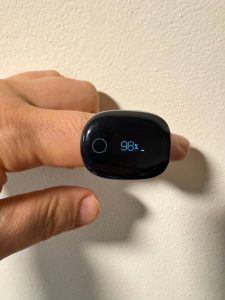
You wake up with a dry mouth and a headache. Your partner says you snore, or worse, that you “stopped breathing” for a second. You feel exhausted despite sleeping 8 hours.
You suspect Sleep Apnea or UARS (Upper Airway Resistance Syndrome).
The logical step is to see a doctor. But in many countries, the waitlist for a sleep clinic is 6 to 12 months. In the US, a lab study can cost $3,000. You are stuck in limbo, tired and worried.
This is where the Wellue O2Ring becomes a lifesaver. It is not a Fitbit toy; it is an FDA-registered Class II medical device that records your oxygen and heart rate every 4 seconds (or 1 second on newer models).
This review cuts through the marketing. We analyze the O2Ring accuracy, how to use it to spot the “sawtooth” patterns of apnea, and I (Alex) share my 9.5/10 rating for this essential tool in my stack.
What is the Wellue O2Ring?
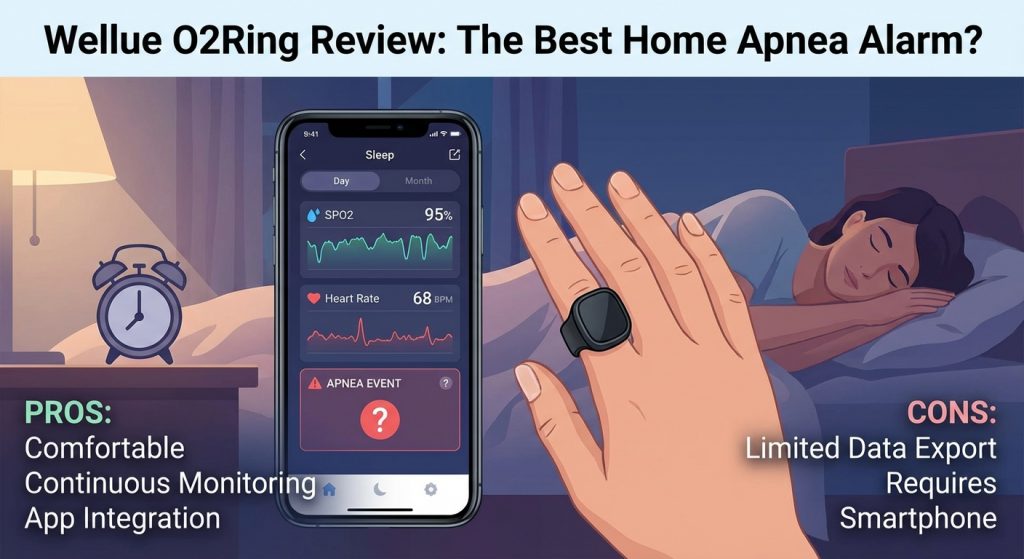
It is a silicone ring that slides onto your finger (thumb or index/middle). Unlike the cheap plastic clamps you see at the doctor’s office, it is soft, comfortable, and designed to stay on all night.
The Specs (2026 Standard):
- Sensors: Industrial-grade Pulse Oximeter (SpO2) and Heart Rate monitor.
- Sampling Rate: It records data continuously. While most smartwatches (Apple, Garmin) measure every 15-30 minutes during sleep, the O2Ring captures data every 4 seconds (and the newer “S” model captures every 1 second). This granularity is critical for catching apnea events which often last only 10-20 seconds.
- Battery: 12-16 hours of continuous use (rechargeable via Micro-USB or USB-C on newer units).
- Vibration Alarm (Optional!): The “Killer Feature.” It vibrates silently on your finger if your oxygen drops below a threshold you set (e.g., 88%). This prompts you to change position or breathe without waking your partner.
Is Wellue an American company?
Wellue is the consumer-facing brand of Viatom Technology, a major Chinese medical manufacturer. While the hardware is Chinese, it is FDA-registered and widely used by patients and even some clinics for remote monitoring.
Why “Smartwatches” Fail at Apnea Detection
You might ask: “My Apple Watch tracks oxygen. Why do I need this?”
The Sampling Gap:
- Sleep Apnea is a rapid event. You stop breathing, oxygen drops, heart spikes, you gasp, and recover. This whole cycle can happen in 30 seconds.
- Apple Watch/Oura 4: They take “spot checks” to save battery. If your apnea event happens at 2:03 AM, but the watch measures at 2:15 AM, it misses it entirely.
- O2Ring: It records the entire movie, not just snapshots. It catches the desaturation (drop) and the resaturation (recovery), creating the jagged “sawtooth” graph that screams apnea.
The Finger vs. The Wrist:
Pulse oximetry is most accurate at the extremities (fingertips) where blood vessels are dense. The wrist is a notoriously difficult place to measure oxygen via reflection, especially during movement.
How to Use It for Screening (The Protocol)
If you suspect you have a breathing problem, here is how to use the O2Ring to gather evidence.
1. The Setup
- Finger: Wear it on your thumb or index finger. I (Alex) prefer the middle finger as it feels most secure, but Wellue recommends the thumb.
- Tightness: It should be snug but not strangle your circulation.
- The Alarm: For the first few nights, turn off the vibration alarm in the app. You want to record your natural sleep. If the ring wakes you up every time you drop to 89%, you won’t get a clear picture of your baseline severity.
2. The Data Extraction
In the morning, take the ring off. It automatically ends the session.
- Mobile (ViHealth App for Android/iOs): Sync via Bluetooth. Good for a quick look.
- Desktop (O2 Insight Pro): This is mandatory for serious analysis. Connect the ring to your PC or Mac via the cable. The desktop software allows you to zoom in second-by-second.
- OSCAR: Advanced users can import O2Ring data into OSCAR (Open Source CPAP Analysis Reporter) to overlay oxygen data with CPAP machine data.
Be sure to review our in-depth guide on how to correctly analyze data from the O2Ring.
3. Analyzing the “Drops”
Look at your ODI (Oxygen Desaturation Index).
- The 4% Rule: Count how many times per hour your oxygen dropped by 4% or more.
- Interpretation:
ODI < 5: Normal. ODI 5-15: Mild Apnea probable. ODI 15-30: Moderate. ODI > 30: Severe. Go to a doctor immediately.
Reference: Read our guide on SpO2 & Oxygen Desaturation: Understanding the 4% Drop Rule.
False Positives: Don’t Panic Yet
The O2Ring is sensitive. It can lie to you.
- 1. The “Compression” Artifact:
If you sleep on your hand, you cut off blood flow to the finger. The device reads this as zero oxygen or a massive drop.
How to spot it: The graph drops vertically (straight down) to a flat line, then shoots straight up when you move. Real apnea looks like a “V” or a “U” shape (gradual drop, sharp recovery). - 2. Movement Spikes:
If you thrash around, the sensor might lose contact. Look at the “Motion” bar in the app. If a drop coincides with a massive movement spike, treat it with skepticism.
Wellue O2Ring vs. WatchPAT One
This is the big comparison.
- Wellue O2Ring ($150 – Reusable): Tracks Oxygen and Heart Rate. It screens for hypoxic (low oxygen) events. It misses UARS events that don’t cause oxygen drops.
- WatchPAT One ($200 – Disposable): Tracks PAT (arterial tone), Actigraphy, and Snoring. It can detect UARS (RERAs) even if oxygen stays perfect. It is a diagnostic tool accepted by doctors.
Use the O2Ring for long-term monitoring and initial screening. Use the WatchPAT One if your O2Ring data looks “clean” but you still feel like a zombie (indicating UARS).
Reddit & Community Consensus
I scoured the archives of ApneaBoard.com, SleepHQ, and subreddits like r/SleepApnea and r/UARS to find the unfiltered truth about this device.
- The “Life Saver” Sentiment:
Many users credit the O2Ring with saving their lives. “My doctor said I was fine because I’m thin. The O2Ring showed I dropped to 78% oxygen. I forced a sleep study and had severe Apnea.” This story is repeated hundreds of times. - Integration with SleepHQ:
The popular sleep analysis platform SleepHQ allows you to import O2Ring data. Users love overlaying their O2Ring oxygen data on top of their CPAP machine data to see if leaks are causing desaturations. - The Red Light Complaint:
Some users find the red sensor light annoying in a pitch-black room. “It looks like I have ET’s finger.” The solution is usually wearing a sleep mask or putting a small piece of tape over the silicone (though this can affect fit). - Durability Concerns:
A minority of users report the silicone strap breaking after 12-18 months of daily use. It is a wear-and-tear item. - “Is Wellue O2 ring FDA approved?”
Wellue (Viatom) has FDA clearance for some of its devices as “Class II” medical devices, but they are often sold as “Wellness Trackers” to consumers to bypass prescription requirements. The sensor technology is clinical-grade, but the diagnosis is up to you. - Durability Complaints:
Some users report the silicone strap breaking after 12-18 months of daily use. It is a wear-and-tear item.
AI Analysis: The Future of Your Data
One of the most powerful features of the O2Ring is the ability to export CSV files.
You are not limited to the ViHealth app. You can take your raw data file and upload it to AI models like ChatGPT (5.1+) or Google Gemini 3.
The Prompt:
“I am uploading my sleep oximetry data. Please analyze the correlation between heart rate spikes and oxygen drops. Calculate the percentage of time my SpO2 was below 90%. Look for patterns of cyclical desaturation indicative of OSA vs. patterns of stable oxygen with pulse spikes indicative of UARS.”
The AI can often spot trends that the basic app summary misses, acting as a “junior sleep technician.”
Alex’s Personal Review
The following is based on my personal logs.
I have worn the Wellue O2Ring for over 2 years. It is the single most important device in my bedroom, ranking higher than my Apple Watch Ultra.
My Experience:
- Comfort: I wear it on my middle finger. It is invisible to me now. I disabled the screen (so it doesn’t light up the room) and the vibration (unless I am testing a new pillow).
- The Data: The PDF reports are incredibly detailed. You can show these reports to your doctor!
- The “False Alarm” Story: Early on, I saw drops to 88%. I panicked. I thought I had severe apnea. However, zooming in on the Desktop app, I saw the “Square Wave” pattern. I was sleeping on my hand. Once I trained myself to sleep with my hand free, the drops disappeared.
- Lesson: Do not trust the summary number alone. Look at the shape of the graph.
My Rating: 9.5/10
It loses 0.5 points because you have to manually sync it every morning (it doesn’t auto-upload to the cloud like Whoop 4) and the CSV export is a bit clunky for non-techies.
But for the price? It is a miracle. It gave me the peace of mind to know my oxygen was stable, and later, helped me correlate “bad sleep” with “high heart rate,” guiding me away from bad late-night snacking.
Where to Buy:
Amazon or the official GetWellue website often have sales. Ensure you get the version with the PC software access (with usb-a/usb-c PC cable).
Update for December 2025:
Since I first published this review, the landscape of sleep tracking has shifted. We have new hardware, new FDA clearances for smartwatches, and a completely new way to analyze data using AI.
1. The New Standard: O2Ring “S” (1-Second Sampling)
If you are buying a device today, you must pay attention to the model name. Wellue (and its partners like SleepHQ) have released the O2Ring S (sometimes labeled as the “Pro” or “High-Res” version in specific markets).
- The Upgrade: The original ring recorded data every 4 seconds. The new “S” model records every 1 second (1Hz).
- Why It Matters (Crucial for UARS): If you have classic Sleep Apnea, the 4-second version is fine; oxygen drops are slow and long. But for UARS, the events are rapid. You might have a micro-arousal that lasts only 6 seconds. The older ring might “average out” this spike, missing it entirely. The 1-second recording captures the jagged heart rate spikes that define respiratory effort.
- My Advice: If you suspect UARS or are a data perfectionist, pay the extra 30-50 for the “S” / 1-second model. If you just want a general apnea alarm, the classic version is still valid.
2. The AI Analyst: Using ChatGPT/Gemini to Read Your Sleep
This is the biggest change in my personal stack. I no longer just “look” at the charts; I let AI analyze them.
The ViHealth app gives you a summary, but it often misses the nuance of why you woke up.
The Protocol:
- Export your data from the O2 Insight Pro software as a CSV file.
- Upload this file to an LLM like ChatGPT (5.2+/4o), Gemini 3.0+, or Claude.
- Use this Prompt: “I am uploading my sleep oximetry data. Please analyze the correlation between Heart Rate spikes (>10bpm) and Oxygen drops. Identify if there are clusters of heart rate accelerations that occur without significant oxygen desaturation (indicative of UARS/RERA) versus those that follow a desaturation (indicative of OSA). Calculate the percentage of time my pulse was unstable.”
- The Result: The AI acts as a “Junior Sleep Technician,” often spotting positional issues (e.g., “Your spikes cluster between 03:00 and 04:00, likely when you rolled onto your back”) that you might miss with the naked eye.
3. Apple Watch Series 10/11 vs. O2Ring
In late 2024, Apple received FDA clearance for “Sleep Apnea Notifications” on the Series 9, 10, 11, and Ultra 2/3. Many readers ask: “Do I still need the O2ring?”
The Answer is Yes.
- Apple’s Approach: The Watch uses its accelerometer to detect “Breathing Disturbances” (movements) over a 30-day period. It is a “Notifications” tool designed to flag high-risk trends over weeks. It does not give you a second-by-second breakdown of tonight’s sleep.
- The Ring’s Approach: The O2Ring measures the actual physiological consequence (Hypoxia) in real-time.
- The Difference: The Apple Watch is a Scout; it tells you something might be wrong eventually. The O2Ring is a Sniper; it tells you exactly when and how bad the event was last night. For titration (adjusting pillows, mouth tape, or CPAP), the Ring is the only viable option.
4. The “SleepHQ” Integration
The community has largely moved away from using standalone software. The platform SleepHQ now supports direct Bluetooth syncing with the O2Ring (especially the “Pro” versions sold through their shop).
This is a game-changer because it allows you to overlay your Oxygen Data directly on top of your CPAP Flow Rate charts. If you use a CPAP machine, this integration is mandatory to see if your therapy is working.
5. Durability Warning: The 2-Year Itch
After years of use, I must issue a durability warning. The weak point of the O2Ring is the silicone strap connecting the sensor to the ring body.
The Failure: After roughly 18-24 months of daily stretching, the silicone tends to tear.
The Fix: Do not throw it away. I (and many on Reddit) use “Vet Wrap” (self-adhering bandage tape) or simple medical tape to secure the sensor to the finger. It looks ugly, but the electronics usually outlast the silicone by years.
Conclusion: The “Check Engine” Light
The Wellue O2Ring is the “Check Engine Light” for your sleep.
- Buy it if: You snore, wake up gasping, or simply want to know if you are breathing at night.
- Skip it if: You obsess over data to the point of anxiety (Orthosomnia).
Your Protocol:
- 1. Buy the ring.
- 2. Wear it for 3 nights (Screen off, Vibration off).
- 3. Check the ODI 4% score.
- 4. If ODI > 5, take the PDF to a doctor and demand a Polysomnography.
You cannot fix what you cannot measure. Breathing is life. Make sure you are doing it.
Read Next:
Polysomnography vs. Home Tests: What to Expect |
The Sleep Triage Test: Do You Have Insomnia, Apnea, or UARS? |
Home Sleep Apnea Tests (HSAT) & Polygraphy: Beyond Oximetry |
Bedroom Air Quality: Is High CO2 Causing Your Morning Headaches? |
Sleep Hygiene Checklist: The 5 Non-Negotiables Before Biohacking |
Restless Legs Syndrome (RLS): Symptoms vs. Normal Fidgeting

By: Alex Warenstein.
Bio: Alex Warenstein is a sleep biohacker and founder of Night Time Comfort. After battling chronic insomnia and circadian disruption, he now helps others optimize their sleep using data-driven protocols. Read full story.
Disclaimer: Alex is not a doctor. This content is for educational purposes only. Always consult a specialist.