We talk a lot about the “hardware” of sleep on this site—pillows, mattresses, and O2Rings—but we often ignore the software. I’m talking about the brain. Specifically, the racing, anxious, foggy mess that the brain becomes after months or years of poor sleep.
If you are reading this, you probably know the feeling. You are exhausted, but your mind is wired. You can’t remember where you put your keys, your patience with your family is thin, and the idea of learning something new feels like climbing a mountain. This is cognitive decline caused by sleep deprivation.
In my quest to fix my own sleep architecture—specifically my struggle with staying asleep past 4 AM—I have explored almost every adaptogen known to man. I’ve tested `Ashwagandha KSM-66`, `Rhodiola Rosea`, and `Holy Basil`. But one herb kept popping up in the literature and on the “biohacker” forums for its unique ability to dual-wield stress reduction and memory enhancement: Bacopa Monnieri.
This isn’t a simple sedative. You don’t take it and get knocked out like you might with `Liposomal Apigenin` or a pharmaceutical. This is a long-game supplement. It is an ayurvedic sleep herb in the sense that it repairs the frayed edges of your nervous system.
I decided to put it to the test. Could this swamp plant actually calm my mind enough to improve my sleep metrics, or is it just another overhyped weed? Here is my deep dive and personal review.
What is Bacopa Monnieri?
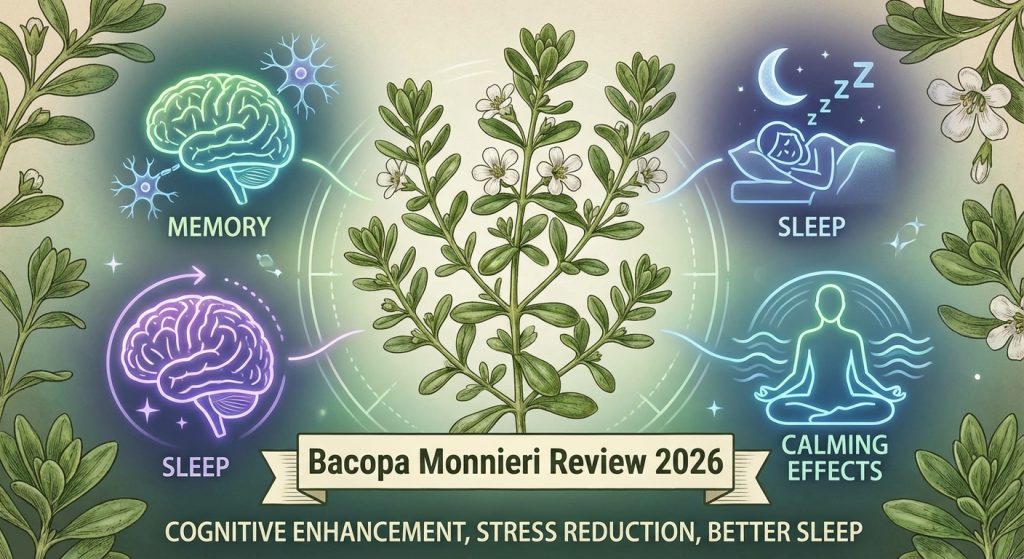
To understand why a sleep-deprived person would take this, we have to look at its resume. Bacopa Monnieri, also known as Brahmi or Water Hyssop, is a creeping perennial herb that grows in wet, marshy wetlands.
In the ancient tradition of Ayurveda, it has been used for centuries, not just for sleep, but as a Medhya Rasayana—a class of herbs specifically meant to rejuvenate the intellect and memory. The ancient texts didn’t speak of “neurotransmitters,” but they described it as a tool to “open the mind” and settle the spirit.
Modern science has caught up, and the mechanism of action is fascinating. The primary active compounds in Bacopa are bacosides (specifically Bacoside A and B). These compounds don’t just sedate you; they physically alter the structure of your brain.
How It Works: Dendrites and 5-HT2A
This is the part that got my attention. Research suggests that Bacopa can induce dendritic branching. Dendrites are the tree-like extensions of your neurons that receive signals from other neurons. When we are stressed and sleep-deprived, these connections can wither. Bacopa appears to stimulate the proliferation of these dendrites.
Think of it as upgrading the wiring in your house. Better wiring means better signal transmission. This is why bacopa benefits are primarily associated with memory formation and recall.
But the 2025 science points to something even more interesting for us insomniacs: the interaction with the 5-HT2A receptor. This is a serotonin receptor involved in mood regulation and “neural flexibility.” Newer studies suggest that specific compounds in Bacopa (like Ebelin Lactone found in hydrolyzed extracts) modulate this receptor, potentially increasing BDNF (Brain-Derived Neurotrophic Factor).
By stabilizing these systems, the theory is that Bacopa creates a “buffer” against stress. It raises your stress resilience, meaning the daily annoyances that usually keep you awake at night might not trigger that same adrenaline spike.
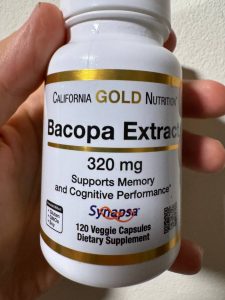
The Three Faces of Bacopa: Bacognize vs. Synapsa vs. Hydrolyzed
Before you run out and buy the first bottle you see, you need to understand that not all Bacopa is the same. In 2025, the biohacking landscape distinguishes between three main types. If you read the forums, you will see these distinctions constantly, and choosing the wrong one can ruin your results:
- 1. Bacognize (The Sleep Choice): This extract is standardized to high levels of serotonin-active bacosides. This is the version most often discussed in the context of sleep. Many users on Reddit report that Bacognize has a heavy, lethargic, or sedating effect. If you want to sleep, this is the one to target.
- 2. Synapsa (The Focus Choice): This extract (formerly KeenMind) is standardized for a specific ratio focused on “clean” cognitive enhancement. Most users report this is better for daytime use, focusing, and memory without making you tired.
- 3. Hydrolyzed Bacopa (The New “Mood” Choice): Often sold under trade names like Cognance, this entered the mainstream biohacking conversation recently. It removes some of the traditional bacosides to focus on Ebelin Lactone. It targets the 5-HT2A receptor for mood and creativity without the “lethargy” associated with traditional extracts.
For my experiment, I used a generic standardized extract (50% Bacosides) that closely mirrors the traditional preparations, rather than a specific patented version, to get a baseline understanding of the raw herb.
The “Calm Mind Herb” Theory
Why did I, Alex, take a memory herb for insomnia?
The primary reason is to treat the “Tired but Wired” sensation. When your brain is inflamed and overactive, falling into deep sleep is biologically difficult.
Bacopa acts on the GABA receptors (though indirectly) and regulates serotonin. Serotonin is the precursor to melatonin. By balancing serotonin levels during the day, you set the stage for better melatonin production at night.
Furthermore, there is a connection between memory and sleep. Sleep is when memory consolidation happens—moving data from short-term to long-term storage. If your brain is struggling to process the day’s information because of oxidative stress, your sleep quality suffers. Bacopa is a potent antioxidant in the brain, scavenging free radicals that accumulate during wakefulness.
Critical Safety Warnings (2025 Update)
We need to discuss bacopa side effects seriously. Just because it is natural does not mean it is benign. There are three major risks you must know before swallowing a pill.
1. The Heavy Metal Risk (Hyper-accumulator)
This is a massive topic in the Bryan Johnson / Blueprint community right now. Bacopa is a “hyper-accumulator” plant. It loves to suck up lead, mercury, and arsenic from the swampy soil it grows in.
Risk: Buying cheap, generic Bacopa from untested sources is a gamble with your brain.
Solution: You must only buy brands that publicly post a COA (Certificate of Analysis) verifying low heavy metal content. Do not trust a random Amazon brand with this specific herb.
2. Thyroid T4 Spike
There is evidence that Bacopa can increase the production of Thyroxine (T4).
Risk: If you are on thyroid medication or have hyperthyroidism, this can cause heart palpitations, heat intolerance, and worsen insomnia.
Solution: Consult your endocrinologist. If you are hypothyroid (low thyroid), this might actually help you, but it’s a medical roll of the dice.
3. “Bacopa Anhedonia” (The Zombie Effect)
This is the most common complaint on r/Nootropics in 2025. Long-term use (8+ weeks) of potent extracts can lead to a flattening of emotions. You stop feeling anxious, but you also stop feeling joy or motivation.
Solution: Cycle it. The current community consensus is 5 days on, 2 days off, or taking a full week off every month.
My Personal Experiment: 14 Days on Bacopa
I approached this test with a specific goal. I wanted to see if the calm mind herb reputation held true for a chronic insomniac with a history of early waking.
The Protocol:
- Dosage: 500mg total per day (Generic Standardized Extract, 50% Bacosides).
- Timing: 250mg with breakfast (eggs/fatty meal) and 250mg with dinner.
- Duration: 14 Days.
- Tracker: Apple Watch Ultra 2 (Sleep Stages) + Subjective Journaling.
- Context: I maintained my `Magnesium L-Threonate` but paused `Apigenin` to isolate the Bacopa effects.
The Experience
Week 1: The Gut Check
The first three days were… uncomfortable. Bacopa contains saponins which can irritate the gut lining. Even taking it with food, I felt a distinct rumbling and cramping about an hour after the morning dose. It increases gastric motility—in polite terms, it makes you run to the bathroom. By day 4, my body seemed to adjust, but it was a rough start.
The Mental Shift
By day 7, I noticed a subtle shift in my workday. I was learning a new data analysis tool for the site, which usually frustrates me. On Bacopa, I felt a kind of detachment from the frustration. I could sit and read technical documentation without the urge to tab-switch. This was the “anxiolytic” aspect kicking in. It wasn’t happiness; it was just… silence.
Sleep Effects
This is what matters. Did it stop the 4 AM wake-up?
Sadly, no. My cortisol curve or whatever mechanism wakes me up at that hour was stronger than the Bacopa.
However, the onset of sleep changed. Usually, I toss and turn for about 15-20 minutes, my mind replaying the day’s mistakes. With the evening dose of Bacopa, that mental chatter was quieter. It wasn’t “silenced” like with `Liposomal Apigenin`, but the volume was turned down.
The Data
Looking at my Apple Watch data compared to the previous two weeks:
- Sleep Onset Latency: Reduced from average 16 minutes to 15 minutes. (Statistically insignificant, but felt smoother).
- Deep Sleep Duration: No significant change. Hovered around my usual low baseline.
- Wake After Sleep Onset (WASO): No change. I still woke up at 4 AM.
- Heart Rate Variability (HRV): Slight increase (approx +5ms average), suggesting a mild reduction in physiological stress.
Why I Stopped
While the focus benefits were nice, I missed the immediate, reliable “switch-off” effect of my standard stack. Bacopa felt more like a background optimizer than a targeted sleep tool. Also, having to carefully time my meals to avoid stomach cramps became a chore.
Alex’s Rating: 6 out of 10
Bacopa Monnieri is not a “sleeping pill.” If you take it expecting to be knocked out, you will be disappointed. It is a formidable tool for stress resilience and memory repair, but it is not a quick fix for insomnia.
For the aging sleeper (like myself, pushing 50), the neuroprotective benefits are a massive bonus. We lose dendrites and synaptic plasticity as we age, and sleep loss accelerates that decline. Bacopa helps pump the brakes on that process.
However, the side effects—specifically the gastrointestinal distress and the risk of heavy metals—prevent me from recommending this as a “core” sleep supplement.
My advice:
- Check the COA: Never buy generic Bacopa without heavy metal testing.
- Eat Fat: Always take it with a fatty meal (eggs, avocado) to save your stomach.
- Choose Wisely: If you want sleep/sedation, look for the Bacognize extract. If you want focus without the nap, look for Synapsa or the new Hydrolyzed forms.
- Expectation Management: Give it 4 to 8 weeks for memory benefits, but don’t expect it to cure your 4 AM wake-up call.
For pure sleep onset, I still prefer `Magnesium L-Threonate` or `Apigenin`. But if you want a calm, sharp mind that transitions easier into rest, Bacopa is worth a spot in your rotation—just cycle it.

By: Alex Warenstein.
Bio: Alex Warenstein is a sleep biohacker and founder of Night Time Comfort. After battling chronic insomnia and circadian disruption, he now helps others optimize their sleep using data-driven protocols. Read full story.
Disclaimer: Alex is not a doctor. This content is for educational purposes only. Always consult a specialist.