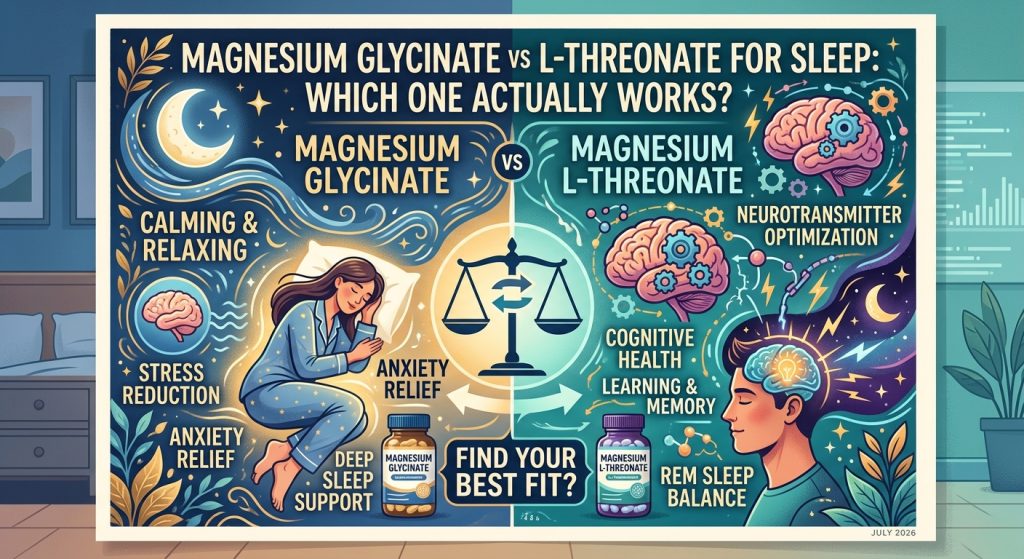
If you’ve spent any time in sleep forums, you’ve met this argument. One camp says glycinate is the sensible choice. The other says threonate is the only form that reaches your brain, so everything else is a waste. Both camps sound confident.
Having tested both and gone through the actual trials, I’ll give you the conclusion up front, because it’s more interesting than the marketing on either side.
The verdict
For sleep specifically, magnesium glycinate has the better evidence — and it isn’t close. Threonate has a genuinely fascinating mechanism and real cognitive data, but its sleep evidence is thinner and has a funding problem worth knowing about.
Start with glycinate. Consider threonate if your goal is cognitive, or if glycinate genuinely did nothing for you.
Now let me show you why, because the reason is what makes this decision easy.
The most important fact: nobody has compared them directly
No published trial has ever put magnesium glycinate head-to-head against L-threonate for sleep. Every confident claim you’ve read that one is “better for sleep” than the other is built on indirect comparison — different studies, different populations, different outcome measures, different funders.
Once you know that, the whole internet argument looks different.
What glycinate has going for it
Magnesium glycinate (bisglycinate) is magnesium bound to glycine. Two useful things follow: the chelation makes it gentle on the gut compared to cheaper forms like oxide or citrate, and glycine itself has independent sleep evidence — it lowers core body temperature, which is one of the physiological triggers for sleep onset. You’re effectively getting two sleep-relevant compounds in one molecule. I go deeper on the amino acid side in l-glycine.
The evidence picture improved meaningfully in 2025. The Schuster 2025 RCT is now the most important magnesium-for-sleep study published — a double-blind, placebo-controlled trial of 155 healthy adults aged 18–65 reporting poor sleep, using 250 mg of elemental magnesium as bisglycinate daily for 28 days. Insomnia Severity Index scores improved by 3.9 points in the magnesium group versus 2.3 for placebo.
Be honest about what that means: the effect is modest. A 1.6-point difference on the ISI is real but not dramatic, and it barely cleared statistical significance. What makes this trial matter isn’t the effect size — it’s that it was independently funded and well designed, which is unusual in the supplement literature. Before it, most magnesium-for-sleep evidence came from older, smaller trials using magnesium oxide or citrate rather than glycinate, plus the 2012 Abbasi trial in elderly insomniacs.
What threonate has going for it — and the catch
Magnesium L-threonate was developed at MIT, binding magnesium to threonic acid (a vitamin C metabolite). The claim that made it famous: it’s the form shown to raise brain magnesium levels. The foundational work — Slutsky and colleagues in Neuron, 2010 — demonstrated enhanced synaptic plasticity and memory in aging rats.
That’s a genuinely elegant mechanism, and I don’t want to dismiss it. Threonate’s cognitive story is the strongest of any magnesium form.
The catch is the sleep evidence. There are two sleep-relevant threonate trials, and both were funded by the company holding the Magtein patent. Hausenblas and colleagues (2024) tested 1 g/day in 80 adults with self-reported sleep problems for 21 days; Lopresti and Smith followed with a larger, longer trial. Both found improvements on sleep questionnaires — but notably, objective sleep measurements from wearable tracking didn’t move in the same way. One of these publications also required a 2025 correction notice regarding initially undisclosed funding.
That combination — industry funding, subjective improvement without matching objective change — is exactly the pattern that should make you cautious. It doesn’t mean threonate does nothing. It means the evidence is weaker than the marketing implies. I cover the form in more detail in magnesium l threonate.
For a neutral reference on magnesium generally, the NIH Office of Dietary Supplements fact sheet is the least commercially motivated summary available.
The elemental magnesium trap
This is the practical detail that costs people money, and almost nobody explains it.
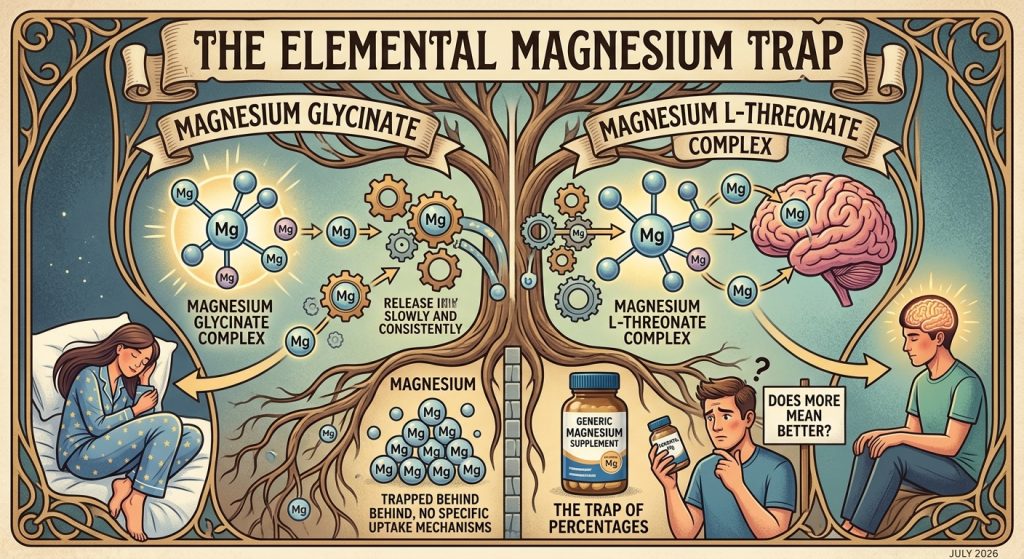
The number on the front of the bottle is usually not the amount of magnesium you’re getting. Magnesium compounds are heavy; the mineral itself is a fraction of the total weight. A capsule labeled “500 mg magnesium glycinate” may contain only around 70 mg of elemental magnesium. A 2,000 mg glycinate dose might deliver roughly 200 mg elemental.
Threonate is worse on this axis: 1 g of magnesium L-threonate provides only about 144 mg of elemental magnesium, which is why threonate doses in trials look so large.
Always read the Supplement Facts panel and find the elemental magnesium number. Then compare products on that basis and on cost per elemental milligram. Once you do, threonate’s premium pricing looks steeper still.
For reference, the Schuster trial used 250 mg elemental daily; typical sleep-oriented recommendations land in the 200–400 mg elemental range taken 30–60 minutes before bed. Treat those as what has been studied, not as instructions for you — and note that magnesium has a tolerable upper intake level for supplemental forms, above which loose stools become the limiting factor.
Which one for which sleep problem
This is where I find the choice genuinely clarifying, and it maps onto the distinction I use for everything: are you struggling to fall asleep, or to stay asleep? (I break that down in sleep onset vs maintenance insomnia.)
Glycinate suits sleep onset and physical tension. The glycine component’s thermoregulatory effect and magnesium’s role in the nervous system both act on “my body won’t settle.” If you lie there physically restless, muscles tight, this is your form. It’s also the more sensible choice if you suspect general magnesium insufficiency — it’s cheaper, so you can dose adequately without wincing.
Threonate suits a cognitive complaint. If your problem is a brain that won’t stop generating thoughts, and especially if you also want the daytime cognitive angle, that’s where threonate’s mechanism is at least plausible. Just go in knowing you’re paying a premium for a promising rather than proven sleep effect.
If you have restless legs, magnesium is worth discussing with your doctor for a different reason entirely — see restless legs syndrome.
What the community says
Reading r/Supplements, r/Nootropics, r/insomnia, and r/Biohackers on magnesium is instructive, partly because the community reached roughly the right conclusion before the good trial existed:
- Glycinate is the community default for sleep, and has been for years. The most common report is a general sense of physical relaxation and easier onset rather than sedation. Complaints are mostly “didn’t notice much” — rarely adverse.
- Threonate reports are more polarized. A subset describe genuinely vivid dreams and a distinct mental quality. Another subset report nothing at all and resent the price. Vivid dreams is by far the most consistent threonate-specific anecdote.
- The elemental magnesium point circulates constantly in these communities as the standard correction to people comparing doses — “check the actual elemental content” is practically a forum reflex, and rightly so.
- A very common protocol people describe is glycinate at night, threonate earlier in the day if they want the cognitive effect, on the logic that they’re solving different problems. That’s sensible, if expensive.
- The “stack” everyone eventually lands on for sleep is magnesium plus l theanine, sometimes with apigenin or taurine added. Magnesium is the base layer in almost every version.
- Gut tolerance is the practical dividing line for many people who abandoned citrate or oxide — glycinate is the form people switch to when cheaper forms sent them to the bathroom.
How I use it
Glycinate is a permanent fixture in my routine — not because it’s dramatic, but because it’s cheap, well tolerated, and the one supplement where the trial evidence and my own experience actually agree. I take it in the evening and think of it as a base layer rather than a sleep aid.
I ran threonate for several weeks. I got the vivid dreams everyone mentions, and my subjective sense of sleep quality was decent — but when I looked at objective data, I couldn’t distinguish it from my glycinate baseline. Which, notably, is exactly the pattern the threonate trials showed: subjective improvement without matching objective change. I stopped paying the premium.
That said, magnesium in any form is a supporting player. It won’t fix an airway problem, a glucose crash, or a genuine circadian misalignment — and if any of those is your actual issue, no capsule is going to substitute for addressing it. Start with identify sleep problem before optimizing supplements.
When to see a doctor
Talk to a physician before supplementing if you have kidney disease (impaired kidneys can’t clear excess magnesium — this is the one genuinely serious caution), take antibiotics, bisphosphonates, diuretics, or heart medication, or are pregnant. And if your insomnia has lasted more than a few weeks, magnesium is not the answer — proper evaluation is.
FAQ
Is magnesium glycinate or threonate better for sleep?
Glycinate, based on current evidence. It has the only independently funded sleep RCT (Schuster 2025), costs less, and delivers more elemental magnesium per dose. Threonate’s sleep trials were funded by the patent holder and showed subjective but not objective improvement.
Can I take both together?
You can, and some people do — glycinate at night, threonate during the day. Just count your total elemental magnesium across both to stay within sensible limits.
Why does my threonate bottle say 2,000 mg?
Because that’s the compound weight, not the magnesium. Roughly 1 g of magnesium L-threonate delivers about 144 mg of elemental magnesium, so the large numbers are necessary rather than impressive.
How long before magnesium works for sleep?
The Schuster trial ran 28 days. Some people notice something within days, but give it several weeks before judging — and if you were deficient to begin with, you’re more likely to feel a difference.
Does magnesium cause vivid dreams?
It’s one of the most consistently reported anecdotes, particularly with threonate. There’s no strong trial evidence for it, but the reports are numerous enough to be worth mentioning.

By: Alex Warenstein.
Bio: Alex Warenstein is a sleep biohacker and founder of Night Time Comfort. After battling chronic insomnia and circadian disruption, he now helps others optimize their sleep using data-driven protocols. Read full story.
Disclaimer: Alex is not a doctor. This content is for educational purposes only. Always consult a specialist.