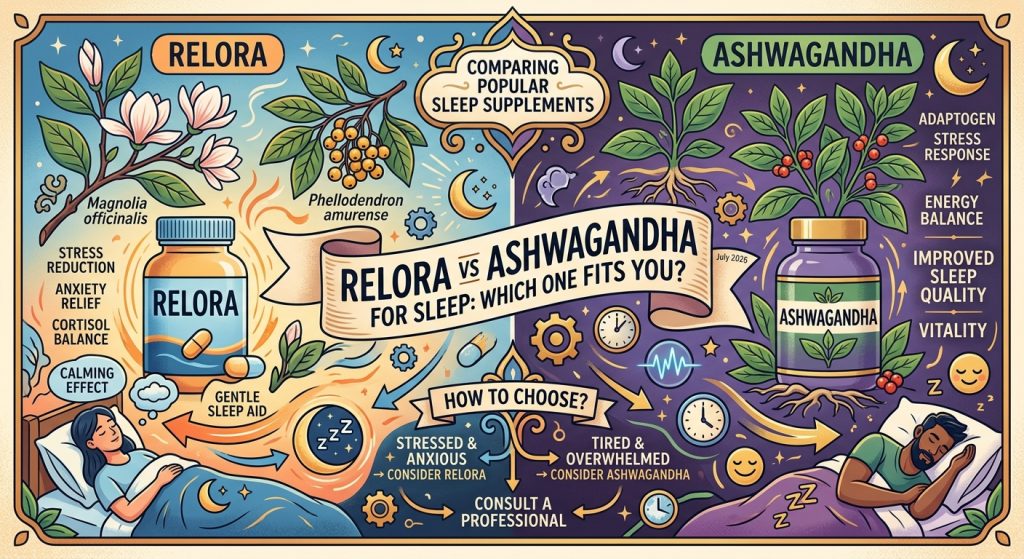
Relora and ashwagandha are often sold for the same problem: stress, “high cortisol,” and poor sleep.
They are not interchangeable.
Relora is the more logical short-term evening experiment when you are physically tired but your mind will not slow down.
KSM-66 ashwagandha is the more logical multiweek experiment when stress follows you all day and seems to spill into sleep.
The evidence is not equal. Relora has only a few small human studies, and its sleep results are weak. Ashwagandha has more randomized trials and a meta-analysis showing a small sleep benefit, especially in people with insomnia who used it for at least eight weeks.
No good study has directly compared Relora vs ashwagandha. Anyone claiming that one is definitively “better” is going beyond the data.
Before choosing either one, identify whether your problem is falling asleep or staying asleep. My guide to sleep onset vs maintenance insomnia explains the difference.
What is Relora?
Relora is a branded blend of extracts from magnolia bark and phellodendron bark. Magnolia contains honokiol and magnolol, compounds that may support the brain’s calming systems.
In plain English, Relora is supposed to reduce the internal “alarm” that keeps some people mentally active at night. That is why it is commonly used for tired but wired syndrome.
But the human evidence for Relora for sleep is thin.
A 2008 placebo-controlled pilot study followed 42 premenopausal women with stress-related eating. Researchers studied 750 mg per day for six weeks.
The Relora group reported falling asleep faster than at baseline, but the sleep result was not clearly better than placebo.
A 2013 placebo-controlled trial studied 56 adults with moderate stress. Researchers studied 500 mg per day for four weeks.
Stress scores and salivary cortisol improved, but sleep was not a primary outcome.
That is the main limitation: Relora may reduce stress for some people, but we do not have convincing evidence that it reliably improves insomnia.
There are also no strong human sleep trials showing that isolated honokiol or magnolol improves sleep.
Read my full Relora guide for more details.
What is KSM-66 ashwagandha?
Ashwagandha is an herb used in traditional Indian medicine. KSM-66 is a standardized root extract.
“Standardized” means the manufacturer tries to keep the active compounds consistent from one batch to another. Ordinary ashwagandha powders and extracts can differ considerably.
Ashwagandha is not simply a bedtime sedative. It may change the body’s wider response to stress, so the effect can take weeks and may appear during the day as well as at night.
A 2021 meta-analysis combined five randomized trials. It found a small but significant improvement in sleep.
Benefits appeared stronger in people with insomnia, in trials lasting at least eight weeks, and around the 600 mg-per-day research range. The studies were small and used different extracts, doses, and sleep measurements.
A new 2026 randomized trial studied 200 adults with sleep disturbance for eight weeks.
KSM-66 improved wrist-tracker measures such as time to fall asleep, total sleep time, nighttime wakefulness, and sleep efficiency compared with placebo.
That is much stronger than the Relora evidence, but there are limits.
The trial lasted only eight weeks. It excluded many people with sleep apnea, restless legs, major psychiatric disorders, and significant medical conditions. The ingredient was also supplied by its manufacturer.
Real-world insomnia after age 40 is often more complicated than the study population.
My detailed ashwagandha KSM-66 guide covers extracts, timing, and safety.
Fast evening effect vs slow cumulative effect
This is the most useful practical difference.
People often judge Relora over the first few evenings. When it works, the calming effect may be noticeable fairly quickly.
However, this acute use is supported more by personal experience and community reports than by strong sleep trials. The human Relora studies used daily supplementation for several weeks.
KSM-66 should not be judged like a sleeping pill. The better studies used it every day for six to ten weeks.
The choice therefore depends partly on your sleep pattern:
- You cannot switch off after a stressful day: Relora may fit better.
- You feel stressed throughout the day: KSM-66 has better supporting evidence.
- You fall asleep but wake at 3 a.m.: investigate the cause before assuming either supplement fits.
What I found in my own testing
I tested the two ingredients separately.
I tracked sleep onset, awakenings, next-day mood, CGM glucose, Withings Sleep Analyzer data, Hypnodyne ZMax EEG, and oxygen and pulse with the Wellue O2Ring.
Relora was easier for me to notice. On some high-stress evenings, it shortened the mental wind-down.
However, I did not see a consistent increase in total sleep or deep sleep across my devices. It sometimes made the next morning feel heavier.
KSM-66 was subtler. After several weeks, daytime stress felt lower and sleep onset was somewhat steadier.
The downside was emotional flattening and lower motivation. I stopped rather than trying to treat that side effect with another supplement.
My biggest lesson was that neither supplement explained every awakening.
Some nights lined up better with glucose changes. Other nights showed pulse or oxygen disturbances. Calling all of them “cortisol” would have been a mistake.
This is one person’s experience, not proof.
What Reddit and sleep forums report
The useful part of Relora Reddit discussions is not any single success story. It is the repeated pattern across many reports.
For Relora, users generally fall into three groups:
- They notice better evening relaxation or easier return to sleep.
- They notice little or nothing.
- They stop because of headache, stomach upset, morning fog, low mood, anxiety, or palpitations.
Some long-running reports suggest that the effect can fade with regular use. Controlled studies have not established whether this is true tolerance.
Reports about KSM-66 are similarly divided:
- Some users report lower stress and better sleep after several weeks.
- Some report no useful change.
- Others mention daytime sleepiness, digestive problems, vivid dreams, stimulation, earlier waking, thyroid-like symptoms, or emotional blunting.
These reports cannot tell us how common an effect is. Reddit and forums attract people with unusually good or unusually bad experiences.
They are useful for spotting possible problems that short trials may miss. They cannot replace controlled research.
Ashwagandha anhedonia and emotional blunting
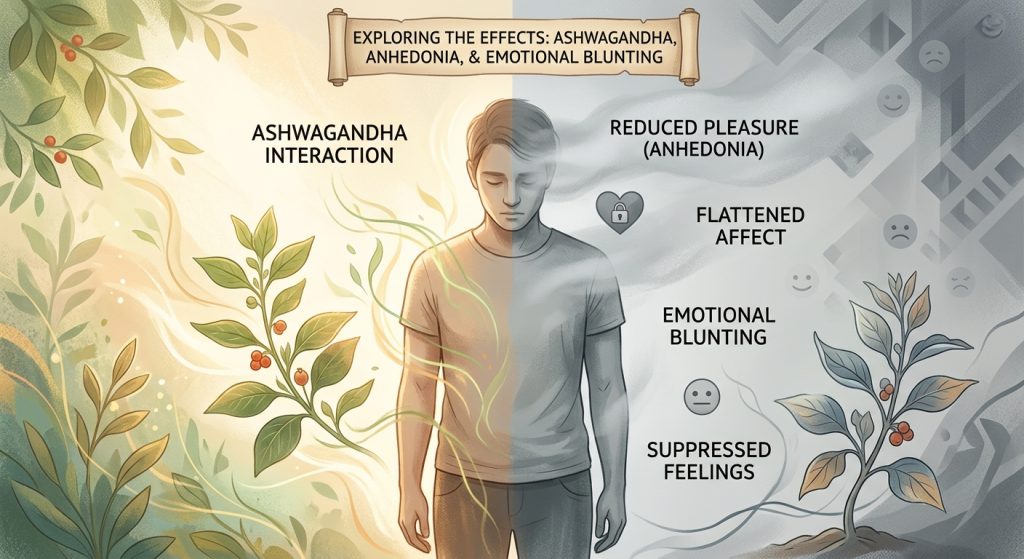
Anhedonia means losing interest or pleasure. It is not the same as healthy calm.
Ashwagandha anhedonia and emotional blunting appear repeatedly in user reports. The common pattern is reduced motivation, emotional range, libido, or enjoyment.
Controlled sleep trials have not measured this carefully enough to show how frequently it occurs or why it happens.
The mechanism is unknown. Online explanations involving dopamine, serotonin, GABA, or cortisol remain theories.
When testing ashwagandha, do not track only sleep and anxiety. Also track:
- Motivation
- Enjoyment
- Libido
- Sociability
- Interest in normal activities
A supplement is not helping overall if sleep improves slightly while waking life becomes emotionally flat.
Cortisol supplements for 3 a.m. waking: check the cause first
Many articles treat 3 a.m. waking as proof of high cortisol.
It is not.
Cortisol normally starts rising toward morning. This helps prepare the body to wake.
A cortisol rise might contribute to waking. But waking because of another problem can also activate cortisol and adrenaline. The clock cannot show which came first.
Common alternatives include the following.
Low blood sugar or a rapid glucose change
Nighttime hypoglycemia can cause sweating, hunger, shaking, nightmares, confusion, or a racing pulse, especially in people who use insulin or other diabetes medication.
The Mayo Clinic overview explains the main warning signs.
A CGM can reveal useful patterns, but pressure on the sensor can also create false nighttime lows. See my guide to low blood sugar at night.
Sleep-disordered breathing
With obstructive sleep apnea OSA or UARS, the airway narrows during sleep.
The brain briefly activates to restore breathing. That can produce a pulse spike, lighter sleep, and a stress-hormone surge.
Possible clues include:
- Snoring
- Gasping
- Dry mouth
- Morning headaches
- Repeated nighttime urination
- Oxygen drops
- Exhaustion despite enough time in bed
A wearable cannot diagnose sleep apnea. Home sleep apnea tests or an in-lab sleep study may be needed.
Other possible causes of early waking include alcohol wearing off, reflux, pain, hot flashes, restless legs, medication effects, depression, room temperature, and an early body clock.
No cortisol supplement can repair an obstructed airway or treat a genuine glucose disorder.
Safety differences
Relora has fewer documented safety warnings, but this may reflect how little it has been studied.
Its human trials were small and lasted only four to six weeks. Reported problems include headache, digestive upset, sedation, dizziness, low mood, and palpitations.
Combining it with alcohol, sedatives, or several calming supplements can make the result harder to predict.
Ashwagandha has much more safety information.
According to the NIH Office of Dietary Supplements, use for up to about three months is generally tolerated, but long-term safety is unknown.
It may cause stomach upset, diarrhea, nausea, or drowsiness. It may also affect thyroid function and interact with thyroid, diabetes, blood pressure, immune-suppressing, and sedating medications.
Denmark banned ashwagandha in food supplements in 2023 after a national risk assessment, although parts of that assessment remain disputed. France has also advised certain higher-risk groups to avoid it.
In July 2026, Australia’s Therapeutic Goods Administration again warned about a very rare but possible risk of liver injury.
The regulator also noted that researchers and authorities disagree over whether ashwagandha itself causes liver toxicity or whether some cases involve individual reactions, contamination, mixed products, or pre-existing liver disease.
Amounts mentioned in studies—such as Relora 500–750 mg per day or KSM-66 600 mg per day—are research amounts, not personal recommendations.
Which one fits you?
Relora may fit better when your main problem is occasional evening mental overdrive and you want to assess a short-term calming effect.
KSM-66 may fit better when stress is present throughout the day and you are prepared to evaluate sleep and mood over several weeks.
Neither is a good first answer when you have repeated 3 a.m. waking, snoring, gasping, glucose symptoms, major mood changes, or unexplained pulse and oxygen events.
Do not start both together. Testing one variable at a time makes it easier to identify both benefits and side effects.
FAQ
Is Relora or ashwagandha better for sleep?
Ashwagandha has stronger human evidence.
Relora may be a better practical fit for acute evening stress, but its sleep research is weak.
Does Relora work immediately?
Some users notice an evening calming effect, but controlled studies have not established Relora as a reliable fast-acting sleep treatment.
How long does KSM-66 take to help sleep?
Most useful trials lasted six to ten weeks. It should be evaluated as a cumulative stress-and-sleep experiment, not as a rescue pill.
Can ashwagandha cause anhedonia?
It is a repeated community report, but trials have not established its frequency or mechanism.
Loss of motivation or pleasure should not be dismissed as “just being calm.”
Can ashwagandha make sleep worse?
Yes. Some people report stimulation, vivid dreams, earlier waking, or daytime sedation.
It is not universally calming.
Is 3 a.m. waking always caused by cortisol?
No.
Breathing problems, glucose changes, alcohol, reflux, pain, temperature, medication, mood, and circadian timing can all cause early waking.
Can you take Relora and ashwagandha together?
There is no strong sleep research showing that the combination is more effective.
Starting both at the same time also makes it difficult to identify which ingredient caused a benefit or side effect.
Final verdict
For a mind that will not switch off after an unusually stressful day, Relora is the more targeted option—but the science is weak.
For chronic stress that affects both day and night, KSM-66 has better evidence—but it requires a longer test and closer attention to mood, thyroid effects, interactions, and rare liver problems.
For repeated 3 a.m. waking, start by identifying the trigger.
The most useful answer may not be another cortisol supplement.

By: Alex Warenstein.
Bio: Alex Warenstein is a sleep biohacker and founder of Night Time Comfort. After battling chronic insomnia and circadian disruption, he now helps others optimize their sleep using data-driven protocols. Read full story.
Disclaimer: Alex is not a doctor. This content is for educational purposes only. Always consult a specialist.