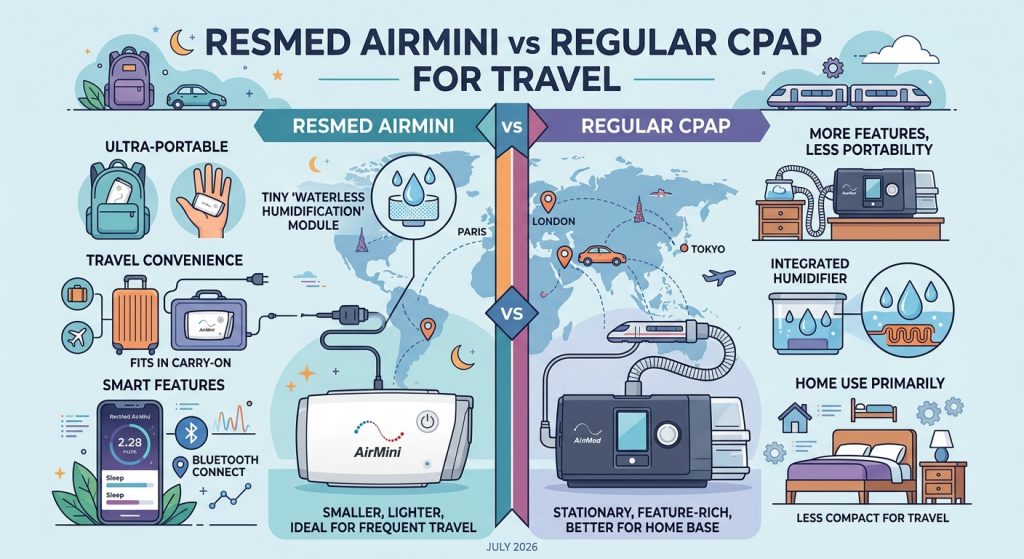
I have a simple view of the resmed airmini vs regular cpap question: the AirMini does not give you weaker sleep apnea treatment. It gives you the same type of ResMed CPAP or APAP therapy in a much smaller package.
What you give up is comfort, flexibility, and detailed data.
That distinction matters. A compact machine is useful only if you actually sleep with it. My AirMini review is therefore less about the blower and more about humidity, mask choice, noise, power, and the true cost of building a second setup.
The answer first: Who should buy an AirMini?
The resmed airmini makes sense when you travel frequently, pack light, take overnight flights, camp, move between two homes, or do not want to risk damaging your primary machine.
I would consider it a good second CPAP when:
- You travel several times a year.
- Your pressure and mask setup are already stable.
- You tolerate nasal or pillow masks.
- You can sleep with limited humidification.
- Saving space matters more than having detailed data.
I would keep traveling with a regular machine when:
- You take only one or two trips a year.
- Heated humidity is essential for you.
- You already have a reasonably compact machine such as the resmed airsense 11 autoset.
- You need a heated hose, special mask, supplemental oxygen connection, or SD-card data.
- You use bilevel, ST, or ASV therapy.
For occasional trips, carrying the machine you already know is often cheaper and more comfortable.
AirMini therapy is not the compromise
As of July 2026, ResMed still lists AirMini as its current travel CPAP. I found no official AirMini 2 announcement.
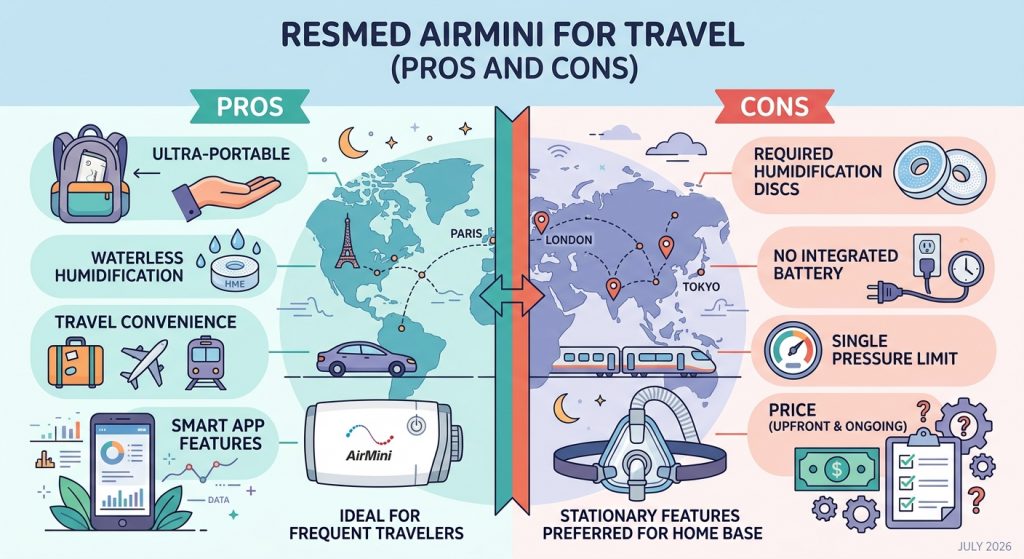
The machine weighs 300 grams and measures 136 × 84 × 52 mm. It provides fixed CPAP, AutoSet, and AutoSet for Her modes across a pressure range of 4–20 cm H2O. ResMed states that it uses the established AutoSet algorithms found in its regular AirSense range.
That is the important part: the pressure range and treatment logic are not “travel grade.” AirMini can respond to obstructive breathing and flow limitation like a regular ResMed APAP.
It also includes EPR pressure relief, ramp, SmartStart, and SmartStop. It is rated for operation from sea level to 8,500 feet and meets FAA requirements for use during all phases of air travel.
The official sound-pressure rating is approximately 30 dBA. However, that number does not fully describe the breathing-related noise some users hear through the narrow tube and mask vent. Full specifications are available on ResMed’s AirMini product page and in the official AirMini user guide.
The compromise begins after the air leaves the machine.
HumidX vs humidifier: The main reason people are disappointed
A normal CPAP humidifier heats water and sends controlled moisture through the hose.
HumidX works differently. The small cartridge catches heat and moisture from your exhaled breath, then returns some of that moisture during your next inhalation. You do not need to carry water, but you also do not get the same level of adjustable humidification.
There are three versions:
- HumidX is the standard cartridge for compatible nasal and pillow-mask setups.
- HumidX Plus retains more moisture and is intended for very dry air, altitude, and aircraft cabins.
- HumidX F20 is the separate version for AirFit F20 and AirTouch F20 full-face setups.
A cartridge must be replaced within 30 days after opening. It cannot be washed, soaked, or refilled. That 30-day period starts when you open it, not after 30 nights of use.
The biggest limitation is mask compatibility.
Standard HumidX and HumidX Plus work with the approved N20, N30, and P10 AirMini systems. HumidX F20 works only with the F20 connector and compatible F20 masks. The F30 setup does not support HumidX.
ResMed’s current official compatibility list includes:
- AirFit P10 for AirMini
- AirFit N30 for AirMini
- AirFit N20
- AirTouch N20
- AirFit F20
- AirTouch F20
- AirFit F30
HumidX may be adequate in a moderately humid hotel room. It can be much less convincing in winter heating, desert air, high altitude, strongly air-conditioned rooms, or during a long flight.
Research does not show that heated humidification automatically makes every patient use CPAP longer. It does show that heated humidity reduces dryness and other treatment side effects. The AASM PAP guideline generally favors heated humidification for reducing side effects, while a meta-analysis of randomized trials found no consistent overall improvement in nightly adherence.
I found no strong independent trial showing that AirMini’s waterless HME system is clinically equivalent to a heated humidifier for long-term home use.
My practical conclusion is simple: if your home humidifier is set high every night, do not assume HumidX will feel comparable. Buy from a seller with a realistic return policy.
The proprietary system costs more than the machine
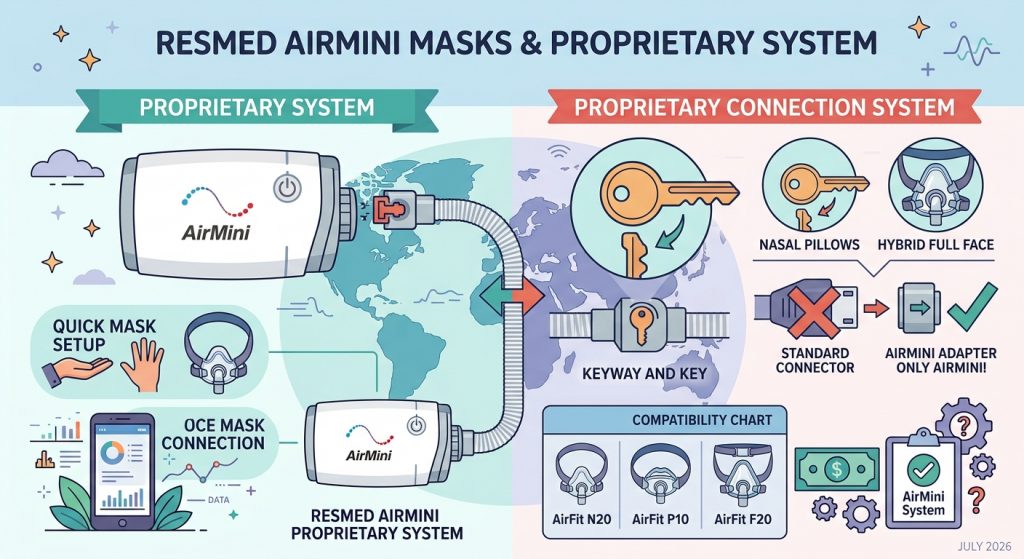
The AirMini machine alone is not a complete setup. You need its special tube plus the correct mask pack or connector pack.
That catches buyers out.
A current U.S. machine price is around $900 before the mask system. Complete bundles commonly exceed $1,050. Add a case, battery equipment, DC converter, filters, replacement tubing, and HumidX cartridges, and the real cost rises again.
A six-pack of genuine HumidX cartridges has recently cost around $60 in the United States. At one cartridge per opened month, full-time use could add roughly $120 per year. Occasional travelers may use a cartridge for one short trip and then discard it when its 30-day period expires.
Your resmed n30 p10 choice also affects the initial price.
P10 and N30 packs include the mask, tube, connector, and initial HumidX cartridges. N20, F20, and F30 setup packs normally provide the special tubing and connector, while the mask may need to be purchased separately.
Third-party adapters can connect standard tubing and additional masks. However, they usually remove the intended HumidX arrangement and can change the venting and sound characteristics of the system.
I would not build my travel setup around an adapter until I had tested it for several complete nights at home.
What long-term users repeatedly report
I reviewed years of discussions on ApneaBoard, CPAPtalk, r/CPAP, and r/SleepApnea. The same patterns appear repeatedly.
Humidity divides users
Some people find standard HumidX similar enough to a low or medium home-humidifier setting. Others still experience dryness, particularly in aircraft cabins, dry climates, heated winter rooms, and strongly air-conditioned hotels.
HumidX Plus helps some users. It does not turn the AirMini into a heated humidifier.
Noise can be more noticeable than expected
The common complaint is not always a loud motor on the bedside table. It is breathing-synchronized airflow noise transmitted through the narrow tube and vent near the face.
Some people stop noticing it after a few nights. Others use a fan or white noise. Very light sleepers sometimes return the machine.
Mask choice and leak control make a major difference. A poorly seated connector or leaking nasal pillow can make the system sound much worse.
Battery runtime is not a fixed number
Pressure, mask leak, breathing rate, altitude, battery condition, temperature, and electrical conversion losses all affect runtime.
People who use the AirMini successfully for camping or power outages normally test the complete setup at home first. They do not rely solely on the battery manufacturer’s best-case estimate.
The app is adequate, but the data are limited
The AirMini app shows basic information such as usage, events per hour, mask seal, and an overall score.
The machine has no SD-card slot. This means users cannot access the same detailed breath-by-breath flow data available from a regular ResMed machine through software such as OSCAR.
ResMed says the device can retain up to 365 days of information internally, while the consumer app displays the most recent 30 days.
That may be enough for a stable CPAP user taking a short trip. It is a limitation when troubleshooting leaks, central events, pressure changes, or unexplained sleep problems.
The happiest owners use it for a specific job
Frequent flyers, backpackers, and people who divide their time between two homes often value the AirMini highly.
People expecting an AirSense experience in a smaller box are more likely to be disappointed.
AirMini full time use is possible, but not ideal for everyone
Some owners use an AirMini every night for years. The machine is officially intended for home and travel treatment, not merely occasional emergency use.
However, most experienced users who own both types keep a regular machine at home. They prefer its heated humidity, quieter breathing circuit, normal mask options, heated hose, and detailed data.
AirMini, travel, and CPAP adherence
CPAP works only while you wear it. Missing treatment during trips is not a harmless holiday from obstructive sleep apnea osa.
Long-term adherence is strongly influenced by what happens early: mask fit, comfort, side effects, confidence in the equipment, and actual use during the first weeks.
In cardiovascular trials, patients who averaged at least four hours of CPAP per day had better outcomes than groups that included poor or inconsistent users. The relevant individual-participant meta-analysis is available here. Early CPAP usage has also repeatedly predicted longer-term adherence.
This is why smaller is not automatically better.
If AirMini makes you use CPAP on nights you would otherwise skip, it can be an excellent health purchase.
If dryness or noise makes you remove it after two hours, your regular machine is the better travel CPAP.
AirMini is not bilevel
AirMini provides CPAP and APAP. EPR can reduce pressure during exhalation by a limited amount, but that does not make it a true bilevel machine.
People prescribed VAuto, bilevel ST, or ASV should travel with their prescribed device. This includes some patients with difficult uars, high pressure requirements, hypoventilation, treatment-emergent central apnea, or other complex breathing conditions.
There is still no genuine pocket-sized bilevel equivalent to AirMini.
A user of a resmed aircurve 10 vauto uars setup should plan around the full bilevel machine, its power supply, and an appropriate battery.
Do not replace bilevel therapy with an AirMini merely because the pressure numbers appear similar.
Competitors in 2026
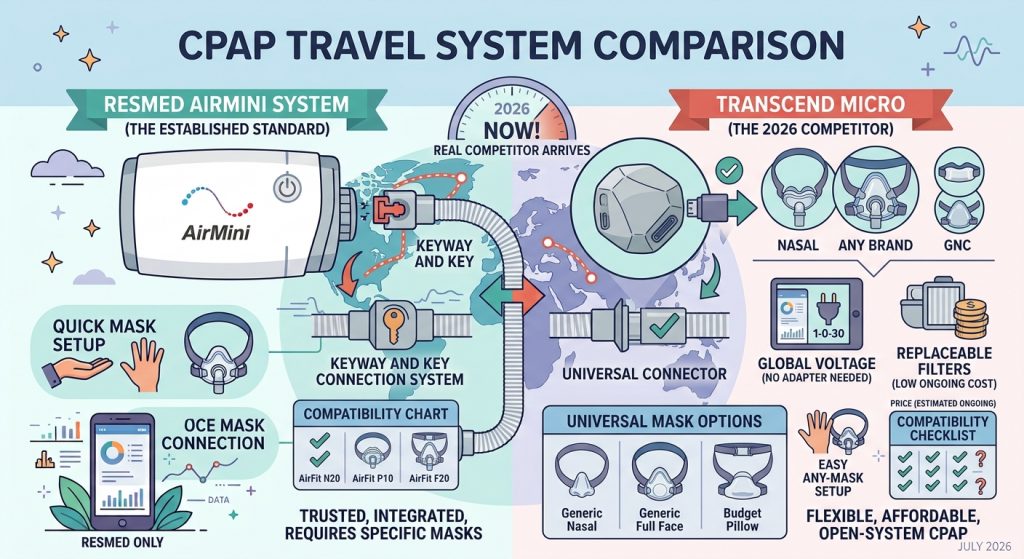
The main current alternative is the Transcend Micro.
It is lighter than the AirMini, accepts standard 22 mm mask connections, supports an external battery, and offers an optional waterless HME. Its tradeoffs include a different APAP algorithm, a different data ecosystem, and similar travel-machine concerns about noise and limited humidity.
The Breas Z2 and earlier Z1 machines still appear in older best travel CPAP lists. However, Breas discontinued the Z Sleep line, PowerShell, and Q-tube effective November 30, 2025. Remaining machines may become progressively harder to support with original parts.
For someone already comfortable with ResMed AutoSet, AirMini offers the closest match to their regular ResMed therapy.
For someone who refuses proprietary mask connections, the Transcend Micro deserves closer consideration.
My own travel routine
I choose the machine based on the trip.
For one or two nights in a normal hotel, I take the AirMini. Before leaving, I run it at home using the exact mask, connector, and HumidX cartridge I plan to pack. I synchronize the app, check the settings, inspect the filter, and carry a spare cartridge.
For a long stay, very dry destination, winter heating, or any period when I may need detailed data, I take the larger machine. I would rather carry extra weight than spend a week fighting dryness and fragmented sleep.
My basic travel rules are:
- Keep the CPAP and prescription in cabin baggage.
- Download the FAA compliance letter before leaving.
- Carry the correct international plug adapter.
- Never transport a regular CPAP with water inside its chamber.
- Confirm the airline’s battery capacity and carry-on rules.
- Test the battery for a complete night at home.
- Keep spare mask parts where they cannot be crushed.
- Use HumidX Plus cautiously in very dry air; more retained moisture can also feel stuffy to some users.
- Remember that the official operating-altitude limit is 8,500 feet.
AirMini has no internal battery. Its standard power supply accepts common international AC voltage, and ResMed sells a converter for 12- or 24-volt DC sources. An external CPAP battery is required for camping, unreliable electricity, or most in-flight use.
For my own checks, I may compare symptoms with wellue o2ring trends and review them through my o2ring data analysis process.
An oximeter does not replace CPAP data or a sleep study. It can show that a travel setup deserves closer investigation.
Is a travel CPAP worth it?
Yes, for frequent travelers who can tolerate waterless humidity and the approved mask system.
No, for occasional travelers who already sleep well with a regular CPAP and do not mind carrying it.
The AirMini is not a cheap upgrade. It is a convenience tool.
Its value comes from nights of treatment you would otherwise miss, baggage space saved, and reduced risk to your primary machine.
FAQ
Can AirMini replace my regular CPAP?
It can provide ongoing CPAP or APAP therapy. Most people will still find a regular machine quieter, better humidified, more flexible, and easier to analyze.
Does AirMini use the same pressure as AirSense?
It supports the same 4–20 cm H2O pressure range and the ResMed AutoSet algorithm family. Your clinician or equipment provider should transfer and verify the prescribed mode and settings.
Can I use my normal mask?
Only approved ResMed masks work as intended with official AirMini connectors. Third-party adapters may permit additional masks, normally without the proper HumidX arrangement.
Does HumidX work as well as a water humidifier?
For some users in moderate humidity, it is sufficient. It cannot provide the same adjustable, heated moisture as a water chamber and heated hose.
Can I use AirMini on an airplane?
Yes. It meets FAA requirements. Confirm the individual airline’s notification, seat-power, and battery rules before departure.
Does AirMini have a battery?
No. It requires AC power, the appropriate DC converter, or a compatible external CPAP battery.
How loud is AirMini?
Its official sound-pressure rating is approximately 30 dBA. Real-world perception varies because some noise is transmitted through the tube and mask during breathing.
What is the final verdict?
Buy AirMini when its small size will materially increase how often you use treatment away from home.
Keep traveling with your regular CPAP when heated humidity, low noise, mask freedom, bilevel therapy, or detailed data matter more than luggage space.

By: Alex Warenstein.
Bio: Alex Warenstein is a sleep biohacker and founder of Night Time Comfort. After battling chronic insomnia and circadian disruption, he now helps others optimize their sleep using data-driven protocols. Read full story.
Disclaimer: Alex is not a doctor. This content is for educational purposes only. Always consult a specialist.