The search for the perfect mattress is not just about comfort; it can meaningfully affect how well you sleep and how often you wake up with stiffness or pressure points. If you are reading this mattress firmness guide, you may be dealing with a sore lower back, a numb shoulder, or simply the sense that you never fully “reset” overnight. I’ve been there. The marketing jargon—thousands of coils, proprietary foam names, and arbitrary firmness scales—often makes comparison harder than it needs to be.
Most people make a binary choice: they think they need a “soft” mattress for comfort or a “firm” mattress for their bad back. This binary thinking is exactly why so many of us end up returning expensive beds or suffering in silence. The reality of choosing mattress firmness requires understanding the critical difference between immediate surface feel and deep structural support, and how those two factors interact with your specific body weight and sleep position.
This guide is not a sales pitch. It’s a practical decision framework informed by basic biomechanics and by published research on mattress firmness and back pain—including a randomized trial indexed by PubMed in which a medium-firm mattress performed better than a very firm one for many adults with chronic, non-specific low back pain. This is general information, not a diagnosis; if your pain is severe, persistent, or comes with numbness/weakness, consider getting clinical input—the rest of this guide focuses on comfort and alignment variables you can control.
The Great Misconception: Firmness vs. Support
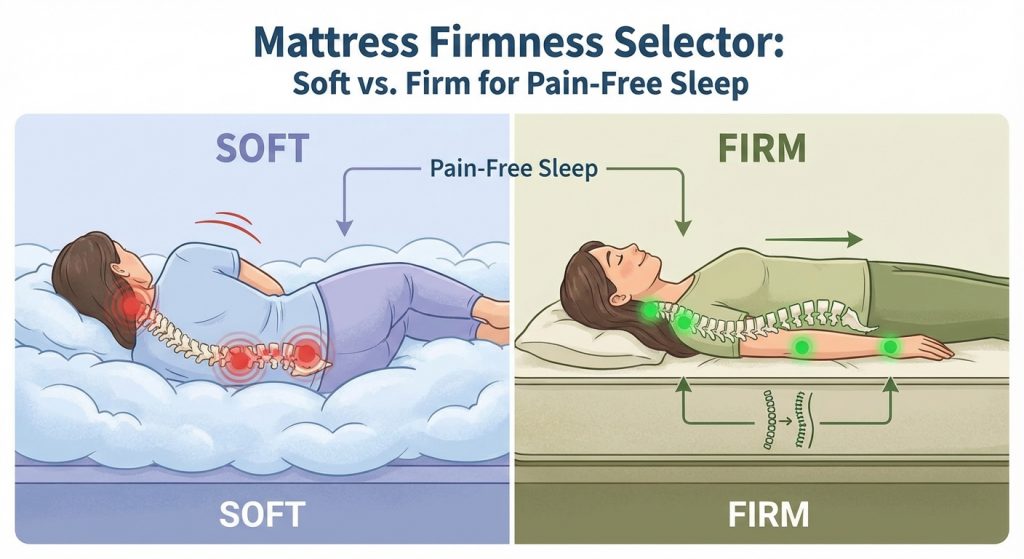
Before we analyze your specific needs, we need to separate two ideas that are often blended together in marketing: firmness and support—and even Mayo Clinic notes that the “ideal” firmness can differ from person to person.
Firmness is the immediate sensation you feel when you lie down. It is the “ahhh” factor. It is determined by the top layers of the mattress (the comfort layers), usually made of memory foam, latex, or fibrous fills.
Bed support level, on the other hand, is the mattress’s ability to keep your spine in a neutral alignment. It is determined by the core of the mattress (the support core), which is usually steel coils or high-density polyfoam.
Here is the crucial takeaway: You can have a mattress that feels incredibly soft on top (low firmness) but provides rock-solid alignment for your spine (high support). Conversely, you can have a mattress that feels like a concrete slab (high firmness) but sags in the middle, ruining your back (low support).
When people ask about soft vs firm mattress options, they are usually asking about the comfort layer. But if you suffer from back pain, your problem is often a mismatch between your support core and your body weight.
The Algorithm: Body Weight and Mattress Mechanics
You cannot select a firmness level in a vacuum. A mattress that feels “Medium-Firm” to a ~130 lb (60 kg) person can feel closer to “Soft” for a ~230 lb (105 kg) person. This is simple physics. Heavier bodies compress the foam layers more deeply, engaging the firmer support core faster. Lighter bodies float on top of the comfort layers.
In my experience, ignoring how body weight interacts with mattress materials is one of the most common reasons for buyer’s remorse.
- 1. The Lightweight Sleeper (Under 130 lbs / 60 kg)
If you are in this category, standard “Universal Firmness” mattresses (often rated 6-7 out of 10) will likely feel too hard. Your body does not have enough mass to sink through the surface tension of the upper fabric and foam.The Risk: You float on top of the mattress. If you are a side sleeper, your shoulder won’t sink in, twisting your upper spine.
The Fix: You generally need a softer rating (Soft to Medium-Soft, 3-5/10) to allow for contouring. You need plush comfort layers that collapse easily under lighter pressure.
- 2. The Average Weight Sleeper (130-230 lbs / 60-105 kg)
This is the “Goldilocks” zone that most manufacturers target. A standard Medium-Firm (5-7/10) usually works here because the foams are calibrated for this density.The Risk: The danger here is usually material quality. A cheap medium mattress will soften rapidly, turning into a hammock within a year.
The Fix: Focus on material density (which we will discuss later) rather than just the firmness rating.
- 3. The Heavyweight Sleeper (Over 230 lbs / 105 kg)
If you fall into this category, very soft foams are often a poor match. You will blow right through the “comfort layer” and hit the hard support core or coils, causing pressure points.The Risk: “Bottoming out.” This creates a paradox where a soft mattress feels hard because you are essentially sleeping on the springs. Furthermore, if the support core isn’t robust, your hips will sink too deep, creating the dreaded “hammock effect” that can aggravate the lower back.
The Fix: You need a Firm to Extra-Firm support core, but potentially with a thick, high-density comfort layer if you sleep on your side. Hybrid mattresses (coils + foam) are often superior here because steel coils provide stronger pushback than foam cores.
The Position Factor: Aligning the Spine
Once you understand how your weight alters the feel, you must overlay your sleeping position. This is the second variable in our selector.
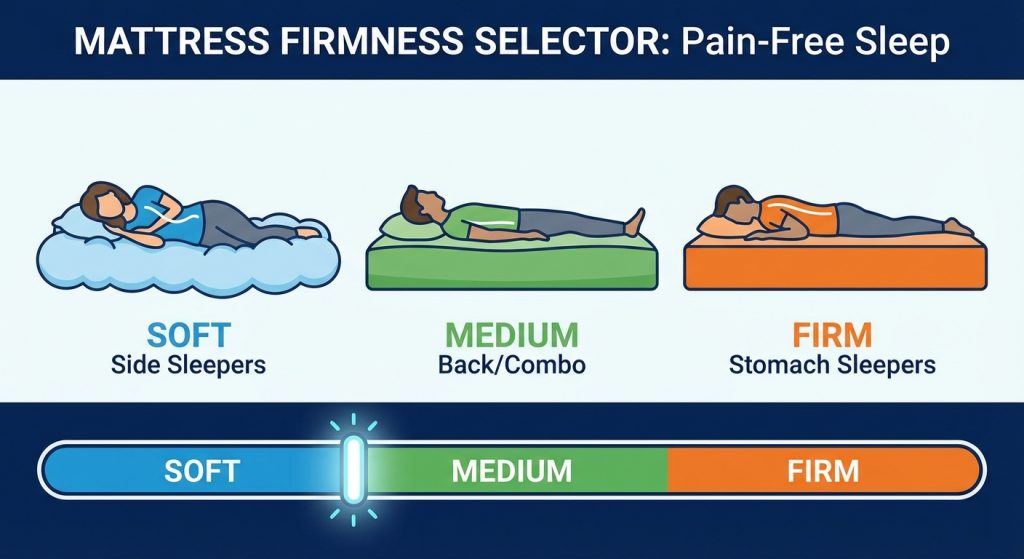
Side Sleepers: The Shoulder and Hip Crisis
I am a side sleeper. I know the specific agony of waking up with a “dead arm” or a sharp pain in the AC joint of the shoulder. For side sleepers, the mattress has one job: let the wider parts of your body (shoulders and hips) sink in, while rising up to support the waist.
- The Firmness Trap: If you choose a mattress that is too firm, your shoulder stays high, jamming your neck upwards. This can contribute to next-day neck tightness and headaches. A simple add-on is placing a pillow between your knees to help keep hips and spine aligned, a tip echoed by Cleveland Clinic.
- The Softness Trap: If the mattress is too soft, your heavy hips will sink lower than your shoulders, twisting your lumbar spine.
- The Protocol: You generally need a firmness of Soft to Medium (3-6/10). You need a “comfort layer” thick enough (at least 3 inches) to accommodate the depth of your shoulder.
- Community Insight: On forums like Reddit and Mattress Underground, many side sleepers report preferring Talalay Latex over memory foam because it allows the shoulder to sink while still “pushing back” enough to feel easier to move.
Back Sleepers: The Lumbar Bridge
Back sleepers have it slightly easier, but the stakes for lower back pain are higher. You need the mattress to fill the gap in the small of your back (the lumbar curve).
- The Protocol: For many back sleepers, a Medium-Firm (about 5–7/10) is a strong starting point—supportive enough under the hips, but not so hard that your lower back is left “floating” (Harvard Health Publishing).
- The Test: If you can slide your hand easily under your lower back while lying on the mattress, it is too firm. If you cannot slide it at all because you are sunk in too deeply, it is too soft. If you sleep on your back, adding a pillow (or rolled towel) under your knees is a simple way to reduce strain and keep the lower back more neutral, as suggested by MedlinePlus.
Stomach Sleepers: The Danger Zone
Sleeping on your stomach places the highest stress on the spine. Gravity pulls your heaviest section (the pelvis) down. If the mattress allows this, your lower back can arch more than it wants to, which may lead to morning stiffness or soreness over time—especially if you already have back issues.
- The Protocol: You need Firm to Extra-Firm (7-9/10). You require a surface tension that refuses to let your hips sink. Comfort layers should be minimal—thin and firm. If you are a stomach sleeper with back pain, the first step is often just getting a harder surface.
Special Considerations: Scoliosis and Chronic Pain
Navigating mattress selection with spinal pathologies like Scoliosis requires nuance. Simply saying “buy a firm bed” is outdated advice that can cause more harm than good.
Evidence on “the best” firmness for scoliosis is mixed, and comfort can vary widely depending on curve pattern, body weight, and sleep position. In practice, many people do best on a “cushioned support” setup: enough surface cushioning to reduce pressure points around ribs/hips, paired with a stable core that helps prevent the midsection from sagging.
A Medium-Firm (often around 6/10) hybrid is a common starting point because coils can provide resilient support while foam layers fill gaps and soften contact pressure.
For generic chronic back pain (non-specific mechanical back pain), research suggests Medium-Firm often performs as well as—or better than—Extra-Firm for many people. The old wisdom of “sleeping on a board” doesn’t hold up for everyone. If a surface feels too hard, some people notice they stay tense and wake up stiffer, so it can be worth experimenting one step softer while keeping good support.
Coil vs Foam: The Construction Materials
When looking at specs, you will see endless debates about coil vs foam. Here is how to interpret the data without the marketing fluff.
Innerspring/Coils (Hybrids):
The coil count is often a lie. A mattress with 2,000 bad coils is worse than one with 800 good ones. What matters is the gauge (thickness) of the steel.
- Lower gauge number (e.g., 12-13) = Thicker, stiffer wire. Good for heavy people and support.
- Higher gauge number (e.g., 15-16) = Thinner, more flexible wire.
- Why choose Coils? They sleep cooler (air gap) and provide “active support.” They push back against your weight. If you struggle to change positions at night, coils help you move.
Memory Foam:
Density is the key metric here.
- Low-density memory foam (under 3 lbs/ft³) breaks down quickly and sleeps hot, so it’s best to avoid it.
- High-density memory foam (4–5+ lbs/ft³) is highly durable and supportive, but it can trap heat.
- Why choose Foam? Unmatched pressure relief. If you have bursitis in the hip or shoulder pain, foam distributes weight better than any spring. However, it has “dead” energy—it absorbs movement, making it harder to roll over.
Latex:
The alternative to memory foam. It is bouncy, naturally cooler, and very durable. It is excellent for those who want the pressure relief of foam but hate the “sinking” feeling of memory foam.
Testing Protocol: Don’t Buy Blind!!!
I cannot stress this enough: purchasing a mattress solely based on online specs is a gamble with your comfort—and can keep you stuck in a trial/return loop. The return process for a mattress is grueling—wrestling a 100lb expanded foam block back into a box or coordinating freight pickup is a nightmare you want to avoid.
The In-Store Protocol:
As I wrote in my article regarding my own journey, it is critically important to test a mattress for at least 30 minutes in the store. Do not just sit on the edge. Do not just lie down for 30 seconds.
- 1. Go to the store in loose, comfortable clothing.
- 2. Bring your own pillow if possible (or grab one that matches your home setup).
- 3. Lie in your actual sleeping position.
- 4. Stay there for 15 to 20 minutes.
- 5. Ideally, do this on two different days.
Why? Your body’s initial reaction is often wrong. A soft mattress feels amazing for the first 2 minutes (“It’s like a cloud!”). After 20 minutes, your muscles might start to scream as your spine falls out of alignment. Conversely, a supportive mattress might feel “stiff” initially, but after 15 minutes, you realize your back pain has subsided. Only your body can tell you this.
The Pillow Synergy: Fine-Tuning the Feel
You can buy the perfect mattress and still wake up in pain if your pillow is wrong. The mattress and pillow work as a system.
When I bought my Tempur mattress, I assumed my sleep problems were over. They weren’t. The mattress allowed my shoulder to sink in differently than my old bed, which changed the distance between my head and the mattress. My old pillow was suddenly too high, cranking my neck upward.
I had to learn how to select the correct pillow height effectively, starting from scratch. My quest led me through the Tempur Sonata and the Tempur Ombracio, finally landing on the Cloudpilo, which allowed me to adjust the filling height to the millimeter.
If you change your mattress firmness, you must re-evaluate your pillow.
- Softer Mattress: You sink deeper. The gap between head and bed shrinks. You likely need a lower pillow.
- Firmer Mattress: You float higher. The gap increases. You likely need a higher pillow (or a pillow for side sleepers with more loft).
For a detailed breakdown of how to measure this gap, refer to my specific guides on pillow alignment. But understand that a “firmness problem” in your bed might actually be an “alignment problem” in your neck.
Troubleshooting: What If You Choose Wrong?
Sometimes, despite all the testing, you get it wrong. Or perhaps your body changes (weight gain/loss, injury, pregnancy). Before you throw out a mattress, consider a mattress topper guide approach.
If the Bed is Too Firm:
This is the easiest problem to fix. Buying a 2-3 inch soft topper (Memory Foam or Serene Foam) can transform a “brick” into a luxury hybrid. You keep the deep support of the hard core but add the pressure relief you missed. This is often cheaper and more effective than buying a “Soft” mattress that lacks support.
If the Bed is Too Soft:
This is harder. You cannot easily add support to a sagging foundation. However, a firm Latex topper can sometimes bridge the gap, creating a “floating” surface above the soft foam. It is not a permanent fix, but it can extend the life of a mistake.
Temperature and Firmness:
Remember that memory foam is temperature sensitive. A Visco-elastic mattress will feel like a rock in a cold room (60°F) and a marshmallow in a hot room (75°F). If your mattress feels different in winter vs summer, this is why. Sometimes, simply adjusting your bedroom temperature or your bedding (see my thoughts on Tempur mattress review regarding heat retention) can alter the perceived firmness.
Summary: Your Checklist for Pain-Free Sleep
To navigate the soft vs firm mattress confusion, follow this logic sequence:
- 1. Identify the Goal: Are you seeking pressure relief (shoulders/hips hurt) or spinal support (lower back hurts)?
- 2. Factor Weight: Are you under 130 lbs (need softer) or over 230 lbs (need firmer/hybrid)?
- 3. Factor Position: Side (Softer), Back (Medium), Stomach (Firm).
- 4. Check Materials: Ignore coil count. Look for coil gauge and foam density.
- 5. Test: Spend 20 minutes on the bed in a store. Ignore the awkwardness; your back is more important.
- 6. Align: Adjust your pillow height to match the new sinkage level of the mattress.
There is no “Best Mattress in the World.” There is only the mattress that matches your biomechanics. Don’t let a salesperson sell you a cloud if you need a support beam, and don’t buy a board if you need pressure relief. Your sleep quality—and your pain levels—depend on getting this balance right.

By: Alex Warenstein.
Bio: Alex Warenstein is a sleep biohacker and founder of Night Time Comfort. After battling chronic insomnia and circadian disruption, he now helps others optimize their sleep using data-driven protocols. Read full story.
Disclaimer: Alex is not a doctor. This content is for educational purposes only. Always consult a specialist.