Three years ago, I was destroying my body every single night. I was 44, weighing around 90kg (198 lbs), and I was sleeping on a sofa that had lost its structural integrity a decade prior. I didn’t think it mattered. I thought insomnia was just a chemical imbalance in my brain or a result of stress at work.
Then the pain started. It wasn’t a subtle ache; it was a sharp, screaming pain in my shoulder that would wake me up at 3:00 AM, pulling me out of deep sleep and forcing me to rotate like a rotisserie chicken just to find relief. My Apple Watch sleep tracking data was a disaster—my HRV was tanking, and my sleep continuity was non-existent.
I have scoliosis. For years, I ignored it, but combined with the rotator cuff shoulder pain and the extra weight I was carrying at the time, my body finally went on strike. I realized that before I could fix my cortisol or buy fancy supplements, I had to fix the foundation. I needed a high-end foam bed.
My search came down to two finalists: a highly-rated German mattress brand that was available exclusively online, and a Danish model from Tempur (18cm depth). I chose the Tempur.
Why? Because I could test it.
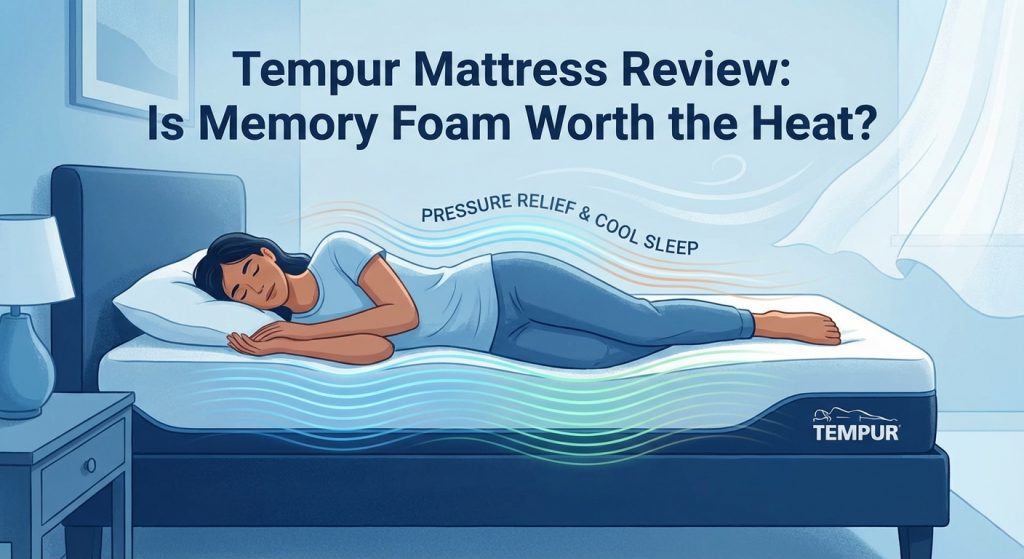
In this review, I am going to be brutally honest about my experience over the last two years. I will cover the legendary pressure relief mattress capabilities that saved my shoulder, the motion isolation that saved my marriage (before we eventually moved to separate rooms), and the elephant in the room: memory foam heat.
This is not a sales pitch. This is a user manual for your potential investment.
The “German vs. Danish” Dilemma: Why You Must Test
When I started my research, the internet was flooded with “Bed-in-a-Box” companies. They promise 100-night trials and free returns. One German brand, in particular, had excellent specs and a price point that was significantly lower than Tempur.
But I am a skeptic. Returning a mattress is not like returning a pair of shoes. It is a logistical nightmare involving plastic wrap, scheduling couriers, and hauling a heavy slab of foam through your hallway. I wrote a detailed mattress firmness guide on this site, but the core rule I developed during my search is simple: Do not buy a mattress online without testing it first.
I went to a local retailer that stocked Tempur. I didn’t just poke it with my finger. I took off my shoes, lay down, and stayed there. I visited the store on two separate days. I spent 40 minutes to an hour lying in my preferred side-sleeping position. I ignored the awkward stares of the sales staff. I needed to know if my spine—twisted by scoliosis—would actually align, or if I would just sink into a hammock shape.
The German brand might have been fine. But the Tempur spoke to my back immediately. I bought the 18cm depth model.
Understanding the Material: It’s Not Just Sponge
To understand why Tempur feels the way it does—and why it retains heat—you have to understand what you are lying on. Most people call it “memory foam,” but Tempur insists on calling it “viscoelastic material.”
This isn’t marketing fluff; it’s physics. The material was originally developed by NASA to cushion astronauts against G-force during lift-off. Unlike standard polyurethane foam (the yellow stuff in cheap sofas) or latex (which pushes back against you), viscoelastic foam is temperature sensitive.
It consists of billions of open cells that respond to your body heat. When the material is cold, it is firm. When it contacts your body (37°C), it softens and molds to your exact shape. This is why, when you first lie down, it feels firm, but after three minutes, you feel like you are floating. It essentially displaces your weight across the entire surface area of your body.
However, this mechanism is a double-edged sword. To mold to you, it must absorb your heat. To support you without pushing back, it must be dense. Density and heat absorption are the enemies of airflow.
The Elephant in the Room: Memory Foam Heat
Let’s address the biggest concern people have with a Tempur mattress review: Does it sleep hot?
If you look at the discussions on Reddit (r/Mattress) or forums like SleepHQ from late 2025, the consensus is clear: Yes, traditional memory foam sleeps warmer than innerspring or latex mattresses.
My Experience with Heat Retention
I am a warm sleeper. My wife is a furnace. When we shared the bed, heat management was our biggest battle.
The Tempur material works by wrapping around you. This “hug” increases the surface area of contact between your skin and the mattress. The more contact, the less air circulates around your body. In the first few weeks, I noticed a distinct difference compared to my old sofa or traditional spring mattresses. I wasn’t waking up in a sweat, but I was waking up… warm.
Here is the reality of mattress heat retention in 2025:
- If you keep your bedroom at 24°C (75°F), a Tempur mattress will feel hot. The foam will absorb that ambient heat and then add your body heat on top of it.
However, I did not return the mattress. Why? Because the trade-off for my shoulder pain was worth it, and I learned to manage the environment.
How I Manage the Heat (The Protocol)
If you decide to invest in a high end foam bed, you must optimize your sleep hygiene checklist. You cannot use heavy flannel sheets or cheap polyester duvets.
- 1. Room Temperature: I keep my bedroom strictly at 18-19°C (65-66°F). The cool ambient air keeps the exposed parts of the mattress firm and cool, balancing out the heat under my body.
- 2. Bedding: I switched to a cooling duvet made of bamboo fibers. I also experimented with grounding sheets, which are generally thinner and more conductive, helping to dissipate some heat.
- 3. The Base: I ensured my bed frame had slats to allow air to move under the mattress. Putting a foam mattress on a solid plywood floor is a recipe for mold and heat buildup.
Community Consensus (2025):
Recent reviews of the newer Tempur “Breeze” lines (LuxeBreeze, ProBreeze) suggest they are significantly cooler (up to 5-10 degrees) than the “Adapt” or “Original” lines due to phase-change material in the cover. However, they come with a massive price premium. If you are on the standard or “Pro” line like me, you are relying on the density of the foam, which naturally retains heat. If you suffer from severe night sweats or are in menopause (see my article on menopause sleep solutions), this is a critical factor to consider.
Frequently Asked Questions (from Community Research 2025)
Q: Does the “chemical smell” (off-gassing) last long?
Alex: Mine had a distinct smell for about 3 days. I left the windows open and stripped the sheets every morning. It dissipates. It is not toxic, just part of the manufacturing process.
Q: Is it good for stomach sleepers?
Alex: Generally, no. Most Tempur models allow too much sinkage in the hips for stomach sleepers, leading to lower back extension. The Tempur Ombracio pillow is designed for this, but as for the mattress, you would need their firmest model.
Q: Does it sag over time?
Alex: I have had mine for over 2 years. I rotate it (head to toe) every 6 months. There is zero visible sag. High-density foam is incredibly durable compared to cheap poly-foam.
Q: Can I use an electric blanket?
Alex: Be careful. Tempur advises against high heat as it can alter the memory foam properties temporarily. I prefer using a cooling duvet and regulating my own body temp.
Pressure Relief: Why I Kept It (The Pain Killer)
This is the section that matters for anyone with chronic pain, scoliosis, or tired but wired symptoms caused by physical discomfort.
When I weighed 90kg and slept on my side, my entire body weight was concentrated on two points: my shoulder joint and my hip bone. On a normal spring mattress, the springs push back against these points with equal force (Newton’s Third Law). This cuts off circulation, compresses the nerves, and causes the brain to send “move now” signals—resulting in tossing and turning.
The Tempur material does not push back. It absorbs.
- The “Ahhh” Moment:
When I settle into my position on the Tempur, it takes about two minutes for the “melting” sensation to happen. My shoulder sinks into the mattress rather than being crushed against it. My ribcage is supported by the foam filling in the gap between my armpit and my waist.For my scoliosis, this was a revelation. My spine could finally maintain a neutral alignment. The morning shoulder pain that had plagued me for a year vanished within ten days of sleeping on this mattress.
- The Pillow Factor:
However, the mattress is only 50% of the equation. Because you sink deeper into a Tempur mattress than a standard bed, your old pillow will likely be too high. You will sink, but your head will stay propped up, straining your neck.
I had to go on a quest for the perfect pillow. I tried the Tempur Ombracio (designed for stomach sleepers, too low for me) and finally settled on the Tempur Sonata (Size M). The Sonata’s curved shape follows my neck as I roll, and because the mattress allows my shoulder to sink, the Size M provided the exact alignment I needed. Later, I also experimented with the Cloudpilo for its adjustability, and the Cloudpilo/Tempur Mattress combo remains my gold standard for eliminating neck pain.
If you buy this mattress, budget for a new pillow. It is not optional. Check our pillow height guide for complete information on this topic.
Motion Transfer: The “Dead” Bed
If you sleep with a partner, Tempur motion transfer control is arguably the best feature of the technology.
In the industry, they use the “wine glass test”—jumping on a bed next to a glass of red wine. I didn’t try that (I don’t drink wine anymore, it destroys REM sleep—see my article on alcohol and sleep), but I lived the reality.
My wife is an active sleeper. On our old bed, every time she rolled over, I bounced. On the Tempur, the energy is absorbed instantly. It is a “dead” bed. There is zero bounce.
Even when my 3-year-old Spaniel would jump on the bed (before we banished him to the kitchen for hygiene reasons), I barely felt it. For light sleepers who suffer from sleep fragmentation due to a partner’s movement, this material is superior to any pocket spring system I have ever tested.
The “Quicksand” Effect: The Downside of Foam
There is a characteristic of Tempur that you will either love or hate, and you will only discover it during a 20-minute test in the store. It is the lack of mobility.
Because the foam molds to your shape, creating a “cast” of your body, moving out of that position requires effort. You have to climb out of your own imprint.
- Turning Over: Changing from my left side to my right side requires more physical effort than on a spring mattress. In the Reddit communities, some older users or those with weak core strength complain about feeling “stuck.”
- Intimacy: I will be blunt. For sleep, this mattress is a 10/10. For “active” married life, it gets a 5/10. The lack of bounce changes the mechanics of movement. It requires more physical exertion. It is something to consider if that part of your life is a priority over pain relief.
For me, the deep sleep benefit outweighed the “stuck” feeling. In fact, the difficulty in moving actually reduced my tossing and turning. I tend to pick a position and stay there, which improves my sleep efficiency.
The “Tempur Brick” Phenomenon: Break-in Period
If you order this mattress, you need to know about a phenomenon discussed widely on r/Mattress called “The Brick Phase.”
When my mattress arrived, it was winter. The delivery guys dropped it off, I unwrapped it, and that night I jumped on it. It felt like sleeping on a sidewalk. It was rock hard.
I panicked. I thought I had made a terrible mistake. I thought they had sent the wrong model.
Here is what I learned from digging into the forums: Fresh high-density memory foam needs to be mechanically broken in, and it is highly temperature sensitive. The warehouse was cold, the truck was cold, and the foam’s cell structure was tight.
My Break-in Protocol:
- 1. Walk on it: Yes, I spent 10 minutes a day walking on my knees across the surface of the mattress to loosen the cells.
- 2. Heat: I kept the room warmer than usual for the first week.
- 3. Patience: It took about 3 weeks for the mattress to soften into the feel I experienced in the store.
Do not judge the mattress by the first night. Give it 30 days.
Is It Good for Tired But Wired?
We often talk about the tired but wired syndrome as a cortisol or HPA axis issue. But sometimes, your nervous system remains in “fight or flight” simply because it doesn’t feel safe.
Physical pressure points are perceived by the brain as a threat. If your hip hurts, your brain keeps a level of vigilance. By eliminating these pressure points, the Tempur material allows the physical body to send a “safe” signal to the brain.
Combined with my weighted blanket (which I use in winter), the sensation of the mattress molding to me creates a sensory deprivation effect that significantly lowers my sleep onset latency.
Buying Guide: Alex’s Rules
If you are going to spend this amount of money (and it is an investment), follow these steps. Do not be lazy.
- 1. The 20-Minute Rule: Go to a store. Lie on the mattress in your dominant sleeping position. Set a timer on your phone for 20 minutes. Close your eyes. If you feel any tingling in your arm or hip after 20 minutes, it is too firm. If your lower back hurts, it is too soft.
- 2. Ignore the Labels: “Soft,” “Medium,” and “Firm” mean nothing. A Tempur “Medium” feels different than a Sealy “Medium.” Trust your back, not the tag.
- 3. Check the Climate: If you live in a tropical climate without air conditioning, think twice about the standard Tempur line. Look at the Breeze models or consider latex. Memory foam needs a controlled environment.
- 4. The Foundation: Ensure you have a solid, non-sagging base. A $3000 mattress on a broken $100 frame will feel like garbage.
Summary
The Tempur mattress is not for everyone. It is hot (if you don’t manage your room temp), it is heavy, and it feels like quicksand when you try to roll over.
But for me—a 47-year-old man with scoliosis, shoulder pain, and a history of insomnia—it was the critical hardware upgrade I needed. It solved the physical pain that was fragmenting my sleep. It stopped me from waking up every time my wife moved.
Is memory foam heat real? Yes. But is the pressure relief worth it? Absolutely.
If you are currently sleeping on a surface that fights against you, pushing into your joints and twisting your spine, no amount of Magnesium L-Threonate or Apigenin will fix your sleep. You cannot biohack your way out of a bad mattress.
Go to the store. Lie down. Give it 20 minutes. Your body will tell you the truth.

By: Alex Warenstein.
Bio: Alex Warenstein is a sleep biohacker and founder of Night Time Comfort. After battling chronic insomnia and circadian disruption, he now helps others optimize their sleep using data-driven protocols. Read full story.
Disclaimer: Alex is not a doctor. This content is for educational purposes only. Always consult a specialist.