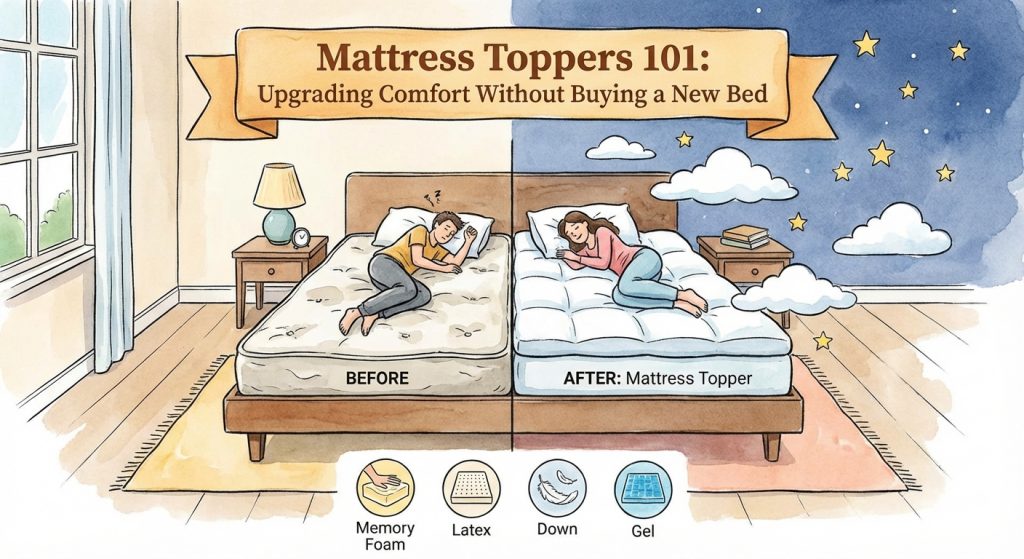
We have all been there. You wake up, and instead of feeling recharged, you feel like you have gone ten rounds in a boxing ring. Your shoulder is numb, your lower back is throbbing, and your Oura Ring 4 or Apple Watch is screaming at you about a lack of deep sleep. You look at your mattress. Maybe it is a cheap model you bought five years ago, or maybe it is an expensive “orthopedic” slab that feels like sleeping on a sidewalk.
Buying a new mattress is a logistical nightmare and a massive financial commitment. Often, you do not need to replace the entire engine; you just need to upgrade the suspension. This is where the mattress topper—or mattress overlay—comes in.
However, the market is flooded with marketing nonsense. They promise to turn a sagging disaster into a luxury hotel bed. They promise to cool you down while wrapping you in plastic foam. Most of this is hyperbole. In 2026, the technology behind sleep surfaces has evolved, and the “biohacker” approach to sleep requires understanding the materials, the physics of pressure points, and the biology of thermoregulation.
This mattress topper guide is not a sales pitch. It is a tactical manual on how to salvage your sleep surface, fix alignment issues, and optimize your bed for physical recovery without spending thousands.
The Sleep Triage: Do You Actually Need a Topper?
Before you spend a cent, we need to diagnose the problem. A topper is a tool, not a magic wand. Through my research on forums like The Mattress Underground and my analysis of discussions on Reddit’s r/Mattress, a clear consensus has emerged: toppers are excellent at fixing surface feel, but they are terrible at fixing structural failure.
The “Too Hard” vs. “Too Soft” Dilemma
The golden rule of mattress physics is simple: You can make a hard mattress softer, but you cannot make a soft mattress harder.
If your bed feels like a brick, a topper acts as a comfort layer, allowing your hips and shoulders to sink in just enough to relieve pressure while the mattress below provides support. This is the ideal use case for upgrading an old mattress.
If your bed is sagging, has a dip in the middle, or acts like a hammock, a topper will simply follow the contours of the dip. You will just be sleeping in a softer, deeper hole. In this case, no mattress overlay will save you; you likely need to inspect your bed base or replace the mattress entirely.
The Diagnostic Protocol (15 Minutes)
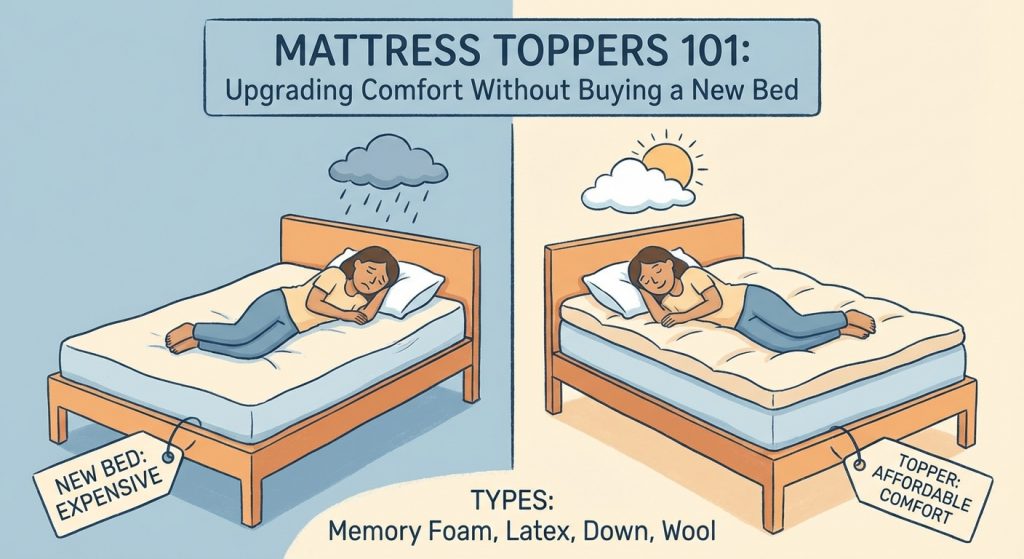
Do not guess. Use this physical diagnostic protocol to determine what your body actually needs.
1. The Pressure Point Test
Lie down in your preferred sleeping position. Stay still for 10 minutes.
- Signs of “Too Hard”: You feel a burning sensation or numbness in your shoulder (if you are a side sleeper). Your hip bone feels like it is grinding against a board. You find yourself tossing and turning simply to get blood flow back to your extremities.
- Signs of “Too Soft”: You feel no specific pressure points, but your lower back aches as if it has been hyperextended. It requires effort to roll over.
2. The Hand Test (For Back Sleepers)
Lie on your back. Slide your hand under the curve of your lower back.
- Too Hard: If your fist or hand slides through easily with a gap above it, your mattress is not contouring to your spine. You are bridging, which means your muscles are working all night to hold your spine up. You need a bed-softening strategy.
- Too Soft: If you cannot slide your hand in at all because your hips have sunk below your ribs, you are in a “hammock.” A topper will likely make this worse.
3. The Base Check
Before blaming the mattress, check what is underneath. If you are using a slat base, measure the gaps—many manufacturers set a max around 4 inches/10 cm (Tempur-Pedic is one clear example), and wider spacing can let the mattress dip between supports and feel softer or uneven. Placing a piece of plywood or a bunkie board under the mattress can sometimes “firm up” the feel significantly. Always rule this out before buying a topper.
Material Science: Foam, Latex, Wool, and Microcoils
Once you have established that you need a topper (usually to improve pressure relief or comfort), you must choose the material. In 2026, the conversation has moved beyond just “memory foam.” We now look at response time, off-gassing, and heat retention.
Memory Foam (Viscoelastic Polyurethane)
Memory foam is the classic choice for a reason. It offers the highest level of pressure point relief. It reacts to your body heat, softening and molding to your shape. This creates a “hug” sensation that distributes your body weight across a larger surface area, which can reduce sharp pressure hotspots that trigger discomfort and make you reposition during the night.
- The Pro: Unbeatable for side sleepers with shoulder pain or anyone needing to drastically soften a firm surface.
- The Con: Heat. Traditional memory foam traps body heat. If you struggle with maintaining a low core body temperature—critical for deep sleep—this can be a dealbreaker. However, modern iterations infused with graphite or gel have improved this.
- Density Matters: Look for density ratings. As a rough rule, 4–5 lb/ft³ foams are often built for better durability. Foams under ~3 lb/ft³ can feel great at first but tend to soften faster and develop impressions sooner—especially for heavier sleepers.
Latex (The Biohacker’s Choice)
Latex is the material I see recommended most frequently by the health-conscious community and longevity enthusiasts. It is derived from the sap of the rubber tree (Hevea brasiliensis).
- The Feel: Unlike the “quicksand” feel of memory foam, latex has high elasticity and “bounce.” It pushes back. When you roll over, it instantly snaps back to its original shape.
- Thermoregulation: Latex has an open-cell structure that allows for significantly better airflow than memory foam. It is naturally cooler.
- Types:
- Dunlop: Denser, firmer, and more supportive. Better for back sleepers or those who want a latex topper that adds a buffer without a sink-hole effect.
- Talalay: Softer, more consistent, and airier. Incredible for pressure relief while maintaining bounce.
- Metric to Watch: Look for the ILD (Indentation Load Deflection). An ILD of 19-22 is soft (plush); 28-32 is medium; 34+ is firm.
Wool and Natural Fibers
If your mattress firmness is acceptable but you sleep hot, a wool topper is a sophisticated upgrade. Wool does not provide structural support, but it is the king of micro-climate management.
- The Mechanism: Wool fibers absorb moisture vapor from your skin and release it into the air, keeping you dry. It acts as a humidity buffer.
- The Feel: It adds a “cloud-like” surface softness without changing the underlying support mechanics of the mattress.
- Cons: It compresses over time and requires fluffing. It will not fix a hard mattress that is causing skeletal pain.
Microcoils (The 2026 Trend)
A newer entrant gaining traction in high-end discussions is the microcoil topper. These are thin layers (1-3 inches) containing thousands of tiny, individually wrapped steel springs, often encased in a thin layer of foam.
- The Benefit: They offer 3D support and airflow that no foam can match. They decouple your movement from the mattress.
- The Verdict: If you find foam too hot and latex too “wobbly,” microcoils offer a mechanical suspension upgrade that preserves the “traditional mattress” feel while enhancing contouring.
Thickness and Density: The Engineering of Comfort
Selecting the right material is only half the battle. You must dial in the specifications. Buying a 4-inch topper when you only need a slight adjustment is a recipe for back pain.
Thickness Guide (Depth)
- 1 to 2 Inches: This is a fine-tuning adjustment. Use this if your mattress is almost perfect but you want a slightly softer surface feel, or if you are a stomach sleeper who cannot afford to have your hips sink.
- 2 to 3 Inches: The “Goldilocks” zone. This provides enough depth to cradle shoulders and hips for the average sleeper (130-200 lbs) without compromising the support of the mattress below. Most mattress-topper guides recommend starting here.
- 4+ Inches: This creates a completely new sleeping surface. Be careful. A topper this thick can mask the support layer of your mattress so much that you lose spinal alignment. It is usually only necessary for side sleepers with heavier body weights or extreme pressure point sensitivity.
Density and ILD
Do not confuse firmness with density.
- Density (lbs/ft³): Indicates durability. A 5lb memory foam is not necessarily harder than a 3lb foam, but it will last three times as long and feel more “dead” (less bounce).
- ILD (Indentation Load Deflection): Measures firmness. If you are buying a latex topper, you must check this number. A soft topper (ILD 19) on a soft mattress is a disaster. A medium topper (ILD 28) on a hard Tempur mattress is usually the safe bet.
Fixing Specific Problems: A Tactical Approach
Let’s look at the specific scenarios you are likely facing and the precise protocol to fix them.
Scenario A: The “Brick” (Mattress is too firm)
This is the easiest problem to solve. Your body is staying on top of the mattress surface, creating high-pressure interfaces at the heavy points (shoulders, hips).
- The Fix: You need displacement.
- Recommendation: A 2–3-inch memory foam topper if you sleep cold, or a soft Talalay latex topper (ILD 19–24) if you sleep hot.
- Why: You need a material that allows your protruding parts to sink in at least 2 inches before hitting the resistance of the firm mattress. This realigns the spine and restores blood flow.
Scenario B: The “Hammock” (Mattress is too soft or sagging)
As mentioned, this is hard to fix. However, if buying a new mattress is absolutely impossible right now, you can try a “band-aid” approach.
- The Fix: You need a “bridge” layer.
- Recommendation: A 2-3 inch Medium-Firm Dunlop Latex topper (ILD 30+).
- Why: Unlike memory foam, which will just bend into the dip, dense Dunlop latex has some structural integrity. It can span minor depressions and create a flatter surface. Warning: This will not work for deep sags (over 1.5 inches).
Scenario C: The “Furnace” (Sleeping Hot)
If your mattress is comfortable but wakes you up sweating, the issue is airflow.
- The Fix: Create a breathable gap between you and the mattress foam.
- Recommendation: A wool topper or a microcoil topper.
- Why: You are lifting your body off the heat-retaining foam of the mattress. Pair this with simple environment tweaks like keeping the bedroom cool; Sleep Foundation summarizes the commonly recommended range as 65–68°F (18–20°C).
Optimization by Sleeping Position
Your biomechanics dictate your needs. A stomach sleeper on a soft topper is inviting lower back trauma.
Side Sleepers
You have the most complex geometry to accommodate. The distances between your ear and the mattress and between your waist and the mattress need to be filled.
- Goal: Allow the shoulder and hip to sink until the spine is horizontal.
- Gear: 3-inch Soft Latex or Memory Foam. You need thickness to accommodate the width of your shoulder.
- Cross-Check: Ensure you are using the correct pillow height guide logic. Often, shoulder pain is blamed on the mattress when it is actually a pillow that is too low, forcing the shoulder to bear excessive weight.
Back Sleepers
You need to support the lumbar curve (lordosis) without pushing the hips up.
- Goal: Neutral spine. The hand should slide under the lower back with slight resistance.
- Gear: 2-inch Medium Latex or High-Density Memory Foam. You generally need less depth than side sleepers. If you go too soft, your hips will sink, causing lower back strain.
Stomach Sleepers
This is the most precarious position. A soft surface causes hyperextension of the lumbar spine (swayback).
- Goal: Keep the front of the pelvis flat against the bed.
- Gear: 1-inch Firm Latex or simply a wool pad.
- Warning: Avoid thick, soft memory foam if you sleep on your stomach—it often lets the hips sink and can aggravate lower-back strain. If your mattress is already soft, adding more “sink” usually makes things worse; consider firmer bedding options, and treat positional therapy for sleep apnea techniques (like the tennis ball trick) as a behavioral cue, not a substitute for proper evaluation if sleep apnea is a concern.
Couples with Different Needs
If one partner sleeps on a “rock” and the other needs a cloud, use the “Split King” approach even on a Queen bed. Buy two Twin XL (for King) or custom-cut foam pieces. Place a 2-inch soft topper on one side and a firm one on the other, then cover both with a thick, high-quality mattress protector or a mattress overlay made of wool to bridge the gap.
Advanced Considerations: The Biohacker’s Edge
For those of us obsessed with data and optimization, a topper is not just about comfort—it is about biological variables.
Chemicals and Off-Gassing
Standard memory foam is a petrochemical-based product, and new foams can emit odors and volatile organic compounds (VOCs) for a period of time—EPA explains why ventilation matters when you bring new materials into a bedroom.
- The Protocol: Look for third-party emissions/material checks such as CertiPUR-US, UL GREENGUARD Gold, and OEKO-TEX STANDARD 100 —especially on the foam, cover, and any fabric layers you’ll be breathing near for 7–9 hours a night.
- The Best Option: GOLS-certified organic latex. It is naturally antimicrobial, dust-mite resistant, and free from harsh chemical fire retardants (usually using wool as a barrier instead).
Grounding and Conductivity
There is a growing discussion around grounding sheets for sleep, but the evidence base is still limited and the claims often outpace the data. If you use one anyway, focus on practical variables you can feel and track—heat, humidity, and static cling—rather than assuming a topper will meaningfully change the outcome.
Integration with Tech
If you are using a Withings Sleep Analyzer or an under-mattress tracker, be aware that adding more than 3 inches of high-density foam might dampen the signal of your heart rate and respiration. In my experience, 2 inches is fine, but 4 inches of dense latex can sometimes cause data gaps. If you rely on this data to analyze correlations in your O2Ring data, keep the topper moderate.
Buying Guide Checklist (2026 Edition)
Before you click “buy,” run through this checklist to ensure you aren’t wasting money.
- 1. Return Policy: This is non-negotiable. You cannot know if a topper works until you sleep on it for at least 14 days (the adjustment period). Look for companies offering a 30-100 night trial. If there is no return policy, do not buy it.
- 2. Straps: Does the topper have corner straps? Without them, the topper will migrate or “walk” off the mattress during the night, especially if you are an active sleeper.
- 3. Cover: Does it come with a removable, washable cover? Raw foam oxidizes and crumbles when exposed to air and light. It tears easily. A bamboo or cotton cover is essential for longevity and cooling.
- 4. Certification: Check for Oeko-Tex Standard 100 or GOLS (for latex). This ensures you aren’t inhaling formaldehyde all night.
Summary
A mattress topper is a powerful tool in your sleep arsenal, but only if applied correctly. It effectively solves the fix hard mattress problem, relieving pressure points that destroy deep sleep and cause morning stiffness. However, it is rarely a cure for a bed that has lost its structural integrity.
- For Pressure Relief: Choose Memory Foam (3 inches).
- For Cooling & Bounce: Choose Latex (2-3 inches).
- For Climate Control: Choose Wool.
- For Stomach Sleepers: Keep it thin (1 inch) and firm.
Remember, the goal is not just “comfort” in the subjective sense. The goal is mechanical alignment that allows your nervous system to downregulate, dropping you into the restorative stages of sleep without the interference of pain signals. Start with a conservative thickness, prioritize material quality over marketing hype, and treat your sleep surface as personal equipment worth tuning; if you have ongoing pain, numbness, or a diagnosed condition, get individualized guidance from a qualified clinician.
Related Articles to Explore:
Sleep Hygiene Checklist: Before buying gear, ensure your room environment isn’t the real problem. |
Sleeping Positions for Back Pain & Sciatica: How to combine your new topper with positional tactics for relief. |
Weighted Blankets & Cooling Duvets: Complete your bed setup for anxiety reduction and temperature management.

By: Alex Warenstein.
Bio: Alex Warenstein is a sleep biohacker and founder of Night Time Comfort. After battling chronic insomnia and circadian disruption, he now helps others optimize their sleep using data-driven protocols. Read full story.
Disclaimer: Alex is not a doctor. This content is for educational purposes only. Always consult a specialist.