
If you have followed my journey, you know that for a long time, I thought I had solved the physical equation of my sleep. I was a die-hard Tempur fan. The Tempur Sonata (Size M) was my sanctuary, the tool that finally stopped the morning shoulder aches that used to plague me. It was solid, reliable, and consistent.
But “consistent” sometimes means “inflexible.”
A few months ago, I started noticing that on nights when my neck felt particularly stiff, or if I changed mattresses (we were testing a new topper for a while), the Sonata just didn’t feel right. It was either a millimeter too high or a millimeter too low, and because it is a solid block of memory foam, there was nothing I could do about it.
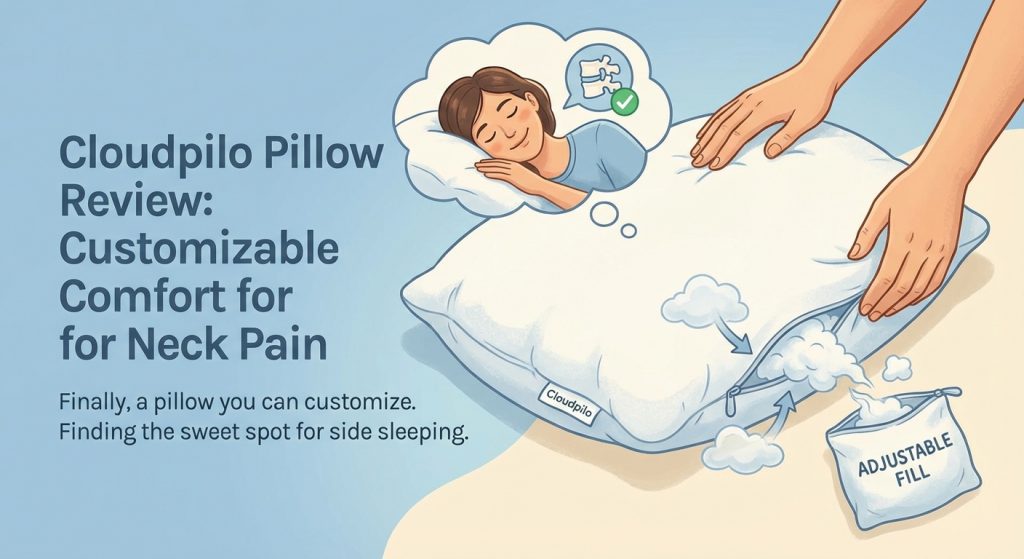
Enter the Cloudpilo (often spelled Cloudpillo in Europe). I kept seeing ads for this adjustable pillow popping up on my social feeds and being discussed on Dutch and German sleep forums. The promise was simple but alluring: a pillow filled with shredded memory foam that you can open up to add or remove filling until it is perfect.
I was skeptical. I hate gimmicks. But after reading enough threads on Reddit where users swore this was the “end game” for their cervical issues, I bought one.
Spoiler alert: It has replaced my Tempur Sonata as my main driver. My wife is now using the Sonata (and eyeing my Cloudpilo with suspicion and envy), and I have finally found the “sweet spot” for my neck alignment.
This is my detailed Cloudpilo review, based on three months of sleeping on it, adjusting it, making a mess with foam, and analyzing how it affects my sleep tracking data.
The Problem with “One Size Fits All”
Before we dive into the Cloudpilo features, we need to talk about why we have neck pain in the first place.
As a side sleeper, the goal of a pillow is to fill the gap between your ear and the mattress. This gap is not static. It depends on how broad your shoulders are, how much your mattress sinks (a soft mattress requires a lower pillow; a firm mattress requires a higher one), and even your weight fluctuation.
I am a 47-year-old male with relatively broad shoulders. For years, I struggled with pillows that were either pancakes (causing my head to tilt down) or bricks (causing my head to tilt up). Both scenarios pinch the nerves in the cervical spine. This physical stress is a massive contributor to that “tired but wired” feeling—waking up exhausted because your body was fighting to stay aligned all night.
Solid memory foam pillows, like the Tempur, are excellent, but they force you to fit their mold. The Cloudpilo reverses this dynamic: it molds to you.
Unboxing and First Impressions
When the box arrived, I was surprised by how heavy it was. Quality memory foam is dense, and Cloudpilo does not skimp on the filling.
The pillow comes vacuum-rolled. When you cut the plastic, it hisses and begins to inflate. A word of warning based on my experience and confirmed by multiple threads on the r/BIFLNL subreddit: there is a distinct “new car” smell (off-gassing).
This is common with all memory foam products. It isn’t a toxic cloud, but it is noticeable. I let mine air out in the spare room with the window cracked open for 24 hours before I slept on it. If you are sensitive to smells or prone to headaches from strong scents, do not skip this step. By the second night, the smell was 90% gone.
The Construction
The pillow feels premium. It features a dual-sided cover, which is a massive selling point for me:
- 1. The “Ice Silk” Side: This is the cooling side. It feels slick and cold to the touch.
- 2. The Warm Side: A softer, cozier texture for winter months.
Inside, there is an inner case with a zipper. This is the gateway to the engine room: the shredded memory foam. Unlike cheap pillows that use polyester fiber (which goes flat in a month), this uses chunks of high-density foam. They are blue and white snippets that look a bit like popcorn.
The Adjustment Ritual: Finding Your Loft
This is the most critical part of this Cloudpilo review. If you buy this pillow and sleep on it straight out of the box, you will likely hate it.
Out of the box, the Cloudpilo is massive. It is overstuffed intentionally so that it can accommodate even the broadest person with the firmest mattress. If you sleep on it like this, your neck will be cranked upward, and you will wake up in pain.
You must customize pillow fill.
My Step-by-Step Process
I approached this scientifically, treating it like a dosage protocol for a new supplement.
- Night 1: I left it as is.
Result: disaster. It was way too high. My Apple Watch sleep data showed restless movement all night, and I woke up with a stiff trapezius. - Night 2: I opened the zipper.
The experience is a bit messy. The shredded foam tends to cling to the zipper and your hands due to static. I recommend doing this over a clean table or a bedsheet you can shake out later. The box comes with a specific storage bag (or you can use the box itself) to keep the excess foam.I removed about four large handfuls of foam.
Result: Better, but still too firm.
- Night 3: The Sweet Spot.
I consulted the official Cloudpilo guide and cross-referenced it with user experiences on bol.com and Reddit. The consensus for side sleepers is to remove roughly 4 to 6 handfuls of foam.I took out two more handfuls. I put the pillow back on the bed, punched it in the middle to create a nest for my head, and lay down.
The sensation was immediate. My head sank in, but then stopped exactly parallel to the mattress. The shredded foam shifted around my neck, filling the nook between my jaw and shoulder perfectly, but without the hard push-back of a solid block.
This capability to fine-tune the adjustable loft is the true power of this product. I realized that my previous pillow was likely about 1cm too low, causing subtle strain. With the Cloudpilo, I dialed it in to the millimeter.
My Rating: 9/10!
The Sleeping Experience: Three Months Later
Now that I have dialed it in, here is how it performs in the three categories that matter most to me: Pain Relief, Temperature, and Stability.
1. Neck Pain Relief
Since adjusting the loft, my morning neck pain has vanished. It is comparable to the relief I got when I first bought the Tempur Sonata, but with an added layer of “plushness.”
The shredded memory foam behaves differently than a solid block. It allows for micro-movements. If I roll slightly forward, the foam moves with me. It doesn’t force my head back into a center position. For someone who moves around a bit before settling into deep sleep, this is superior to a contoured cervical pillow which demands you stay in one specific groove.
If you are suffering from chronic neck issues, I highly suggest combining this pillow with a proper sleep hygiene checklist. A pillow can only do so much if you are looking at your phone (tech neck) until midnight. But as a mechanical aid, this is top-tier.
2. Temperature Regulation (The Ice Silk Feature)
I am a hot sleeper. I have tested cooling mattresses, bamboo sheets, and almost every “cooling” gadget on the market short of an active water-cooled pad.
The “Ice Silk” side of the Cloudpilo is legitimate, but with a caveat. When you first lay your head down, it feels genuinely cold. It’s a relief, specifically for calming the mind and lowering facial temperature, which can help trigger sleep onset.
However, physics is physics. After about 20 to 30 minutes, the foam absorbs your body heat, and the cooling effect neutralizes. It does not stay ice-cold for 8 hours. No passive material does.
Important Note: I read a lot of reviews on Trustpilot where people complained that the cooling effect is lost if you use a thick cotton pillowcase. This is true. To get the benefit, you need a very thin, breathable pillowcase, or—as some reviews suggest—sleep directly on the pillow’s cover (which is washable). I use a thin silk pillowcase, and I can still feel the cool side working.
3. Stability and “Fluffing”
One criticism I saw on Reddit (specifically in r/nederlands threads discussing the brand) is that shredded foam pillows can go flat or the filling can migrate to the sides, leaving your head in a pit.
I have found that this happens if you don’t maintain the pillow. Every morning, when I make the bed, I grab the Cloudpilo by the short ends and give it a vigorous squeeze and shake. This “resets” the foam structure. If you do this, the loft stays consistent. If you are lazy and never fluff it, yes, after a week you might find yourself sleeping in a crater.
Comparison: Cloudpilo vs. Tempur
Since I own both, and my wife is currently sleeping on my “retired” Tempur, I can offer a direct comparison.
Cloudpilo vs. Tempur Sonata (Size M)
The Sonata is a curved, solid block of premium memory foam.
- Tempur Pros: Zero maintenance (no fluffing needed), incredibly consistent, lasts for years without changing shape.
- Tempur Cons: Zero adjustability. If you gain weight, lose weight, or change your mattress softness, you cannot change the pillow. It retains more heat than the Cloudpilo.
- Cloudpilo Advantage: The airflow through the shredded foam is noticeably better than the dense block of the Tempur. And, obviously, the adjustable loft.
Cloudpilo vs. Tempur Ombracio
I have held and tested the Ombracio (the star-shaped “stomach sleeper” pillow).
The Ombracio is unique, but for a broad-shouldered side sleeper like me, it was a failure. It is simply too low. It is designed for people who hug their pillow and sleep half-on-their-stomach. It lacks the structural height to support the neck of a pure side sleeper. The Cloudpilo, when fully stuffed, is significantly higher and more supportive.
Recent Findings & Community Feedback (Late 2025)
In preparing this article, I dug deep into the latest discussions to see if my experience was unique.
The “Recharge” Availability Issue:
If you are looking at the Cloudpilo features on their site, you might see a “Recharge” model which uses layers instead of shredded foam. As of December 2025, this model seems to be perpetually out of stock or on backorder in many European regions. The “Original” (which I am reviewing) remains their flagship and is widely available.
The Pillowcase Struggle:
A common complaint on Trustpilot is that the Cloudpilo is slightly larger or bulkier than standard European pillow sizes, making it a tight squeeze for standard pillowcases. I found this to be true before I removed the filling. Once I took out the 6 handfuls of foam, it fit into my standard bedding just fine. But be aware: if you keep it fully stuffed, it will turn your pillowcase into a sausage.
The “Mess” Factor:
Do not underestimate how messy shredded foam can be. It is static-charged. When you pull it out, small crumbs will stick to your hands and clothes. It’s a minor annoyance for a one-time adjustment, but don’t try to do this while wearing a black suit before work.
Pros and Cons
Pros:
- Fully Adjustable: You are the architect of your own comfort.
- Neck Pain Relief: Excellent for side sleepers once dialed in (approx. minus 4-6 handfuls).
- Temperature Versatility: Distinct cool and warm sides.
- Breathability: Shredded foam sleeps cooler than solid foam blocks.
- Risk-Free Trial: They offer a generous trial period (usually 30 nights or more), which is essential because it takes about a week to find your setting.
Cons:
- The Smell: Needs 24-48 hours to off-gas.
- Maintenance: Requires daily fluffing to maintain shape.
- The Mess: Adjusting the fill is a sticky, static-filled operation.
- Weight: It is a heavy pillow; not ideal for pillow fights.
FAQ
- Q: Can I wash the Cloudpilo?
A: You can wash the outer cover (the one with the cool/warm sides). Do not wash the inner bag with the memory foam. Memory foam acts like a sponge; it will soak up water, become incredibly heavy, and take weeks to dry (or develop mold). - Q: Is it good for back sleepers?
A: Yes, but you will need to remove even more filling than I did. Back sleepers generally need a lower loft to prevent the chin from tucking into the chest (which can exacerbate snoring or mild apnea). - Q: Does it help with snoring?
A: Indirectly. If your snoring is caused by positional issues (chin tucking), adjusting the loft to open the airway can help. However, if you suspect you have UARS or Apnea (check my guide on O2Ring data analysis for this), a pillow alone is rarely the cure. You might need to look into sleep mouth taping or positional therapy alongside the pillow. - Q: I wake up at 4 AM. Will this fix it?
A: If you are waking up due to pain or numbness in the arm, yes, this can help significantly. If your 4 AM wake-up is metabolic (“tired but wired” syndrome, cortisol spikes, hypoglycemia), you should look at my article on the 24h salivary cortisol test or consider supplements like Liposomal Apigenin rather than blaming the pillow.
Summary
The Cloudpilo is not just a pillow; it is a project. If you want something you can pull out of the plastic and sleep on immediately, you might find it frustratingly high and firm.
But if you are willing to spend three nights experimenting—removing a handful of foam here, adding one back there—it transforms into the most personalized piece of sleep gear you will own.
For me, the ability to customize pillow fill was the missing link. My Tempur Sonata was great, but the Cloudpilo is mine. It fits my shoulder width exactly because I made it fit.
The neck pain is gone. The cooling side helps me drift off. And despite the initial chemical smell and the messy adjustment process, I haven’t looked back.
If you are tired of guessing which “firmness level” to buy at the store, stop guessing. Buy the bag of foam and build it yourself.
*** Disclaimer: I am not a doctor. I am a patient sharing my journey. If you have severe chronic neck pain or numbness, please consult a physical therapist or orthopedic specialist.

By: Alex Warenstein.
Bio: Alex Warenstein is a sleep biohacker and founder of Night Time Comfort. After battling chronic insomnia and circadian disruption, he now helps others optimize their sleep using data-driven protocols. Read full story.
Disclaimer: Alex is not a doctor. This content is for educational purposes only. Always consult a specialist.