I have spent a small fortune on sleep gear. When you are desperate to fix your sleep architecture, when your Apple Watch consistently mocks you with low deep sleep scores, you tend to throw money at the problem hoping something sticks. My journey through the world of pillows has been extensive, expensive, and often frustrating. I have tested the adjustable Cloudpilo, the curved Tempur Sonata, and the travel-friendly Blackroll Recovery Pillow.
But the most visually distinct, and perhaps the most confusing product I have brought into my bedroom, is the Tempur Ombracio.
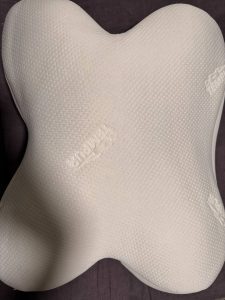
If you have looked for a Tempur stomach sleeper solution, you have seen this. It looks like a four-leaf clover, or a starfish that gave up. It does not look like a pillow. The marketing claims it is the ultimate solution for “prone sleepers” (people who sleep on their stomachs) and for people who like to hug their pillow.
I bought it because, at the time, I was dealing with shoulder pain and was willing to try anything. I am primarily a side sleeper, but I tend to rotate. I wanted to see if this star shaped pillow could offer the hybrid support I needed.
My experience was mixed. While it wasn’t the cure for my specific side-sleeping mechanics, it found a permanent home in my house—just not under my head. This is my detailed Tempur Ombracio review, based on my personal testing, my wife’s very different experience, and a deep dive into the physics of why this shape exists.
The Logic Behind the Star Shape
Before we get into how it feels, we have to address the elephant in the room: the shape. Why would anyone design a pillow with chunks missing from the corners?
This is not aesthetic. It is biomechanical.
For the vast majority of people, sleeping on your stomach is a kinematic nightmare. When you lie prone on a standard rectangular pillow, you have to turn your head 90 degrees to the side to breathe. This creates immense torque on the cervical spine. It locks your neck facets and strains the muscles. Furthermore, most people instinctively raise their arms above their head or tuck them under the pillow to prop themselves up, which cuts off circulation and impinges the nerves in the shoulder.
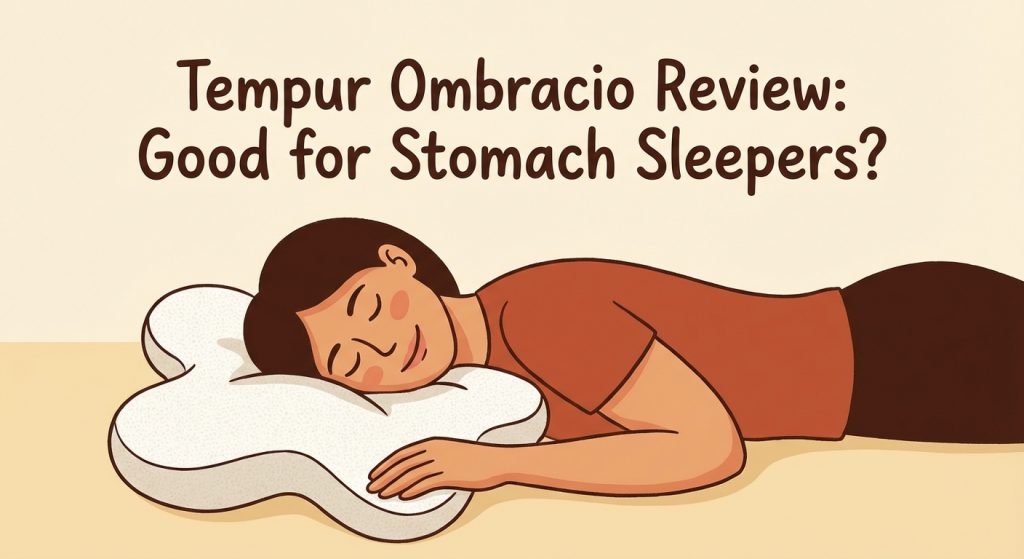
The Tempur Ombracio is designed to solve this specific geometry. The notches (the empty spaces between the “arms” of the star) are there to provide a space for your arms to rest without lifting your upper body into an unnatural arch. The idea is that you can slide your hands into the gaps, hug the pillow, and tilt your head slightly rather than wrenching it fully to the side.
If you read the Expert Reviews analysis on anti-snore pillows, they highlight this exact feature: the shape allows for better airflow management for stomach sleepers because it prevents that “neck-wringing” posture. It essentially attempts to make the most unhealthy sleeping position slightly less damaging.
Materials and “The Squish”
Unlike the Tempur Sonata or the Tempur Original, which are cast as single, solid blocks of memory foam (Monoblock), the Ombracio is different. It is filled with Tempur Adapt Material in the form of granulated micro-cushions.
Think of it as a heavy, dense bag of shredded memory foam that has been molded into a specific shape. Because it is not a solid block, it has a completely different tactile response.
- 1. Malleability: You can “fluff” and “punch” this pillow. You can push the filling from the center to the arms to adjust the loft slightly.
- 2. Softness: It is significantly softer than the classic Tempur contour pillows. It has a “squishy” feel that is immediately comforting.
- 3. Weight: Despite being soft, it is heavy. It stays where you put it.
My version came with the SmartCool cover. I am usually skeptical of “cooling” claims. Most cooling tech is just a coating that feels cold for 10 minutes and then heat-soaks, becoming a radiator for the rest of the night. However, echoing the findings from Ideal Home and Woman & Home, the SmartCool technology here is actually decent. It weaves heat-absorbing threads into the fabric cover. It doesn’t stay icy all night—physics forbids that—but it remains temperature-neutral much longer than standard polyester or cotton. If you suffer from night sweats or are sensitive to the heat retention typical of memory foam, the SmartCool version is the only one you should consider.
My Experience: The Side Sleeper Failure
I am 183cm tall with broad shoulders. I am a dedicated side sleeper. To maintain spinal alignment, I need a pillow that fills the “gap” between my ear and the mattress completely, so my cervical spine remains horizontal.
This is where the Ombracio loft failed me.
When I first lay down on it, it felt luxurious. The material cradles the face beautifully without the pressure points you get from cheaper foams. However, as the material warmed up and settled over the first 20 minutes, my head began to sink.
Because the Ombracio uses shredded micro-cushions rather than a solid block, it has less structural push-back than the Tempur Sonata. The center of the pillow compressed too much for my frame. My head dipped below my spinal line, and my shoulder collapsed inward to compensate.
I tried bunching the material up. I tried folding the “arms” of the star under the center to double the height. Nothing worked consistently. By 3:00 AM, I woke up with that familiar dull ache in my trap muscle and the need to reset the pillow.
If you are a broad-shouldered side sleeper looking for a primary pillow, my advice is blunt: this is likely not for you. The Ombracio loft (roughly 12-14cm technically, but functionally much lower due to compression) is simply not high enough to bridge the shoulder gap. You would be better served by the Tempur Sonata (Size M or L) or the adjustable Cloudpilo, where you can physically add more foam to reach the desired height.
The “Huggable Pillow” Redemption
I did not return the Ombracio. Why? Because while it failed as a head pillow for me, it excelled as a support tool.
I struggle with restlessness. I often need tactile feedback to calm my nervous system—similar to the concept behind Weighted Blankets & Cooling Duvets. I started using the Ombracio as a body pillow.
This is where the “star” shape makes sense in a totally different context.
- I tuck one “arm” of the star between my knees to align my hips.
- I hug the center of the pillow against my chest.
- My arms wrap around the top “arms” of the star.
In this configuration, the Ombracio is incredible. It provides a heavy, comforting mass that supports the upper arm (preventing shoulder rotation) while simultaneously separating the knees. It is the ultimate huggable pillow. If you are a side sleeper who craves something to hold onto to stop your chest from collapsing forward, this is a very expensive, but very effective, solution.
The Wife’s Verdict: The Hybrid Sleeper
My wife, however, has a completely different sleep profile. She is smaller than me and is a “rotational” sleeper—she starts on her side, rolls to her stomach, and sometimes ends up on her back.
She took the Ombracio from me after I complained about the height. She has not given it back since.
For her, the lower loft is a feature, not a bug.
- 1. Side Sleeping: Because her shoulders are narrower, the compression of the pillow puts her in perfect alignment. She does not experience the “sinking” issue I did.
- 2. Stomach Sleeping: When she rolls onto her stomach, the pillow is low enough that it doesn’t crank her neck backward. She utilizes the notches to tuck her arm underneath, exactly as the designers intended.
She describes it as the most “versatile” pillow she has ever owned. It allows her to change positions fluidly without needing to wake up and punch the pillow into a new shape. The micro-cushions adapt instantly.
This dichotomy in our household perfectly mirrors the polarization I found when researching community feedback. On forums like Reddit and ProductReview, the divide is sharp: pure side sleepers with larger frames often hate the low loft, while stomach sleepers and smaller side sleepers call it a “life saver.”
Deep Dive: Is it really a “Pillow for Prone Sleepers”?
If you are a stomach sleeper, you are the unicorn of the sleep world. Most ergonomic products are not made for you. Doctors will tell you to stop sleeping on your stomach. I know that changing a lifelong sleep habit is nearly impossible—I’ve tried to force myself to sleep on my back using positioning backpacks, and it is a struggle.
If you must sleep on your stomach, the Tempur Ombracio is arguably the best of a bad situation.
The Respiratory Advantage:
One of the biggest issues with stomach sleeping is compression of the chest and restriction of the airway. If your pillow is too high, you hyperextend your lumbar spine. If it is too soft, you risk burying your face and re-breathing carbon dioxide (which can degrade sleep quality).
The Ombracio strikes a specific balance. It lifts the upper chest slightly—just enough to take pressure off the lower back—while the “star” channels allow fresh air to circulate near the nose and mouth. The firm-yet-yielding nature of the Tempur material prevents your face from sinking in so deep that you suffocate, which is a risk with super-soft down pillows.
The Arm Numbness Fix:
Many stomach sleepers suffer from paresthesia (pins and needles) in their arms because they sleep with their hands under the pillow, compressing the nerves against the mattress. The Ombracio’s cutouts provide a “safe zone” for your arms. You can slide your arm through the gap, keeping it straight rather than bent at a sharp angle. This simple geometric fix can save you from waking up with a “dead arm” at 4:00 AM.
The Practical Annoyances
No Tempur Ombracio review would be honest without mentioning the casing logistics.
1. The Pillowcase Struggle:
The Ombracio is an odd shape. It does not fit into a standard rectangular pillowcase properly. If you shove it into a standard case, the fabric bunches up around the “arms” of the star, compressing the pillow and ruining the ergonomic effect.
You have two choices:
- Buy the official Tempur Ombracio pillowcases. They are expensive (typical of the brand) and fitting them is like putting a wetsuit on an octopus. However, they fit perfectly and allow the material to breathe.
- Use a massively oversized King-size pillowcase and leave it very loose. This looks messy, but it works if you don’t want to spend more money.
2. The Break-in Period:
When you first unbox it, the Ombracio feels firm. The micro-cushions have been compressed for shipping. You need to spend about 5 minutes aggressively massaging and fluffing the pillow to introduce air into the cell structure. It takes about a week of use for the material to fully relax into its “true” feel. Do not judge it on the first night.
3. Heat Retention:
Even with the SmartCool cover, this is still a block of dense foam. It will be warmer than a buckwheat or latex pillow. If you keep your bedroom at the recommended 18°C (as per the Sleep Hygiene Checklist), it works fine. If you sleep in a hot room (24°C+), the foam will soften significantly and may feel too warm.
Comparisons
Tempur Ombracio vs. Tempur Sonata:
I own both. The Sonata is a curved, solid block. It is designed purely for side sleepers who curl up (fetal position). The Sonata provides significantly more stable, consistent loft. It does not flatten out.
- Choose Sonata if: You are a pure side sleeper who needs consistent height and hates re-adjusting the pillow.
- Choose Ombracio if: You sleep on your stomach, or switch between side and stomach frequently.
vs. Cloudpilo:
The Cloudpilo is a shredded memory foam pillow where you can unzip it and remove handfuls of foam.
- Choose Cloudpilo if: You don’t know your ideal height and want to experiment. It is much cheaper and more customizable.
- Choose Ombracio if: You want the specific “arm-hugging” geometry and the superior pressure relief of the proprietary Tempur material (which is noticeably higher quality foam than what is inside the Cloudpilo).
User Consensus: What the Data Says
My experience aligns with the broader data I have aggregated from Reddit (r/Bedding, r/Mattress) and independent reviews up to late 2025.
- The “Love” Camp: Almost exclusively stomach sleepers and “pillow huggers.” There is a devoted cult following for this pillow among people who claim it is the only thing that stopped their neck pain. Users on ProductReview frequently mention that it is the only pillow that accommodates the “arm under the head” posture without cutting off circulation.
- The “Hate” Camp: Broad-shouldered side sleepers who found it too low. A recurring complaint in 2024 and 2025 is that the “new version” (SmartCool) feels softer and less supportive than the legacy version, leading to bottoming out.
- The “Smell” Issue: Like all fresh memory foam, the Ombracio has an “off-gassing” smell for the first 3-5 days. This is normal VOC release. Unbox it and leave it in a well-ventilated room (or near your Air Purifier) for 48 hours before sleeping on it.
Summary
The Tempur Ombracio is a specialized tool, not a universal solution. It is a piece of sleep engineering designed to solve the specific biomechanical problems of stomach sleeping—a position that most other pillows ignore or actively punish.
If you are a side sleeper with broad shoulders (like me), this pillow will likely disappoint you as a primary head support. The Ombracio loft is simply insufficient to maintain spinal alignment, and you will find yourself folding it in half by morning. However, do not underestimate its value as a secondary huggable pillow or body support; the star shape is surprisingly effective for hip alignment and shoulder relief when hugged.
If you are a stomach sleeper, or a smaller-framed side sleeper who prefers a lower, malleable surface, this might be the “Holy Grail” you have been searching for. It allows you to breathe, it gives your arms a home, and the Tempur stomach support is unmatched by standard rectangular pillows.
My household rating stands at a solid 7.5 out of 10. It wasn’t the one for me, but it was the one for my wife. And in the complex game of sleep optimization, finding a product that works for even one person is a victory.
Pros:
- Unique shape solves arm-positioning issues for stomach sleepers.
- “Squishy” feel is immediately comfortable and comforting.
- SmartCool cover actually helps manage temperature better than generic covers.
- Excellent build quality; heavy and substantial.
Cons:
- Loft is too low for broad-shouldered side sleepers.
- Difficult to find pillowcases that fit (requires expensive proprietary ones).
- Expensive investment if you aren’t sure it fits your posture.
- Requires regular “fluffing” to maintain shape unlike solid Tempur pillows.

By: Alex Warenstein.
Bio: Alex Warenstein is a sleep biohacker and founder of Night Time Comfort. After battling chronic insomnia and circadian disruption, he now helps others optimize their sleep using data-driven protocols. Read full story.
Disclaimer: Alex is not a doctor. This content is for educational purposes only. Always consult a specialist.