Neck pain waking you up? It is rarely just “bad luck.” If you wake up with a stiff neck, a headache at the base of your skull, or a shoulder that feels like it has been in a vice, the culprit is almost certainly geometry. Specifically, the geometry between your mattress, your body, and your head.
Most people spend hundreds of hours researching mattresses but treat their pillow as an afterthought. This is a critical error. In the world of sleep ergonomics, your pillow is the “bed for your head.” Its job is not to be soft or fluffy; its job is to fill a specific gap.
This definitive guide will walk you through the science of pillow alignment, how to determine your correct pillow loft, and why the “one-size-fits-all” pillow is a myth that is destroying your sleep quality. Whether you are a side sleeper dealing with shoulder compression or a stomach sleeper fighting hyperextension, the solution lies in the precise measurement of loft.
The Science of Alignment: Why Height Matters More Than Softness
Before you buy another expensive memory foam block, you must understand the goal. The objective of any sleep system is to maintain a “Neutral Spine.”
When you stand upright with good posture, your ears are aligned with your shoulders, and your spine has a natural S-curve. When you lie down, gravity tries to distort this alignment. A pillow’s only function is to counteract gravity to keep your cervical spine (neck) neutral.
- If the pillow is too high: Your neck is forced into flexion (chin towards chest) or lateral bending. This strains the muscles and, critically, can narrow your airway, potentially exacerbating snoring or issues like UARS.
- If the pillow is too low: Your head drops back (extension) or tilts down towards the mattress. This compresses the facet joints in the neck and can lead to morning headaches and numbness.
The Deception of “Loft” vs. “Compressed Height”
In the bedding industry, “Loft” refers to the height of the pillow when it is sitting on the bed, untouched. This is a useless metric.
What matters for neck alignment is the Compressed Height—how thick the pillow remains once the weight of your head (approx. 4.5 to 5 kg) rests on it.
- A 7-inch down pillow might compress to 1 inch.
- A 5-inch dense memory foam pillow might compress to 4 inches.
Therefore, when we discuss choosing pillow height, we are discussing the height under load. According to updated standards in 2025, we categorize loft as:
- Low Loft: Less than 3 inches (approx. 7.5 cm) compressed.
- Medium Loft: 3 to 5 inches (approx. 7.5–12.5 cm) compressed.
- High Loft: More than 5 inches (approx. 12.5 cm) compressed.
The “Sleep Triage” Algorithm for Pillow Selection
Stop guessing. To find your correct pillow loft, you must run a quick diagnostic on your sleep environment. The “best” pillow for your neighbor may be the worst pillow for you because of two variables: your body and your mattress.
Variable 1: Your Dominant Sleep Position
You move at night, but you likely have a “dominant” position where you spend the majority of your deep sleep stages.
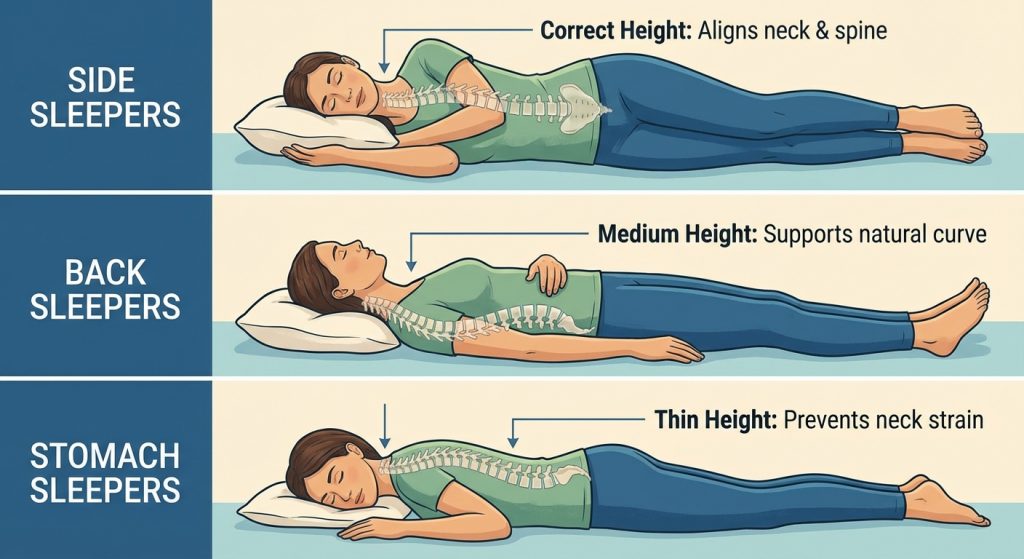
- Side Sleepers: Need the most height to bridge the gap between the ear and the outer shoulder.
- Back Sleepers: Need moderate height to support the cervical curve without elevating the head.
- Stomach Sleepers: Need practically zero height to prevent spinal rotation.
Variable 2: The Mattress Firmness Factor (Crucial!)
This is the variable most people miss. Your mattress firmness dictates how far your body sinks.
- Soft Mattress (e.g., Tempur Cloud): Your heavy torso sinks deep into the bed. This reduces the distance between your head and the mattress. Therefore, you need a lower pillow.
- Firm Mattress: Your body floats on top. The gap between your head and the mattress remains large. Therefore, you need a higher pillow.
If you recently switched to a softer Tempur mattress, the pillow that worked on your old spring bed might now be too high, causing neck strain.
1. The Side Sleeper Guide: Filling the Shoulder Gap
Side sleeping is the most common position, but it is mechanically the most demanding. The goal is to keep the cervical spine horizontal, parallel to the floor.
The “Gap” Calculation
To find your ideal pillow for side sleepers, you need to fill the space created by your shoulder width.
- 1. Stand against a wall.
- 2. Measure the distance from the wall to the side of your head.
- 3. Subtract the estimated sinkage of your mattress (usually 1-2 inches for foam).
- 4. The result is your required compressed height.
For most adults, this requires a High Loft (5–7 inches). If the pillow is too low, your head tilts down, stretching the upper trapezius muscles. This is a leading cause of waking up with a “crick” in the neck.
Recommended Shapes and Materials
For side sleepers, stability is key. You do not want a material that collapses halfway through the night.
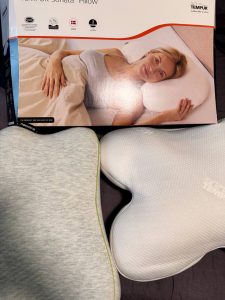
- Solid Memory Foam: Excellent for holding loft. The Tempur Sonata is a prime example of a pillow engineered for this. Its curved design accommodates the shoulder, allowing the pillow to tuck under the neck.
- Shredded Foam (Adjustable): These are increasingly popular in 2025/2026 (like the Cloudpilo or Coop) because you can physically add stuffing to increase the height until your spine is straight.
The “Side Sleeper” Checklist
- Firmness: Medium to Firm. Soft pillows often collapse, suffocating your nose or failing to support the neck.
- Shape: Rectangular or Curved (like the Sonata).
- Optimization: If you suffer from shoulder pain, consider the “hug” technique—using a second pillow against your chest to keep your upper shoulder from collapsing forward.
2. The Back Sleeper Guide: Supporting the C-Curve
Back sleeping is generally considered the best position for spine position sleep alignment, but it carries a risk: airway obstruction.
The danger of “Chin-to-Chest”
If a back sleeper uses a pillow that is widely too high (like a high-loft side sleeper pillow), the head is pushed forward. This flexes the neck and pushes the chin toward the chest.
- Muscular effect: Strain on the back of the neck.
- Respiratory effect: This position narrows the windpipe. If you use a Wellue O2Ring or track your sleep, you may notice oxygen drops or snoring spikes with a pillow that is too high.
The Ideal Back Sleeper Setup
You need a Medium Loft (3–5 inches). The goal is to support the natural curvature (lordosis) of the neck while letting the back of the head rest slightly lower.
- Cervical Contour Pillows: These have a “wave” shape—a higher roll under the neck and a lower dip for the head. This is the gold standard for maintaining the curve.
- Material: Latex or Memory Foam. Down pillows often fail here because the head sinks until it hits the mattress, while the sides puff up around the ears.
Pro-Tip: If you are a back sleeper dealing with lower back pain, the issue might not be the head pillow, but the legs. Placing a pillow under your knees releases tension in the lumbar spine and allows the lower back to flatten against the mattress.
3. The Stomach Sleeper Guide: The “Zero Loft” Rule
Sleeping on the stomach (prone position) is widely regarded by physiotherapists as the most traumatic position for the cervical spine. To breathe, you must rotate your neck 90 degrees to the side. This locks the facet joints and twists the muscles for hours.
However, if you cannot change this habit, you must mitigate the damage.
The Height Requirement: Low or None
A standard pillow is the enemy of the stomach sleeper. Using a medium or high loft pillow while on your stomach forces your neck into extension (bending backward) plus rotation. This is a recipe for chronic pain.
- The Target: Low Loft (<3 inches) or even no pillow at all.
- The Strategy: You need a buffer between your face and the mattress, but nothing that lifts the neck.
The Tempur Ombracio Solution
This is one of the few products specifically engineered for this problem. The Tempur Ombracio has a unique star shape with cutouts at the sides.
- Function: The cutouts allow you to slide your arms underneath the pillow or hug it without lifting your upper body too high.
- Material: It uses a specific density of foam that cushions the face but compresses significantly to avoid hyperextending the neck.
- Review consensus 2026: On forums like Reddit (r/Bedding), the Ombracio is frequently cited by “stomach sleepers” as the only pillow that prevents morning stiffness, primarily because of its low effective profile and ergonomic shape.
If you don’t use a specialized pillow, look for “Ultra-Low Profile” pillows or adjustable pillows where you can remove 80% of the filling.
The Rise of Adjustable Pillows: Customizing Your Alignment
In 2026, the fixed-height pillow is becoming obsolete. The “Shredded Memory Foam” revolution (led by brands like Coop, Cloudpilo, and others) has changed how we achieve pillow alignment.
Why Adjustable is Better
An adjustable pillow comes overstuffed. You unzip the inner casing and remove handfuls of foam until the height is perfect.
- Micro-Optimization: You can tune the height by millimeters. If your mattress sags over time, you can add more foam to the pillow to compensate.
- The “Slope” Trick: You can manipulate the fill to be higher under the neck and lower under the head, creating a custom cervical contour.
Consumer Reports and Tom’s Guide have consistently rated adjustable pillows highly in 2025 because they eliminate the guesswork. If you buy a solid block foam pillow and it is 1cm too high, you are stuck with neck pain. With an adjustable pillow, you fix it in 30 seconds.
Material Guide: Heat, Stability, and Bounce
The material of your pillow affects the “Compressed Height” and your sleep microclimate.
Memory Foam (Solid)
- Pros: unparalleled pressure relief; holds the shape perfectly all night.
- Cons: Can sleep hot (traps heat); can feel “stuck” if the response time is slow.
- Best for: People with chronic neck pain who need rigid consistency.
- Note: High-end foams like Tempur are temperature sensitive—they get softer as they warm up.
Latex
- Pros: Instant bounce-back; naturally cooler than memory foam; consistent height.
- Cons: Can feel “bouncy” or too firm for some; does not contour as deeply as foam.
- Best for: Hot sleepers and those who dislike the “sinking” feeling of foam.
Down / Feather
- Pros: Malleable; luxurious feel.
- Cons: Poor stability. A down pillow that starts at 6 inches high may end up at 1 inch by 3 AM. This lack of support often leads to progressive misalignment throughout the night.
- Best for: Stomach sleepers (because it compresses flat) or back sleepers who want minimal lift.
Buckwheat
- Pros: The ultimate “hard” adjustable. Interlocking hulls hold any shape you mold them into. Extremely cool (airflow).
- Cons: Noisy (rustling sound); feels very hard (like a beanbag).
- Best for: Biohackers and minimalists who prioritize mechanics over “coziness.”
Advanced Troubleshooting: Reading Your Morning Symptoms
Your body tells you if your pillow height is wrong. Here is how to decode the signals:
- Symptom: Pain at the base of the skull/neck upon waking.
Diagnosis: Pillow likely too high (chin forced down) or too firm.
- Symptom: Pain in the shoulder blade (scapula) or numbness in the arm (Side Sleeper).
Diagnosis: Pillow likely too low. Your head is dropping, dragging the neck muscles, and your shoulder is bearing too much weight because the gap isn’t filled.
- Symptom: Lower back pain (Stomach Sleeper).
Diagnosis: Pillow is too high, causing the spine to arch backward. Switch to low loft immediately.
- Symptom: Snoring or Dry Mouth (Back Sleeper).
Diagnosis: Pillow might be tilting the head too far forward, closing the airway. Try a lower contour pillow or check for mouth taping solutions to encourage nasal breathing.
Biohacking Your Pillow Setup: Protocols for 2025
In the community of The Quantified Scientist and among followers of protocols like Bryan Johnson’s Blueprint, the pillow is not just for comfort—it is a tool for spinal hygiene.
1. The Measurement Protocol
Do not eyeball it. Have a partner take a photo of your spine while you are lying on your pillow. Draw a line in the photo from the center of your thoracic spine (upper back) through your cervical spine (neck) to your head.
- Is the line straight?
- Is there a curve?
This “visual audit” is the most accurate way to assess spine position sleep alignment.
2. The Knee Pillow
For side sleepers, spinal alignment doesn’t stop at the neck. Using a small pillow between the knees keeps the hips square and prevents the lumbar spine from twisting. This reduces the pull on the spinal cord all the way up to the neck.
3. Stability Over Softness
The consensus in biohacking forums is to prioritize stability. A pillow that changes shape significantly during the night introduces variables. This is why materials like Buckwheat or high-density Memory Foam (Tempur) are often preferred over soft Down alternatives for optimizing Deep Sleep stats on trackers like the Oura Ring 4 and Apple Watch.
The Bigger Picture: It’s Not Just the Pillow
While finding the correct pillow alignment is essential for physical recovery, it is only one pillar of a high-performance sleep strategy. Mechanical support must be paired with a consistent sleep hygiene checklist to truly resolve insomnia. Even the best memory foam cannot counteract the physiological fragmentation caused by alcohol and sleep, or the metabolic chaos of eating sugar/fruits before bed. To ensure your body is actually ready to rest on your new pillow, make sure to disconnect from work screens at least two hours before sleep to avoid the tired but wired state. Furthermore, review your evening nutrition: avoiding the anti-sleep diet will help prevent insulin spikes sleep and is a critical step to stop waking up to pee, ensuring that your perfectly aligned spine remains undisturbed throughout the night.
Summary: How to Choose Today
Don’t be overwhelmed. Follow this hierarchy to fix your neck pain:
- 1. Check your position: Side (High), Back (Medium), Stomach (Low).
- 2. Check your mattress: Soft mattress = Lower pillow. Firm mattress = Higher pillow.
- 3. Choose the tool:
- For precision: Get an Adjustable Shredded Foam pillow (Cloudpilo/Coop).
- For rigid side-sleeping support: Look at ergonomic shapes like the Tempur Sonata.
- For stomach sleeping: Look at the Tempur Ombracio or ultra-slim profiles.
Your pillow is a medical device for your spine. Treat it with the same importance as your diet or exercise routine. Correct alignment reduces micro-arousals, protects your airway, and ensures that when you wake up, your energy goes into your day, not into fighting a stiff neck.

By: Alex Warenstein.
Bio: Alex Warenstein is a sleep biohacker and founder of Night Time Comfort. After battling chronic insomnia and circadian disruption, he now helps others optimize their sleep using data-driven protocols. Read full story.
Disclaimer: Alex is not a doctor. This content is for educational purposes only. Always consult a specialist.