Three years ago, I woke up with a sensation I can only describe as a rusted nail being slowly driven into my right deltoid. It wasn’t an injury from the gym – I hadn’t touched the heavy weights in days. It wasn’t a drafty room. It was my sleep.
I am a strict side sleeper. For years, I ignored the geometry of my bed, stacking cheap polyester pillows or flattening down generic memory foam blocks until my neck was crooked and my shoulder was crushed under my own body weight. I was sabotaging my own recovery.
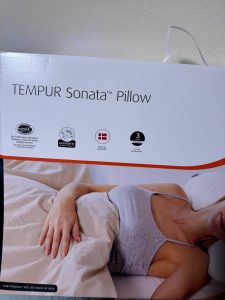
That morning pain sent me down a rabbit hole of research into spine position sleep and ergonomic support. I needed something that didn’t just prop my head up, but actually accommodated the natural curve of my shoulder girdle. I landed on the Tempur Sonata (Size M).
I used this pillow every single night for two years. It was the tool that finally allowed my shoulder to heal. While I have since moved on to the Cloudpilo (for reasons I will explain regarding adjustability), the Sonata remains a piece of engineering I respect deeply. If you are a side sleeper struggling to find the “sweet spot,” this review is for you.
What is the Tempur Sonata?
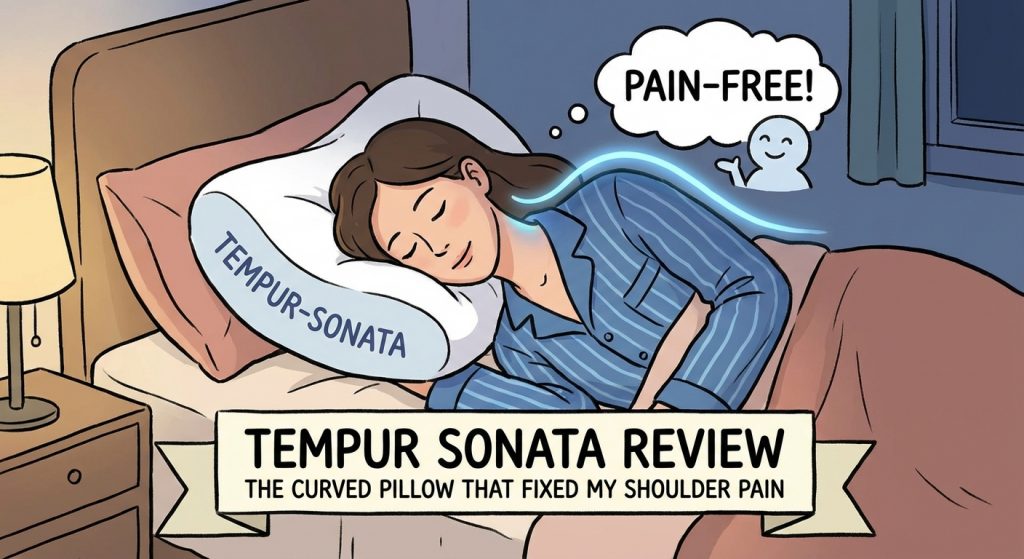
The Tempur Sonata isn’t shaped like a pillow. It looks more like a kidney bean or a crescent moon. In the world of sleep gear, we call this a curved pillow.
Most orthopedic pillows, like the famous Tempur Original, rely on a “cervical roll”—a hard ridge that jams under your neck. I tried those. They felt restrictive, locking me in place like I was in a medical brace. The Sonata is different. It features a subtle slope and a curved bottom edge designed to wrap around your neck and shoulders.
The marketing claims it offers a “hug” or “cradle support.” Usually, I ignore marketing speak, but in this case, the description is accurate. The curve allows the pillow to sit lower and closer to your body, meaning when you roll from your left side to your right side (as we all do during the night), the pillow is already there waiting for you. You don’t roll off the pillow; you roll with it.
Specifications (Size M)
- Dimensions: 61 x 40 x 11 cm
- Material: TEMPUR® Super Soft Material (viscoelastic foam)
- Shape: Crescent / Curved / Bean
- Best For: Side sleepers, Fetal position, Active sleepers
- Cover: Removable and washable (critical for hygiene)
My Experience: The First 30 Nights
I ordered the Size M, which has a loft (height) of 11cm. This is a critical number. If you have read my Pillow Height Guide, you know that matching the pillow height to the distance between your ear and your outer shoulder is the only way to achieve neck alignment.
The “Brick” Phase
I need to be honest about the unboxing. When I first took the Sonata out of the box, I thought I had made a terrible mistake. It was hard. Not just firm—hard.
This is a known characteristic of high-density Tempur material. It is temperature-sensitive. In a cold warehouse (or a cold bedroom), the viscoelastic cells lock up. I remember reading a thread on Reddit where a user complained that their new Tempur felt like a “concrete block.” I almost agreed.
However, the official advice—and the consensus from long-term users—is to “break it in.” You have to physically use it, warm it up, and even walk on it (gently) or sit on it to open up the foam cells.
By night three, the magic happened. As soon as my body heat transferred to the pillow, the memory foam neck support softened. It didn’t collapse like cheap foam; it melted specifically around the pressure points of my ear and jaw, while remaining supportive underneath.
The Side Sleeping Epiphany
The curve is the game-changer. Standard rectangular pillows have corners that poke into your shoulder, forcing you to push the pillow away. This creates a gap between your neck and the support. That gap is where gravity kills your spine alignment.
With the Sonata, I could tuck the curved edge right against my trapezius muscle. My shoulder didn’t feel jammed; it felt accommodated. The “fetal position” became effortless. I realized that for the first time in years, my cervical spine was actually a straight line parallel to the mattress.
The morning shoulder pain began to fade within a week. It wasn’t a miracle cure—it was just physics. I stopped crushing my shoulder joint because the pillow took the weight of my head correctly.
Deep Dive: Material and Heat Retention
We have to talk about heat. Memory foam has a bad reputation for trapping heat, leading to night sweats. If you are reading my articles on Weighted Blankets & Cooling Duvets, you know I am sensitive to temperature.
The Sonata uses a version of the foam called “Tempur Super Soft.” It is definitely softer than their “Original” collection, but it is still dense foam. Does it sleep hot?
My experience: It is warmer than a latex or down pillow. There is no airflow through a solid block of foam. However, I did not find it unbearable. I used a high-quality cotton pillowcase, which helped. If you are a severe “hot sleeper” who wakes up drenched, you might struggle here. But for me, the trade-off for the pressure relief was worth the slight increase in temperature.
Pro-Tip: If your room is cold (below 18°C/64°F), the pillow will feel firmer initially. If your room is hot, it will feel softer. This variable firmness is something you have to accept with genuine Tempur material.
The Controversy: Support vs. Freedom
In preparing this review, I revisited what the broader community says in late 2025 to see if my experience was unique.
There is a polarized debate online regarding the Sonata. A prominent review from Quiesco argues that the Sonata provides insufficient neck support because it lacks that distinct, raised cervical roll found in other orthopedic pillows. They argue that without that bump, the natural curve of the neck isn’t actively supported.
I respectfully disagree, based on my anatomy. For me, the cervical rolls often push too hard, cutting off circulation or pressing on the vagus nerve (which we know from my experiments with the Zenowell taVNS is sensitive).
The Sonata offers what I call “passive support.” It doesn’t force your neck into an arch; it allows your head to sink just enough so that the neck is supported by the remaining foam height. It feels more natural, less corrective.
However, I found agreement on forums like OzBargain and Reddit, where users describe it as a “love it or hate it” product. The positive reviews almost always come from active side sleepers who move around a lot. The negative reviews come from people who wanted a strict, rigid brace for their neck and found the Sonata too “flat” or “unstructured.”
Why I Switched (The Cloudpilo Factor)
You might be asking: “Alex, if it fixed your shoulder, why isn’t it your main pillow anymore?”
The answer lies in adjustability.
The Tempur Sonata is a fixed block. It is 11cm high. That is it. You cannot add foam. You cannot remove foam.
When I changed my mattress to a newer, slightly firmer model, my body didn’t sink as deep into the bed. Suddenly, the 11cm height of the Sonata felt just a tiny bit too low. My head was tilting downward slightly. The pain didn’t return fully, but I could feel the tension creeping back.
This is the limitation of the Sonata. It requires your mattress and your shoulder width to perfectly match that 11cm loft.
I eventually switched to the Cloudpilo, which uses shredded memory foam that you can add or remove. I was able to dial in the height to exactly 12.5cm, which matched my new mattress setup perfectly.
Does that make the Sonata bad? No. It makes it specific. If 11cm fits your frame, the Sonata feels smoother and more consistent than shredded foam (which can get lumpy). But if you are between sizes, you are out of luck.
Who is the Tempur Sonata For?
The Ideal Candidate (Side Sleepers)
If you sleep in the fetal position and constantly flip from left to right, this is arguably the best side sleeper pillow on the market. The curved shape means you never land on a “corner” or a flat spot. The pillow follows you.
The Back Sleeper
The manufacturer claims this is also for back sleepers. My testing confirms this is… partially true. Because the center of the pillow is slightly lower due to the head weight, it can cradle the back of the skull nicely. However, if you have a significant arch in your neck, you might find the support lacking compared to the Tempur Millennium or Original. It works for back sleeping, but it shines for side sleeping.
The Stomach Sleeper (Warning)
Do not buy this pillow if you sleep on your stomach. The 11cm height is too high. It will crank your neck backward, compressing your cervical spine. If you are a stomach sleeper, you need a very low profile or a specific shape like the Tempur Ombracio.
Durability and Value
This is not a cheap item. It is an investment. But is it “Buy It For Life”?
In the r/BuyItForLife subreddit discussions from 2025, Tempur remains a top contender. My Sonata, after two years of nightly abuse, showed zero deformation. Cheap memory foam loses its “rebound” after 6 months. The Tempur material feels exactly the same on day 700 as it did on day 30.
The cover is high quality and washes easily. I washed mine every two weeks (essential for keeping sleep hygiene and reducing allergens that might trigger UARS or congestion), and it never pilled or shrank.
Summary
The Tempur Sonata (Size M) is a specialized tool for a specific problem. It addresses the geometry of the shoulder joint in a way that standard rectangular pillows simply cannot.
If you are a side sleeper dealing with shoulder compression or neck pain, and you prefer a pillow that feels stable yet soft, this is a top-tier choice. It saved me from months of physical therapy and allowed me to sleep pain-free for two years.
My Rating of this pillow: 8/10
Its only downfall is its lack of adjustability. You are betting on the 11cm height being right for you. If it fits, it is heavenly. If you need 13cm or 9cm, you will be fighting it.
Pros:
- Curved shape perfectly aligns with the shoulder.
- “Super Soft” Tempur material reduces pressure on the ear (great if you wear earplugs like Loop Quiet 2).
- Zero motion transfer; the foam absorbs movement.
- Incredible durability; no sagging over time.
Cons:
- Fixed height (non-adjustable).
- Can sleep warm (not ideal for those with night sweats).
- Requires a “break-in” period to soften up.
- Regional availability issues (hard to find in some EU countries).
For me, this was an 8/10 experience. It did its job perfectly until my needs changed. If you are tired of waking up rubbing your shoulder, the Sonata is worth the risk.
Related Articles to Read Next:
Tempur Mattress Review: How pairing this pillow with the right mattress creates a zero-gravity feel.

By: Alex Warenstein.
Bio: Alex Warenstein is a sleep biohacker and founder of Night Time Comfort. After battling chronic insomnia and circadian disruption, he now helps others optimize their sleep using data-driven protocols. Read full story.
Disclaimer: Alex is not a doctor. This content is for educational purposes only. Always consult a specialist.