For the biohacker or the desperate insomniac, the Holy Grail of sleep tracking is the EEG (Electroencephalogram).
We know that wrist wearables like the Apple Watch or Oura Ring gen 4 are just guessing. They look at your heart rate and movement and infer what your brain is doing. But to truly know if you are in Deep Sleep or REM, you need to read the electrical signals of the brain itself.
For years, this technology was locked inside hospitals. Then came the Muse S. Specifically, the latest iteration, often referred to internally and by power users as the Muse S Athena (Gen 3). It promises to be a comfortable, fabric “sleep lab” that you wear around your forehead.
I wanted this to work. I wanted to see my brainwaves. I wanted to confirm if my Apple Watch sleep tracking accuracy was off. I spent weeks testing it, buying specialized conductive gels, and troubleshooting with support.
The result? I sold it on the secondary market!
This review analyzes the Muse S Athena (gen 3) sleep tracking capabilities, the frustrating reality of Muse signal loss, and why seeing “0 minutes of Deep Sleep” on your dashboard might be a hardware flaw rather than a health crisis.
What is the Muse S Athena (Gen 3)?
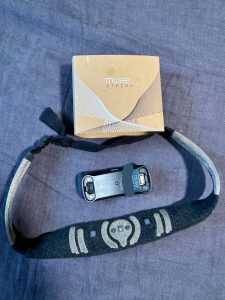
To the casual observer, the Muse S Athena looks like a high-tech sweatband. Unlike the rigid plastic Muse 2 (designed only for sitting meditation), the Muse S Athena is a soft fabric band designed for overnight wear.
The Hardware Shift: Manufacturer Claims & Specs
The “Sparkly” Sensors (EEG + fNIRS):
The most visible change is the sensors themselves. If you look closely at the fabric band, the electrodes are no longer just dull grey fabric; they have a “sparkly” appearance. This isn’t for aesthetics.
- Dual-Layer Sensing: This is the first consumer headband to combine 14-bit EEG (measuring electrical activity) with fNIRS (functional Near-Infrared Spectroscopy).
- What fNIRS does: While EEG listens to the “electricity” of thoughts, fNIRS shoots infrared light into your forehead to measure blood flow (hemodynamics). For sleep, this adds a critical layer: it can distinguish between a “quiet mind” and a “busy but paralyzed” mind during REM, theoretically improving staging accuracy.
- Durability: The new silver-thread matrix is designed to resist the oxidation and degradation that killed many Gen 1 and Gen 2 units after a few months of sweat.
The “Apnea-Ready” Optical Array (PPG):
The heart rate sensor (the pod in the middle) has moved from a simple monitor to a Triple-Wavelength PPG (Infrared 850nm, Near-IR 730nm, Red 660nm).
Connectivity & Power:
- Bluetooth 5.3: Gone is the older, shaky Bluetooth standard. The Gen 3 uses BLE 5.3. In my testing, connection speed (how fast it pairs) is instant. The stability is improved, though it cannot physically solve a sensor moving off your skin.
- 10-Hour Battery: The battery capacity has been bumped to 150mAh, effectively doubling the real-world runtime compared to an aging Gen 2. It now easily survives a 9-hour sleep session plus a morning meditation without needing a charge.
Meditation vs. Sleep:
Muse started as a meditation company. The device provides “Neurofeedback”—it plays sounds (like rainforest rain) when your brain is calm and storm sounds when you are distracted. This feature works reasonably well. However, this review focuses exclusively on its capabilities as a sleep tracker.
The Reality of Sleeping with an EEG
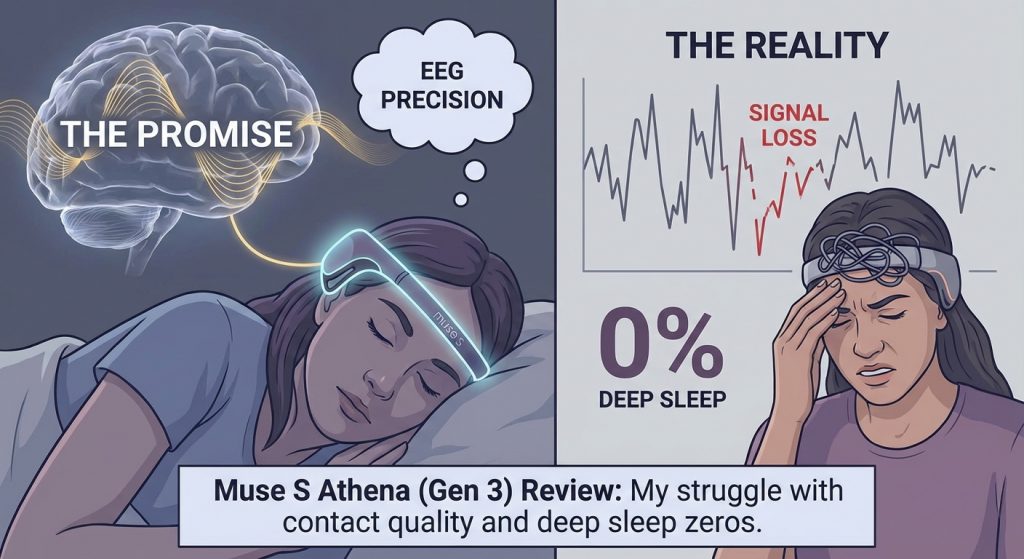
The theory of home EEG is beautiful. The reality is messy. The biggest hurdle for any EEG device is Contact Quality.
To read the faint electrical signals of your brain through your skull, the sensors must have a perfect, uninterrupted connection with your skin. In a sleep lab, a technician scrubs your skin with abrasive paste and glues the electrodes on with conductive gold paste.
With the Muse S, you are relying on a fabric band and the natural moisture of your skin.
The “Signal Loss” Nightmare
During my month of testing, I encountered the “Signal Quality” check every night. The app shows you a circle that fills up as the sensors connect.
- The Setup: You tighten the band. You wait. You wiggle it. You get a connection. You go to sleep.
- The Night: You roll over. The pillow pushes the band 1 millimeter up. The connection breaks.
- The Data: When the EEG signal is lost or noisy, the algorithm panics. It cannot classify the stage. In my experience (and based on hundreds of Reddit reports), the Muse algorithm defaults to marking these periods as Light Sleep or Awake.
The “Deep Sleep Zero” Bug
This is the most anxiety-inducing flaw of the device.
- On multiple nights, I woke up feeling refreshed. My Apple Watch Ultra 2 showed 1 hour of Deep Sleep. My O2Ring showed stable oxygen.
- I opened the Muse app. It showed: Deep Sleep: 3 minutes. Or sometimes 0 minutes.
- If you are a hypochondriac or suffering from Orthosomnia (anxiety about sleep data), seeing a “0” for deep sleep is terrifying. It implies your brain is not recovering. It implies you are physically deteriorating.
The Truth: I was not getting zero deep sleep. The device was simply losing contact during the Delta wave phases, or the algorithm was interpreting movement artifacts as wakefulness. The Muse sleep tracking algorithm seems incredibly conservative; if the data isn’t perfect, it discards the stage.
Troubleshooting: The Gel Experiment
- I refused to give up. I contacted Muse Support. Their advice was standard: “Wipe your forehead with a damp cloth before bed to improve conductivity.”
- I tried water. I tried saline solution. I tried licking the sensors (gross, but I was desperate).
- The result? The water evaporated after 20 minutes, and the signal degraded.
The Conductive Gel Trial:
I dove into the `r/Muse` subreddit. The power users there recommended EEG Conductive Gel (like Spectra 360). I bought three different viscosities of gel.
- Method: I applied a pea-sized amount of high-viscosity gel to the forehead and ear sensors.
- The signal did improve, but even with a layer of medical-grade conductive paste, I could not obtain continuous data for a full night. Furthermore, despite the gel, I still received suspiciously low Deep Sleep scores (5–10 minutes) that contradicted my physical feeling of recovery.
If a consumer device requires you to buy hospital-grade medical goop to work, it is not a “consumer” device. It is a prototype.
The “Walled Garden”: Data Ownership & Subscriptions
This is where my frustration solidified. Since my rigorous testing phase—waiting for various conductive gels to arrive and troubleshooting with support—pushed me past the 30-day return window, I couldn’t send it back. I decided to sell it on the secondary market.
The Subscription Paywall:
- You pay $300-$400 for the headband. But to access the “Biofeedback+” mode (which allows you to track sleep while listening to your own audio like Spotify or Audible, rather than their meditations), you must pay a monthly or annual subscription.
- Without the subscription, the sleep tracking features are severely limited. You are essentially renting the functionality of the hardware you just bought.
Crucially, you simply cannot track your sleep stages or access your data without paying for the recurring Muse subscription—at least, that was the hard restriction I encountered during my testing in September and October 2025.
No Data Export:
- I wanted to see the raw data. I wanted to see the hypnogram in a CSV file to compare it with my Wellue O2Ring and Apple Watch.
- The Reality: Muse does not allow you to export your sleep data or hypnograms. You can only view them as pretty charts in the app. You cannot see the munute-by-minute timestamps.
- Why? Probably to keep you locked into their ecosystem. For a device marketed to biohackers, this is a fatal flaw.
The Mind Monitor Workaround:
There is a 3rd party app called Mind Monitor (paid). It connects to the Muse via Bluetooth and records raw EEG streams.
- The Catch: It is for real-time visualization. It is not a sleep stager. You end up with a massive Excel file of voltage raw data that requires a PhD to interpret. It proved that the sensors were sending data, but it didn’t help me analyze my sleep architecture.
Privacy: Who Owns Your Brainwaves?
This is a darker question. When you sync your Muse, your brainwave data is uploaded to their cloud.
- I read through the Terms of Service and Privacy Policy. While they state they use “de-identified” data for research, the concept of a private company owning a database of my neurological activity made me uneasy.
- Unlike Apple, which processes health data on-device (encrypted), Muse relies on cloud processing. With no clear way to opt-out of cloud sync while still viewing my sleep data, I felt I was the product, not the customer.
Reddit & Community Consensus
I analyzed the sentiment on `r/Muse`, `r/Sleep`, and `The Quantified Scientist` comments section regarding the Muse S Athena.
The Good:
- 1. “Meditation King”: Users universally agree it is the best tool for learning to meditate. The real-time bird sounds (feedback) train your brain to focus.
- 2. “Comfort”: The fabric band is praised as the most comfortable head-worn tracker, far superior to the hard plastic of the Dreem 2 (RIP).
The Bad:
- 1. “The Deep Sleep Glitch”: Dozens of threads exist titled “Why does Muse say I got no deep sleep?” It is a widespread algorithmic failure.
- 2. “Battery Drain”: Users report that the Gen 3 units often drain battery unpredictably overnight, leading to lost data.
- 3. “Connection Anxiety”: Users report waking up in the middle of the night just to check if the app is still recording, which ironically ruins sleep quality.
- 4. “Subscription Fatigue”: The community is largely against the shift to the subscription model for features that used to be standard.
Comparison: Muse S Athena Gen 3 vs. The Competition
vs. Dreem 2 (Discontinued):
The Dreem 2 was the legendary home EEG. It had dry polymer sensors that penetrated hair. It was accurate. But the company pivoted to pharma research and stopped selling to consumers. Muse S is the only real option left, but it lacks Dreem’s accuracy.
vs. Apple Watch:
- Apple Watch: Infers sleep stages from Heart Rate/Movement.
- Muse S: Measures Brainwaves (theoretically).
- Verdict: In practice, the Apple Watch Ultra 2 is more reliable. It never “loses signal” because it is strapped to your wrist. Its algorithm, while an estimate, correlates better with how people actually feel than the Muse’s patchy EEG data.
vs. Withings Sleep Analyzer:
- Withings: Under the mattress. Zero friction.
- Muse S: On the head. High friction.
- Verdict: Both struggle with accuracy, but Withings is less annoying to use.
Alex’s Personal Review
The following is based on my personal logs.
My Rating: 5/10
I wanted to love the Muse S Athena. I am a data nerd. I wanted to see my Alpha, Theta, and Delta waves.
The Experience:
Comfort: 8/10. The fabric is soft. It is breathable. It didn’t hurt my ears.
Meditation: 9/10. As a neurofeedback tool for calming down during the day, it is brilliant.
Sleep Tracking: 1/10.
- I wore it for 30 nights.
- I used 3 types of gel.
- I tightened it until it left marks on my forehead.
- The Result: I never got a consistent night of data. One night it would say 5% Deep Sleep. The next night, 0%. The “Restoration Points” seemed arbitrary.
- Cross-Reference: I compared the data with my O2Ring (for movement) and Apple Watch. On nights when Muse said I was ‘Awake’ for 2 hours (but I was sure I was sleeping), my O2Ring showed a steady heart rate and no movement. Muse was interpreting a loose sensor as being awake.
The Decision:
I realized I was spending 20 minutes every night fussing with a headband, wetting sensors, and checking Bluetooth, only to wake up to data that told me I was sleep-deprived when I felt fine.
It was causing Orthosomnia. The device itself became a source of stress.
I listed it on the secondary market and sold it.
Advice:
Do not buy this primarily for sleep tracking. The technology for dry-sensor fabric EEG is not mature enough for the average toss-and-turn sleeper. Buy it if you want to learn meditation.
Alternatives for the Data-Obsessed
If Muse failed you, what should you use?
- 1. Hypnodyne ZMax: If you have the budget ($1000+), this is a true research-grade EEG. It uses sticky electrodes. It is ugly, wired, and complex, but the data is real.
- 2. Apple Watch + O2Ring: This combo gives you the best “proxy” data. Apple covers the stages (good enough), and O2Ring covers the respiratory health (Apnea check).
- 3. Wait: Companies like Somnee are entering the space with stimulation headbands that also track. The next generation might solve the contact issue.
Update for December 2025:
I have carefully studied the latest feedback and technical updates from across the biohacking community, including deep dives on the r/Muse subreddit, discussions on SleepHQ, and the official release notes for late 2025. Here is my consolidated list of critical updates regarding the Gen 3 “Athena” model.
1. From Passive Tracking to “Sleep by Design”
The most significant change in late 2025 is that Muse is no longer content with just watching you sleep. They have realized that messy data is less of a problem if the device is actively helping you rest.
- Deep Sleep Stimulation: As of December 2025, the Athena creates a closed-loop system. It detects when your brain enters Delta waves (Deep Sleep) and plays precisely timed audio cues (like Pink Noise) to deepen that state. If the signal becomes unstable or you move, the audio fades.
- Enso AI Coach: The new “Enso” feature attempts to translate the raw voltage data into plain English. Instead of just seeing a graph, the AI correlates your sleep stages with your daytime focus scores.
For the biohacker, this is intriguing. But it introduces a new variable: The Subscription Wall. Many of these advanced recovery features and the deeper data granularities have migrated behind a recurring paywall. You are no longer just buying hardware; you are marrying an ecosystem.
2. The Unsolved Physics of Fabric Sensors
Despite the fancy new fNIRS sensors and “Artifact Rejection” software updates in late 2024 and 2025, the core hardware limitation has not changed. You are still trying to read microvolts of electricity through skin, sweat, and hair using a fabric band that moves against a pillow.
The community reports from late 2025 remain consistent with my original experience:
- The “Deep Sleep Zero” Glitch Persists: Users continue to report nights where the algorithm implodes due to poor contact, resulting in logs showing 0 to 5 minutes of Deep Sleep, even when the user feels rested.
- The Reconnection Loop: A common complaint involves the headband waking up the user (via the app or vibration) or simply creating data gaps because it loses the signal when you roll over.
3. The 2025 Alternatives: Truth vs. Stimulation
The market has bifurcated. If you are unsatisfied with Muse, you now have two distinct paths:
- The Path of Truth (Hypnodyne ZMax): For the serious data analyst who needs clinical accuracy, the Hypnodyne ZMax remains the gold standard. It uses hydrogel electrodes that stick to the skin. It is ugly, wired, and expensive, but it does not suffer from signal loss.
- The Path of Stimulation (Somnee / Elemind): Competitors like Somnee have entered the ring with a focus on tES (electrical stimulation) to force the brain into sleep, rather than just tracking it.
A Critical Note on Signal Quality (Alex’s Experience)
I want to be extremely clear about this, as I have tested this rigorously.
Despite the “Athena” updates, this headband remains a problematic device regarding skin contact. I have personally tested it using three different viscosities of EEG conductive gel (liquid saline, medium conductivity gel, and high-viscosity medical paste).
Even with medical-grade adhesive gel, the friction of the pillow against the fabric band caused artifacts that the algorithm often misinterpreted as “Wakefulness.” If your primary goal is accurate, “set-it-and-forget-it” sleep tracking, I do not recommend this device. The technology for dry-sensor fabric EEG is simply not mature enough for a restless side-sleeper to rely on for medical-grade data.
Summary
The Muse S Athena (Gen 3) is a brilliant meditation tool trapped in a marketing campaign that promises a sleep lab experience it cannot deliver.
- Buy it if: You are serious about meditation neurofeedback and view sleep data as a “bonus” novelty.
- Skip it if: You want accurate Deep Sleep numbers, hate subscriptions, or toss and turn at night (which breaks the sensors).
Read Next:
Withings Sleep Analyzer Review |
Deep Sleep vs. REM: How to Read Your Hypnogram

By: Alex Warenstein.
Bio: Alex Warenstein is a sleep biohacker and founder of Night Time Comfort. After battling chronic insomnia and circadian disruption, he now helps others optimize their sleep using data-driven protocols. Read full story.
Disclaimer: Alex is not a doctor. This content is for educational purposes only. Always consult a specialist.