There is a fine line between optimizing your sleep and ruining your comfort. We rely on rings, watches, and headbands to track every minute of our slumber, yet the gear itself often gets in the way. Real ‘wearable fatigue’ sets in when you realize you just want to drift off without wearing a single piece of tech.
This is the promise of the Withings Sleep Analyzer: a “set and forget” under-mattress sleep tracker. It claims to deliver medical-grade data without touching your skin. But for people like us—people with real sleep issues, perhaps suspecting UARS, dealing with chronic insomnia, or managing nocturia—is a pneumatic sensor under a thick mattress actually accurate?
I have spent weeks testing this device, cross-referencing it with my other gear (like the Apple Watch sleep tracking accuracy data and my trusted Wellue O2Ring), and digging through the latest late-2025 research and community findings. Here is the deep dive into whether this contactless sleep monitor is the solution for your sleep lab at home.
The Technology: How Does It Hear Your Heart Through a Mattress?
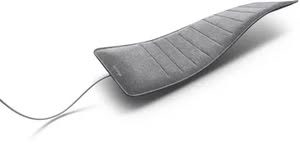
To understand if we can trust the data, we have to understand the magic trick. How can a thin gray pad placed under a heavy mattress detect a heartbeat?
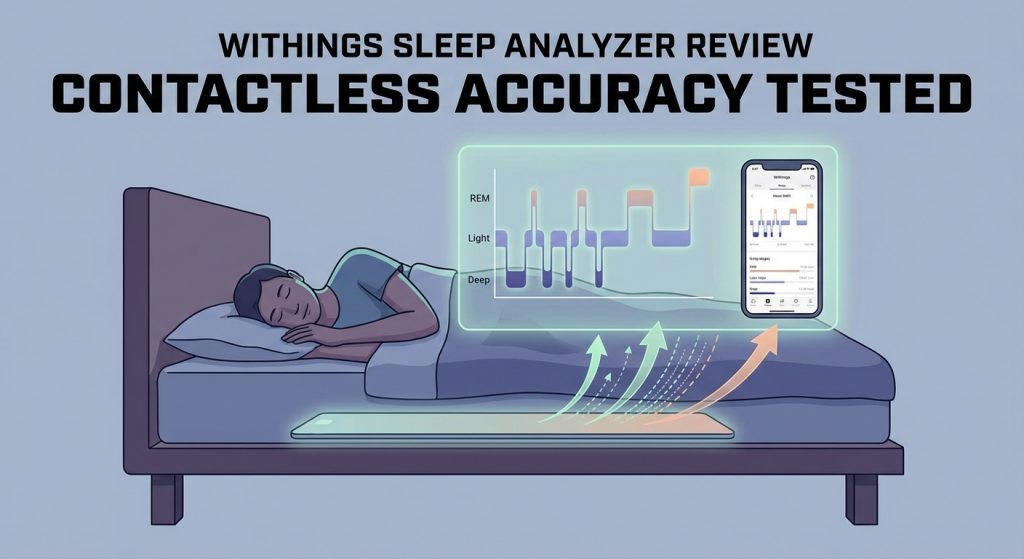
The Withings Sleep Analyzer utilizes pneumatic sensor technology (specifically, ballistocardiography). The mat contains air bladders. When you lie on the bed, your body weight pressurizes these bladders. Every time your heart beats, it creates a subtle mechanical recoil in your body—a microscopic “jiggle.” Every time you take a breath, your thorax expands and contracts, shifting your weight slightly.
The sensor is sensitive enough to detect these pressure waves through mattresses up to 15 inches (approx. 38 cm) thick. It combines this pressure data with a sound sensor to identify snoring and breathing cessations.
Installation and the “Set and Forget” Factor
The setup is admittedly the device’s strongest selling point. You slide it under the mattress at chest level, plug it into a wall outlet, and connect it to your WiFi via the Health Mate app. That’s it. There are no batteries to charge, no buttons to press before sleep. It calibrates automatically (making a faint whirring sound for a minute) and then sits there, invisible.
For an older relative or someone suffering from orthosomnia symptoms (anxiety caused by obsessing over sleep data), this invisibility is a massive benefit. You cannot check your stats in real-time, which forces you to just sleep.
A Note on EMF and WiFi Safety
Since we are optimizing our sleep hygiene checklist, keeping the bedroom low-EMF is a priority for many of us. A common concern is having a WiFi device directly under your body.
It is important to know that the Withings Sleep Analyzer is not constantly blasting data. It collects data locally on the device throughout the night. It typically only activates the WiFi radio for a short burst after you get out of bed in the morning to sync the data to the Withings servers. However, it is mains-powered, meaning there is an electrical cord running under your bed. If you are extremely sensitive to dirty electricity or EMFs, this is a consideration, though for most, the distance provided by the mattress offers some buffer.
Deep Dive: Sleep Cycle Accuracy and Staging
This is where things get complicated. We all want to know: “Did I get enough Deep Sleep?”
As of late 2025, the consensus among the scientific community (including independent tests by reviewers like The Quantified Scientist) and user reports is that contactless sleep monitors have specific strengths and glaring weaknesses compared to EEG devices (like the Muse S Gen 3).
Sleep vs. Wake Detection
The device is surprisingly good at determining total sleep duration. Recent validation studies and long-term user reports suggest an accuracy of around 83% for distinguishing between sleep and wakefulness compared to polysomnography.
However, it relies heavily on movement. If you wake up at 3 AM with a racing mind—the classic tired but wired sensation – and you lie perfectly still trying to perform 4-7-8 breathing, the mat will likely think you are sleeping. It cannot see your brainwaves; it only feels your body. Conversely, if you toss and turn, it registers that immediately.
The “Deep Sleep Inflation” Problem
Here is the critical flaw I found, which is echoed on forums like Reddit and SleepHQ. The Withings Sleep Analyzer has a tendency to overestimate Deep Sleep (NREM3), particularly in the second half of the night.
Biologically, our sleep architecture usually prioritizes deep sleep in the first half of the night and REM sleep in the second half. However, the Withings algorithms often interpret periods of very low heart rate and stillness in the early morning as Deep Sleep.
If you are using this device to track the effectiveness of Magnesium L-Threonate or L-Glycine on your deep sleep scores, be very careful. You might see a “healthy” 1 hour and 30 minutes of deep sleep on the chart, but a portion of that might actually be Light Sleep or even quiet wakefulness. It is useful for spotting trends (e.g., “did my score drop after drinking alcohol?”), but do not take the absolute minute-count as a medical fact.
REM Sleep Detection
In my testing, REM detection was decent regarding timing—it usually spotted the REM cycles where I remember dreaming. However, the duration was often inaccurate compared to my Apple Watch sleep tracking. It tends to smooth out the data, missing the short, fragmented awakenings or micro-arousals that are critical for understanding conditions like UARS (Upper Airway Resistance Syndrome).
Heart Rate and HRV: The 2025 Updates
For a long time, this device was just a heart rate tracker. But late in 2025, Withings rolled out significant firmware and app updates (specifically App 7.5 and 7.6) that unlocked Heart Rate Variability (HRV) data for the Sleep Analyzer.
Resting Heart Rate
The heart rate accuracy is excellent. Validation studies have shown it to be within 2 beats per minute (BPM) of clinical ECGs. This makes it a reliable tool for tracking your sleeping heart rate. If you see your resting heart rate spike from 55 to 65, you know your body is under stress, perhaps from a late meal or alcohol rebound effect.
HRV and Recovery
The addition of HRV is a game-changer for the device’s value proposition. HRV is a metric of your nervous system’s flexibility. A low HRV indicates sympathetic overdrive (stress), while a high HRV indicates parasympathetic dominance (recovery).
However, unlike an Oura Ring Gen 4, which measures HRV directly from the finger arteries, the Withings mat calculates it from ballistocardiography signals through the mattress. The data provides a useful baseline trend for recovery, but I would not use it to diagnose a cortisol issue or HPA axis dysregulation. It is a “broad strokes” metric.
The Big Question: Sleep Apnea and Snoring Detection
This is the most confusing part of the product because the features depend entirely on where you live.
Europe vs. USA (Regulatory Differences)
- In Europe (Sleep Analyzer): The device is medically certified to detect Sleep Apnea. It provides an AHI (Apnea-Hypopnea Index) grade. It has been validated in clinical studies (published in the Journal of Clinical Sleep Medicine) to have high sensitivity (88%) for moderate-to-severe apnea.
- In the US (Withings Sleep): Due to FDA regulations, the standard consumer version often markets this feature as “Breathing Disturbances” rather than a diagnostic AHI score. There is a prescription-only version (Sleep Rx) available in the US that provides diagnostic data, but the one you buy off Amazon may just give you a “risk” score rather than a medical grade.
Performance in the Real World
I compared the data from the Withings mat with my O2Ring data analysis.
The Withings device uses a combination of respiratory rate, heart rate, movement, and sound to estimate apnea events. It does not measure blood oxygen (SpO2).
- The Positives: It is very good at catching heavy snoring and cessation of breathing associated with obstructive sleep apnea (OSA). If you snore like a chainsaw and stop breathing, this mat will flag it.
- The Negatives: It struggles with “Silent” sleep disorders like UARS. In UARS, you might not stop breathing completely; you just struggle to breathe, causing a stress response. Since the mat cannot see the flow limitation or the SpO2 drop, it often gives a “Green/Healthy” score to people who are actually suffering from fragmented sleep.
Furthermore, unlike some apps that record your snoring so you can listen to it (to hear if you are gasping), the Withings app only logs the time and duration of snoring events. You cannot listen to the audio clips. This is a privacy feature, but a functional drawback if you are trying to determine if your mouth taping or nasal dilator is working.
The App, Subscription, and Data Freedom
The device syncs to the Withings Health Mate app. The free version of the app is actually quite comprehensive. It gives you your Withings Sleep Score, a hypnogram (graph of sleep stages), heart rate graphs, and snoring time.
Withings+ (The Paid Subscription)
- Withings pushes a “Withings+” subscription heavily. It promises “advanced insights” and coaching.
- My take: Save your money. The “insights” are mostly generic advice like “try to go to bed at the same time.” For a biohacker or someone knowledgeable enough to read this site, the premium subscription adds very little value. The raw data is what we need, and that is available in the free tier.
Data Export
You can export your data to CSV via the web dashboard. However, the data format is somewhat simplified. You get summaries, but you don’t get the granular, second-by-second raw sensor data that you might get from an EEG file. It is enough for Excel graphing, but not for medical research.
Community Consensus: What the Forums Say (Dec 2025 Update)
To ensure this review reflects reality and not just marketing, I have aggregated the prevailing sentiment from `apneaboard.com`, `SleepHQ`, and the `r/withings` and `r/Biohackers` subreddits as of late 2025.
- 1. The “Phantom Apnea” Spikes: A significant number of users on Reddit have reported sudden, unexplained spikes in their AHI scores following firmware updates in mid-2025. Users with CPAP machines (specifically ResMed AirSense users) often note that the Withings AHI data does not match their CPAP data, sometimes showing high events when the CPAP reports nearly zero.
- 2. Great for “Orthosomnia”: The most positive feedback comes from users who abandoned their Apple Watches and Oura Rings because the constant data-checking was causing anxiety. The “passive” nature of the mat helped them normalize their sleep routine.
- 3. Nocturia Tracking: Many older male users (relevant to prostate health) praise the device for accurately logging the time and duration of bathroom breaks. It reliably detects when you leave the bed and when you return.
- 4. Sensitivity to Mattress Type: Users with memory foam mattresses thicker than 12 inches report less accurate data than those with spring mattresses. The foam dampens the BCG signal.
- 5. Durability: There are scattered reports of the pneumatic bladder failing after 2+ years of use, leading to a “noisy signal” or failure to detect presence.
- 6. HRV Validity: The biohacking community remains skeptical of the new HRV data, viewing it as a “smoothed” trend rather than a precise metric comparable to chest straps or ring sensors.
- 7. Partner Disturbance: A common question is “Does my partner affect the data?” The answer is generally no, provided you place the mat strictly under your side of the bed. However, if your partner is very heavy or encroaches on your side, cross-signal interference can happen.
- 8. WiFi Sync Issues: A subset of users reports that the device occasionally fails to sync in the morning, requiring a “reboot” (unplugging and replugging).
My Personal Review
Note: The following is based on my personal testing protocol, comparing the unit against my subjective logs, Apple Watch data, and O2Ring.
My Score: 6.5 out of 10
I wanted to love this device. The idea of tracking my sleep without wearing a plastic gizmo on my finger or wrist is the dream. However, after using it extensively, my trust in the data—specifically the sleep architecture (hypnogram)—is shaky at best.
The Good:
It is genuinely the best tool for tracking my nocturia. I can tell exactly how many times I got up to pee and how long I stayed up. This is valuable for judging if my Pygeum Africanum supplement is working. It also nails the “Time in Bed” metric perfectly.
The Bad (and why I don’t trust it fully):
- 1. The Hypnogram is a Guess: There are too many nights where the Withings app claims I had a glorious 2 hours of Deep Sleep, yet my Apple Watch and my own body tell me I had a restless, light-sleep-filled night. It seems to struggle to differentiate between “lying frozen in fear/anxiety” and “deep sleep.”
- 2. Apnea Discrepancies: I ran this alongside my O2Ring. There were nights my O2Ring showed significant oxygen desaturations (indicating airway issues), yet the Withings mat gave me a clean bill of health. Relying on this for UARS detection could be dangerous because it misses the subtle flow limitations that don’t result in loud snoring or thrashing.
- 3. The “Black Box” Factor: I dislike that I cannot check why it thought I was awake or asleep. With an audio-recording app, I can listen to the file. With the Withings, I just get a bar chart.
I give it a 6.5 because it is a unique, affordable device that requires zero effort to use. I keep it under my mattress primarily as a backup and to track my heart rate trends and bathroom visits. But for serious biohacking or clinical analysis of sleep stages? I do not trust the data enough to base my health decisions on it. It is a broad-strokes painting, not a photograph.
Summary: Is It Right For You?
The Withings Sleep Analyzer is a triumph of form factor, but a compromise on data fidelity.
Buy this if:
- You absolutely hate wearing watches, rings, or masks to bed.
- You want to monitor the sleep of an elderly parent without confusing them with tech (since it syncs automatically).
- You are primarily interested in tracking resting heart rate trends and total sleep duration.
- You want to track social jetlag symptoms by seeing your bedtime consistency over months.
Do not buy this if:
- You need precise measurement of Deep Sleep vs. REM cycles.
- You suspect you have UARS (Upper Airway Resistance Syndrome) and need to track flow limitations or SpO2 drops (get an O2Ring or WatchPAT one instead).
- You want to listen to audio recordings of your snoring.
- You are a data perfectionist who needs second-by-second raw data accuracy.
Sleep tracking is only useful if it leads to behavior change. If the Withings Sleep Analyzer helps you stick to a consistent schedule because it’s effortless, then it is a valuable tool in your arsenal. Just remember to take the “Deep Sleep” percentages with a grain of salt.

By: Alex Warenstein.
Bio: Alex Warenstein is a sleep biohacker and founder of Night Time Comfort. After battling chronic insomnia and circadian disruption, he now helps others optimize their sleep using data-driven protocols. Read full story.
Disclaimer: Alex is not a doctor. This content is for educational purposes only. Always consult a specialist.