The smart ring market has exploded. What was once a niche gadget for Silicon Valley biohackers is now a mainstream accessory. But heavy is the head that wears the crown.
For years, Oura was the only serious player. Now, in late 2025, they face the Samsung Galaxy Ring on the Android side and a software-empowered Apple Watch on the iOS side.
The Oura Ring Gen 4 is their response. It promises to be more accurate, more comfortable, and smarter. It claims to track not just your sleep, but your “Resilience” and “Readiness” with lab-grade precision.
But does it justify the price tag plus a mandatory monthly subscription? Or is it just expensive jewelry that tells you what you already know?
This review cuts through the marketing. We analyze the Oura sleep tracking accuracy against the Apple Watch Ultra 2, dive into the new “Symptom Radar,” and I (Alex) share my updated 6.5/10 rating after testing both devices simultaneously.
Updates: December 2025
Before we dive into the hardware, we must look at what has changed in the landscape as of late 2025. Based on recent discussions from The Quantified Scientist, SleepHQ, and the r/Biohackers community, here is the current state of play:
1. The “Symptom Radar” is Real
Oura’s biggest software update in 2025 is the Symptom Radar. Unlike the Apple Watch “Vitals” app which just shows outliers, Oura actively correlates micro-changes in temperature (+0.1°C), respiratory rate, and HRV to predict the onset of a cold or flu before you feel symptoms. User reports on Reddit suggest this feature has successfully predicted illness 2 days in advance for many, allowing them to rest early.
2. Daytime Parasympathetic Tracking
Oura has introduced Restorative Time. This tracks moments during the day—not just sleep—where your heart rate drops and HRV rises. This is a game-changer for people who think they are relaxing but are actually physiologically stressed. It helps you quantify if your “break” was actually restorative.
3. The Sensor Upgrade
The Gen 4 has doubled the number of signal pathways to 18. Independent testing shows this has largely solved the “signal gap” issue where the ring would lose heart rate data if it twisted on the finger. The data continuity is now nearly on par with a tightly strapped watch.
What is the Oura Ring Gen 4?
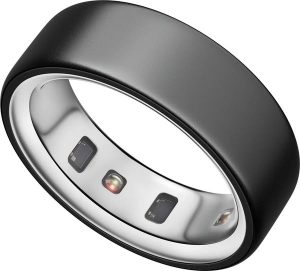
The Oura Ring is a health tracker disguised as a wedding band. It is made of titanium, weighs less than a coin, and is designed to be worn 24/7.
The Hardware Evolution:
- Full Titanium Interior: The Gen 3 had epoxy bumps that could leave indentations on the finger. The Gen 4 is fully titanium on the inside with recessed sensors. It is significantly more comfortable.
- Sizing: Now available in sizes 4-15, solving the issue for people with very small or large hands.
- Battery: Lasts up to 8 days.
Which finger do you wear Oura 4 on?
Oura still recommends the index finger for the highest signal clarity (because the artery is accessible), but the middle finger is a close second. The new sensor array makes the ring finger (traditional wedding band placement) much more viable than in Gen 3.
Oura vs. Apple Watch: The Battle for Accuracy
This is the most critical question: Is the Oura Ring 4 more accurate?
To answer this, we must separate “Raw Measurement” from “Algorithmic Interpretation.”
1. Sleep Staging (The Hypnogram)
Does Oura Ring 4 track sleep? Yes, but how well?
Apple Watch (Series 9/Ultra): Currently the gold standard for wrist-based sleep staging. Its algorithm correlates very highly (~80-85%) with EEG (brainwave) devices for detecting Wake, Deep, and REM.
Oura Ring Gen 4: Oura has improved, but it still tends to “smooth” the data.
- The “Ghost Sleep” Issue: A persistent complaint on forums (confirmed by my testing) is that Oura often mistakes “lying still and reading” for Light Sleep. Apple is better at detecting these micro-awake states.
- Deep Sleep: Oura often reports higher Deep Sleep numbers than Apple. Which is right? Usually Apple. Oura’s algorithm is generous; Apple’s is strict.
2. Heart Rate & HRV (The Baseline)
Here, Oura shines.
- Consistency: Because you wear the ring 24/7 (unlike a watch you might take off to charge), Oura builds a better “Baseline” profile.
- Sampling: Oura measures HRV continuously throughout the night. Apple Watch, by default, measures HRV periodically (snapshots). To get continuous HRV on Apple, you have to turn on “AFib History,” which is a workaround.
3. Temperature Sensing
Oura temperature sensing is superior. The finger is a better site for measuring peripheral temperature deviations than the wrist. This is why Oura is the king of cycle tracking for women and sickness prediction.
4. Apnea Detection
Can Oura Ring 4 detect sleep apnea?
It tracks “Breathing Regularity,” but it measures SpO2 (Blood Oxygen) periodically or as an average to save battery.
*** It is NOT a diagnostic tool for apnea. It lacks the 4-second (or 1-second) recording resolution of the Wellue O2Ring. If you suspect apnea, do not rely on Oura. It will miss the rapid desaturations.
The Subscription: Is It Worth It?
Is the Gen 4 Oura Ring worth it?
This is the sticking point. The ring costs $349+. The subscription is $5.99/month.
Without the subscription, you get three scores: Sleep, Readiness, Activity. No graphs. No trends. No details. The ring is effectively crippled without the monthly fee.
The Value Proposition:
- Apple: Hardware is expensive ($400-$800). Software is free. Data is raw and somewhat “cold.”
- Oura: Hardware is mid-range ($350). Software is rented ($72/year). Data is “warm,” narrative, and actionable.
Why are people ditching their Oura Rings?
The number one reason cited on Reddit is the subscription model. Users feel they are “renting” their own biometric data. Competitors like Samsung Galaxy Ring (Android) and RingConn offer subscription-free alternatives, though their algorithms are currently inferior to Oura’s.
The Software: Interpretation vs. Data Dump
This is where Oura justifies the fee. It acts as a translator for your body.
- Apple Health says: “Your HRV is 42ms. Your Deep Sleep was 45 minutes.” It leaves you to figure out what that means.
- Oura App says: “Your resting heart rate lowered late last night. This suggests your late meal or alcohol kept your metabolism active. Your Readiness is low. Take it easy today.”
The “Symptom Radar”:
As mentioned in the updates, this feature looks at deviations in your baseline. If your temp is up +0.4 degrees and your HRV is down 10%, Oura alerts you that your body is fighting something. This proactive advice allows you to skip the gym and sleep more, potentially shortening the illness.
The “Apple Watch Killers”: Bevel & Athlytic
If you have an Apple Watch, do you need Oura?
In 2025, third-party apps have emerged that mimic Oura’s “Readiness” scores using Apple’s superior raw data.
- 1. Bevel (formerly Superset): The current favorite among biohackers. It costs ~$50/year. It takes Apple Health data and calculates “Strain,” “Recovery,” and “Sleep Bank” (sleep debt). The interface is clean and actionable.
- 2. Athlytic: A cheaper option (~$30/year), but the interface is cluttered.
An Apple Watch + Bevel subscription offers better data accuracy and similar insights to Oura, for a lower long-term price. However, you have to wear a watch to bed.
Reddit & Community Consensus
What do users on r/OuraRing, r/AppleWatch, and r/Biohackers say in late 2025?
The Good:
- 1. “Invisible Tech”: The form factor is undefeated. You can wear a mechanical watch on one hand and the Oura on the other. It doesn’t scream “tech bro.”
- 2. “Women’s Health”: The temperature tracking integration with “Natural Cycles” is considered the gold standard for fertility tracking.
- 3. “Battery Life”: 8 days is real. You can go on a short vacation without a charger.
The Bad:
- 1. “Ghost Sleep”: Users confirm Alex’s experience—Oura often records sleep while you are watching TV. This inflates your sleep score falsely.
- 2. “Workout Tracking”: It is terrible for lifting weights. The bar scratches the ring, and the ring pinches the skin. You have to take it off to lift.
- 3. “Lost Chargers”: The proprietary charging puck is annoying to replace.
Alex’s Personal Review
The following is based on my personal logs.
I wore the Oura Ring Gen 4 on my right index finger and the Apple Watch Ultra 2 on my left wrist for 30 days.
My Experience:
- Comfort: 10/10. I truly forgot I was wearing it. Sleeping without a chunky watch is a luxury.
- The Data: 6/10.
- The “Ghost Sleep” Problem: I have maintenance insomnia. I often wake up at 4 AM and lie still, practicing 4-7-8 breathing to stay calm. My Apple Watch correctly identifies this as “Awake.” Oura almost always marks this as “Light Sleep” or even “REM.”
- The Result: Oura tells me I slept 7.5 hours (Great!). Apple tells me I slept 6 hours (Accurate). Oura gaslights me into thinking I slept better than I did.
- The Insights: 9/10. Despite the data flaws, the “Daytime Stress” and “Restorative Time” graphs were eye-opening. I realized that my afternoon meetings were spiking my stress more than I thought, ruining my evening wind-down.
My Rating: 6.5/10
I raised my rating from the previous generation (5/10) because the new Symptom Radar and Restorative Time features offer value that Apple doesn’t match natively. The form factor is unbeatable.
However, I cannot give it a higher score because of the subscription and the “Ghost Sleep” inaccuracy. If I pay a monthly fee, I expect the algorithm to know when I am awake.
If you hate wearing a watch to bed, this is the only option. It is a fantastic “lifestyle” tracker. But if you want to know exactly how much sleep you got, the Apple Watch is superior. And remember, only EEG devices (like ZMax or Dreem 2) can give you a 100% accurate hypnogram.
Where to Buy:
Best Buy or Oura Direct. Use the sizing kit. Do not guess.
Summary
The Oura Ring Gen 4 is the king of form factor and holistic health coaching.
- Buy it if: You want actionable advice (“Take it easy”), you hate sleeping with a watch, or you track fertility/cycles.
- Skip it if: You have an Apple Watch (get the Bevel app instead), you lift weights daily, or you refuse to pay a subscription.

By: Alex Warenstein.
Bio: Alex Warenstein is a sleep biohacker and founder of Night Time Comfort. After battling chronic insomnia and circadian disruption, he now helps others optimize their sleep using data-driven protocols. Read full story.
Disclaimer: Alex is not a doctor. This content is for educational purposes only. Always consult a specialist.