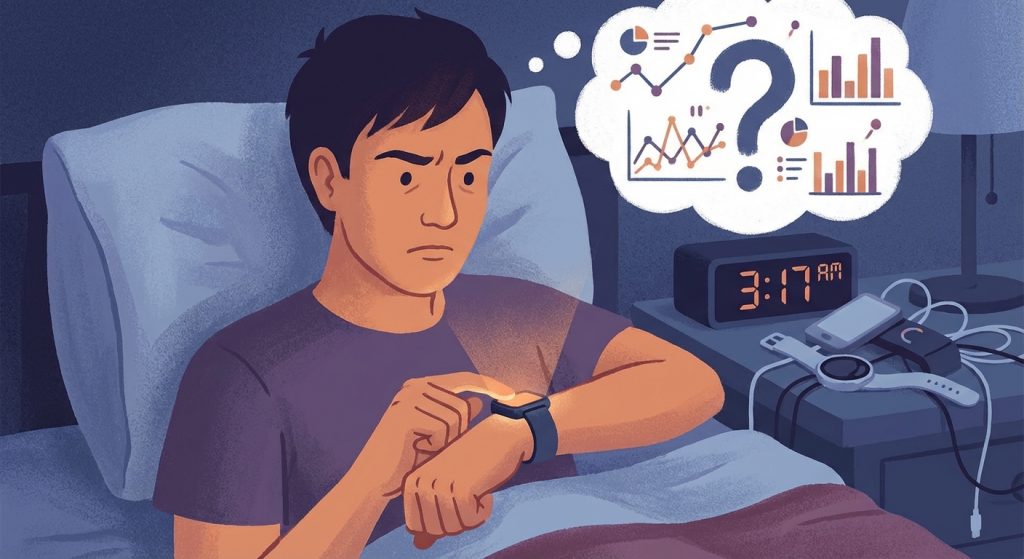
I remember the exact morning I realized my Apple Watch Ultra 2 was making me sick.
I had woken up feeling surprisingly refreshed. The sun was coming bleeding around the edges”, my mind felt clear, and for the first time in weeks, my shoulder (the one I usually jam into my Tempur Sonata) wasn’t throbbing. I sat up, stretched, and instinctively reached for my phone to sync my wearables.
I expected a “Crown.” I expected a Sleep Score in the 90s.
Instead, the screen flashed red: Sleep Score: 54. Readiness: Low. Restfulness: Pay Attention.
In a split second, my physical reality collapsed. The energy I felt five seconds ago evaporated. My brain immediately started scanning for symptoms to match the data. “Am I actually tired? Yes, my eyes do feel gritty. My focus is slipping. I must have had terrible micro-awakenings I didn’t notice.” I spent the rest of the day in a fog, drinking too much coffee, convinced I was running on empty.
I had “placebo’d” myself into exhaustion. Or, to be scientifically accurate, I had “nocebo’d” myself.
This is Orthosomnia. It is the obsessive quest for perfect sleep metrics that ironically destroys your ability to sleep. It is a phenomenon that has exploded by late 2025, affecting biohackers, insomniacs, and anyone who wears a computer on their wrist to bed.
If you find yourself dreading the morning sync, or if your mood for the day is dictated by an algorithm rather than your own body, you are likely suffering from sleep tracker anxiety. Here is what I learned about the trap of obsessing over sleep data, and how I climbed out of it without throwing my gadgets in the trash.
What Is Orthosomnia? (It’s Not Just In Your Head)
Strictly speaking, Orthosomnia is not yet an official diagnosis in the DSM-5, but it is a very real clinical phenomenon. The term was coined by researchers at Rush University Medical Center and Northwestern University to describe patients who were coming to sleep clinics with self-diagnosed disorders based on data from their fitness trackers.
By late 2025, the medical community has started taking this seriously. A scale for measuring orthosomnia was developed by Guldbrandsen and colleagues this year, finally giving us a way to quantify the psychological distress caused by our wearables. According to a 2024 survey referenced by the American Academy of Sleep Medicine (AASM), nearly 35% of Americans now use electronic sleep trackers, and a significant portion of them admit to changing their behavior based on the data—often not for the better.
The core of orthosomnia is sleep perfectionism. It is the belief that if you can just tweak your sleep hygiene checklist enough—adjust the temperature to exactly 18.3°C, tape your mouth, take the perfect dose of Magnesium L-Threonate, and block every photon of blue light—you will achieve a “perfect” sleep score.
When the data doesn’t match the effort, anxiety spikes. And since anxiety is the arch-enemy of sleep (driving up cortisol and heart rate), the next night’s sleep is actually worse. It is a self-sustaining loop of failure.
The Symptoms: Are You an Orthosomniac?
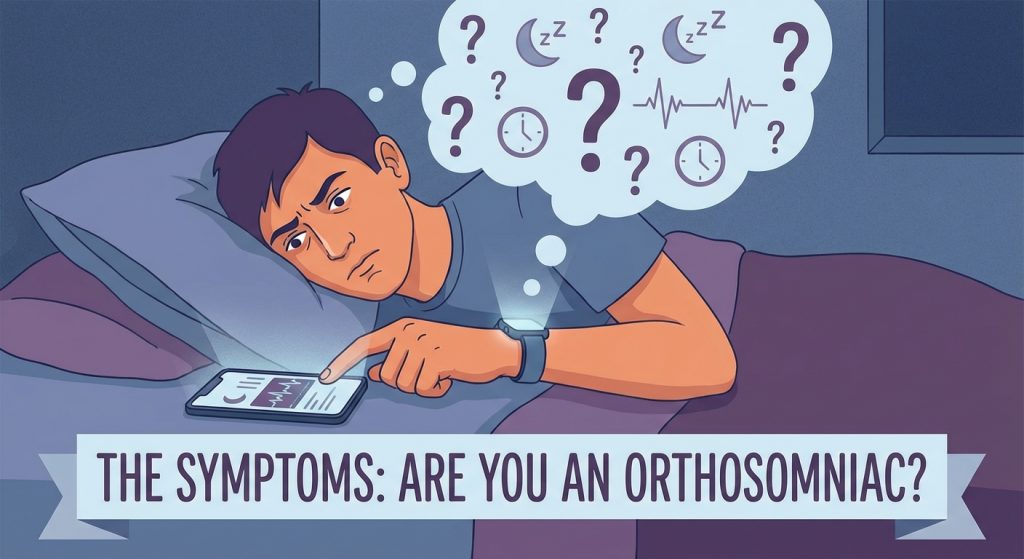
I didn’t think I had a problem. I thought I was just “optimizing.” But looking back at my behavior, and comparing it with the discussions on r/ouraring and r/whoop, the signs were obvious.
- The Morning Verdict: You check your sleep score before you even get out of bed. Your mood for the day is set by that number.
- The “Deep Sleep” Obsession: You fixate on specific stages. If your Apple Watch sleep tracking says you only got 15 minutes of NREM3, you panic about Alzheimer’s and brain detox, even if you slept 8 hours total.
- Metric Shopping: You wear multiple devices (like an Apple Watch and a Samsung Galaxy Ring) and choose to believe the one that gives you the higher score, while obsessing over why the other one is “wrong.”
- Rigidity: You refuse to go out for dinner or watch a movie because it might mess up your “Readiness” or “Recovery” score. You are engaging in what Harvard Health recently termed “sleepmaxxing”—where optimization turns into social isolation.
- The Phantom Problem: You feel fine physically, but the data says you slept poorly, so you assume the device knows something you don’t.
The Nocebo Effect: Why Data Can Make You Sick
To understand why this happens, we have to look at the “Nocebo Effect.” You probably know the Placebo Effect—where a sugar pill cures a headache because you believe it will. The Nocebo effect is the evil twin: negative expectations cause negative physiological results.
There was a landmark study titled “Placebo Sleep Affects Cognitive Functioning” (Draganich & Erdal) that perfectly illustrates this. Researchers hooked participants up to sensors and told them they were measuring sleep quality.
- Group A was told they had “above average” sleep quality (regardless of how they actually slept).
- Group B was told they had “below average” sleep quality.
The result? Group B performed significantly worse on cognitive tests the next day. They had slower reaction times and poorer math skills solely because they were told they slept poorly.
This is exactly what happens when we wake up to a low “Readiness” score. We internalize the data. We subconsciously tell our brain, “I am not recovered.” Our brain responds by downregulating our energy levels. This nocebo effect sleep cycle is dangerous because it overrides our interoception—our internal sense of how we actually feel.
In 2025, popular media outlets like TIME and The Guardian have started highlighting this trap, noting that for perfectionist personalities, the tracker becomes a source of tracking stress rather than a tool for health.
The Accuracy Trap: Why We Trust Flawed Algorithms
One of the biggest drivers of sleep tracker anxiety is the false belief that these devices are medical-grade instruments. We treat the Apple Watch or Whoop 4.0 sleep data as if it were a Polysomnography (PSG) report from a clinical lab.
It is not.
I follow The Quantified Scientist on YouTube religiously. His analysis, along with 2025 validation studies (like those by Robbins et al.), consistently shows that while devices like the Oura Ring Gen 4 and Apple Watch are getting better, they are still estimates. They are guessing your sleep stages based on movement, heart rate, and temperature. They do not read your brainwaves (EEG) like a Muse S Athena or a clinical sleep study would—and even the consumer EEG devices struggle with signal loss.
The “Deep Sleep” Panic
The most common thread I see on forums like r/sleep and r/AppleWatch is the panic over low Deep Sleep numbers.
“My watch says I only got 20 minutes of deep sleep! Am I developing dementia?”
Here is the reality I had to accept: Wrist-based trackers are notoriously bad at distinguishing between Light Sleep (NREM2) and Deep Sleep (NREM3). They often miscategorize “quiet” light sleep as deep sleep, or vice versa. If you are obsessing over sleep data regarding stages, you are likely stressing over a calculation error.
Furthermore, if you suffer from insomnia or sleep fragmentation, the algorithms often break down completely. They are trained on healthy sleepers. When I was waking up at 3 AM with a racing heart (my classic Tired But Wired phase), my trackers would often log me as “awake” for hours, or conversely, mistake my motionless lying in bed for sleep, giving me a wildly inaccurate picture.
Community Experiences: You Are Not Alone
In preparing this article and reflecting on my own journey, I dove back into the community discussions that have evolved over 2024 and 2025. The sentiment has shifted from “Look at my high score!” to “How do I stop caring about this score?”
The Reddit Rebellion
On r/ouraring, there is a recurring genre of posts where long-time users (2+ years) describe developing anxiety. One user described it perfectly: “I used to wake up and check the weather. Now I wake up and check if I’m allowed to feel good today.”
On r/AppleWatch, the confusion is technical. Users download third-party apps like Athlytic or AutoSleep, which use the same raw data from the watch sensors but apply different algorithms. The result? Apple Health says you slept 7 hours with 10% deep sleep. AutoSleep says you slept 7.5 hours with 40% deep sleep. Athlytic says your recovery is 30%.
This contradiction drives people mad. Which one is true? (Answer: Likely none of them are 100% true).
The “Sleepmaxxing” Backlash
A trend noted by Harvard Health in March 2025 is “sleepmaxxing”—the extreme biohacking of sleep. I’ve been there. I’ve taped my mouth, worn blue light blocking glasses (the red ones), slept on an earthing mat, and taken a cocktail of Liposomal Apigenin and L-Glycine.
While these interventions have merit (I still swear by Apigenin and my Tempur mattress), the mindset was toxic. I was treating sleep as a performance sport. If I woke up and the score was low, I felt like I had failed a test. This is the definition of orthosomnia symptoms.
The Cure: How to Stop Checking Sleep Score (The Detox Protocol)
I didn’t want to stop tracking completely. I love data. I wanted to use the data to spot trends (like how alcohol destroys my HRV or how late-night sugar spikes insulin and ruins sleep continuity), but I needed to break the emotional addiction.
Here is the protocol I developed, based on recommendations from Huberman Lab (who suggested checking metrics less frequently in a 2025 newsletter) and CBT-I (Cognitive Behavioral Therapy for Insomnia) principles.
Step 1: The “Feel First” Rule
This is non-negotiable. You are not allowed to look at your sleep data until you have been awake for at least 30 minutes.
During those 30 minutes, you must perform a subjective check-in.
- 1. Energy: How do I feel on a scale of 1-10?
- 2. Mood: Am I irritable or calm?
- 3. Body: Is my soreness gone? (For me, checking if my Tempur Sonata kept my neck aligned).
Only after you have locked in your subjective reality are you allowed to look at the screen. If I feel like an 8/10, but the Ring says 60%, I explicitly say out loud: “The algorithm is wrong today.” I refuse to let the nocebo effect override my biology.
Step 2: Hiding the Score
Many apps now allow you to customize the dashboard. I removed the “Sleep Score” and “Readiness Score” from the home screen of my apps. I dig for the raw data if I need it, but I don’t let a big red circle slap me in the face the moment I unlock my phone.
If your device doesn’t allow this, simply move the app off your main screen. Create friction.
Step 3: The 14-Day Detox (Blind Mode)
When my orthosomnia was at its peak—when I was lying in bed at 2 AM wondering how this awake time would impact my stats—I did a full detox.
I covered the sensors on my Withings Sleep Analyzer (or just stopped looking at the app). I kept wearing the ring (to keep the data continuity) but forced myself not to open the app for two weeks.
The first three days were terrifying. I felt like I was flying a plane without instruments. But by day four, a strange thing happened. I started sleeping better. The “performance anxiety” vanished. I wasn’t trying to “win” sleep anymore; I was just sleeping.
Step 4: Move to Weekly Trends
Data is useless in isolation. One bad night means nothing. A trend of 30 bad nights means something.
Now, I check my data deeply only once a week (usually Sunday morning). I look for patterns.
- Did my HRV drop every time I ate spicy food? (Reflux/GERD trigger).
- Did my Deep Sleep improve when I stuck to the morning sunlight protocol? (Check our article on how Circadian Rhythms work.)
- Did my latency improve when I used Magnesium L-Threonate?
This shifts the focus from judgment (“You are a bad sleeper”) to curiosity (“This variable affects my physiology”).
Step 5: Apply DIY CBT-I Logic
If you are staring at your tracker in the middle of the night, you are breaking the cardinal rule of CBT-I (Cognitive Behavioral Therapy for Insomnia): Stimulus Control.
The bed is for sleep and sex. It is not for analyzing graphs. If you are awake and frustrated, get out of bed. Do a non-stimulating activity (read a paper book, listen to Pink Noise). Do not check the time. Do not check the tracker.
The goal of CBT-I is to break the association between the bed and wakefulness. Sleep trackers often reinforce that association by making you hyper-aware of every minute you are awake.
When Tracking Is Actually Useful (The Middle Ground)
I don’t hate trackers. I still use my Apple Watch ultra 2 and I test new gear like the Samsung Galaxy Ring or Whoop 4.0 for this site. But I use them differently now.
They are excellent for:
- 1. Trend Analysis: Spotting long-term declines in HRV that might signal illness or overtraining.
- 2. Event Correlation: Proving to yourself that alcohol ruins your sleep (seeing the heart rate spike at 2 AM is a powerful deterrent).
- 3. Apnea/UARS Screening: Devices like the Wellue O2Ring are critical if you suspect oxygen drops. This isn’t about “optimization”; it’s about safety. If you see your SpO2 drop below 90%, that’s actionable medical data, not vanity metrics.
They are terrible for:
- 1. Micro-managing Stages: You cannot consciously control how much REM you get tonight. Worrying about it only reduces it.
- 2. Validation: You know if you slept well. You don’t need a machine to validate your fatigue or your energy.
The Role of Tech Companies (2025 Updates)
It is encouraging to see that companies are waking up to this. In June 2025, Oura published a blog specifically addressing orthosomnia, encouraging users to focus on “resilience” rather than daily perfection.
However, the marketing of these devices still relies on gamification. “Keep your streak alive!” “Reach your sleep goal!”
As a user, you must be smarter than the marketing. The device works for you; you do not work for the device.
Summary: Reclaiming Your Night
I created Night Time Comfort to help you navigate the confusing world of sleep health. I talk about liposomal apigenin, cooling duvets, and dietary supplements for sleep. These are tools.
But a sleep tracker is a unique kind of tool because it has the power to mess with your psychology.
If you find yourself stressing over the data, remember this: Humans slept successfully for 300,000 years without knowing their HRV or REM percentages. Your body knows how to sleep. Sometimes, the best thing you can do to fix your chronic insomnia is to stop measuring it.
Take the test: For the next three days, don’t look at your sleep score until noon. Ask yourself how you feel first. If the anxiety drops and the sleep improves, you have your answer. You don’t need a better tracker; you need a better relationship with it.

By: Alex Warenstein.
Bio: Alex Warenstein is a sleep biohacker and founder of Night Time Comfort. After battling chronic insomnia and circadian disruption, he now helps others optimize their sleep using data-driven protocols. Read full story.
Disclaimer: Alex is not a doctor. This content is for educational purposes only. Always consult a specialist.