If you have spent any time reading my articles, you know that I am skeptical of wrist-based sleep tracking. Devices like the Oura Ring Gen 4 or the Apple Watch are incredible feats of engineering, but they are essentially guessing. They look at your heart rate, your movement, and your temperature, and they use an algorithm to probability-match those metrics to sleep stages. For 90% of people, that is enough.
But I am not writing this for the 90%. I am writing this for the people who, like me, have stared at a “Deep Sleep” score of 15 minutes and wondered if it was real or just a sensor error. I am writing for those who suspect they have a sleep disorder that standard trackers simply cannot see.
Enter the Hypnodyne ZMax.
This is not a consumer toy. You will not find it at Best Buy. It does not have a friendly app that gives you a “Readiness Score” with a smiley face. The ZMax is a professional home EEG device designed for research. It is often cited by top data scientists in the biohacking community, such as The Quantified Scientist, as the reference device against which other trackers are tested.
I had the opportunity to test this unit extensively (borrowed from a professional colleague), and this article is a deep dive into what it actually takes to run a sleep lab from your own bedroom in late 2025.
What is the Hypnodyne ZMax?
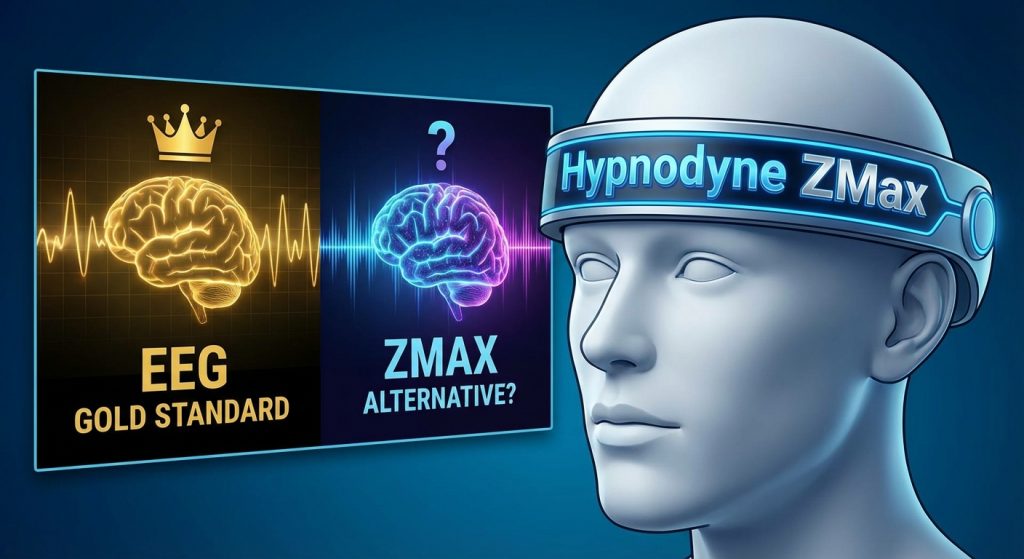
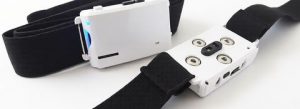
The ZMax is a wireless, headband-based electroencephalogram (EEG). Unlike the Muse S Athena (Gen 3), which tries to be a meditation aid first and a sleep tracker second, the ZMax has one singular purpose: acquiring clinical-grade brainwave data.
In a clinical Polysomnography (PSG), a technician glues electrodes all over your scalp (frontal, central, occipital), your chin (EMG for muscle tone), and near your eyes (EOG for eye movement). The ZMax simplifies this into a “Frontal Montage.” It uses two EEG channels located on your forehead (F7 and F8 positions roughly).
The “Wearable PSG” Claim
Can a headband really replace a hospital sleep study? The answer is nuanced. Because the ZMax lacks a chin EMG (which detects muscle paralysis during REM) and occipital electrodes (which are better at detecting the Alpha waves of relaxation), it is not a 1:1 replacement for a full diagnostic study.
However, for the purpose of sleep staging—determining if you are in Light (N1/N2), Deep Sleep (NREM3), or REM—it is lightyears ahead of any watch or ring. It measures the actual electrical activity of your brain (Delta, Theta, Alpha, Beta, Spindles, and K-Complexes). It doesn’t guess if you are asleep; it sees your brain shutting down.
The Hardware: Sensors and Comfort
The biggest barrier to medical grade EEG home tracking is usually the setup. The ZMax attempts to solve this with a unique sensor design.
The Electrodes: No Glue Required
Standard EEG requires abrasive skin prep and sticky conductive paste that takes 20 minutes to wash out of your hair. The ZMax uses proprietary “solid gel” electrodes. These look like small, rectangular pads that snap into the headband.
They are sticky, but not messy. They adhere to the skin on your forehead and behind your ears (mastoids) to create a circuit.
- The Prep: You absolutely must clean your forehead with alcohol wipes before applying. Any skin oil will destroy the signal quality (impedance).
- The Fit: The headband allows you to adjust the tension. It needs to be tight enough to keep the sensors pressed against the skin, but not so tight that it gives you a headache.
Is it Comfortable?
Compared to the Dreem 2 (which is now defunct for consumers) or the Philips SmartSleep, the ZMax is surprisingly low-profile. The electronics are housed in a small module at the front. It is lighter than it looks. However, you are still sleeping with a computer strapped to your head.
If you are a stomach sleeper, this device will likely be impossible to use. As a side sleeper, I found it manageable, though I had to be careful not to dislodge the sensors against my Cloudpilo.
Data Accuracy: The 2025 Verdict
This is the most critical section. How accurate is the ZMax HD compared to a hospital setup?
We have fresh data on this. A validation study published in late 2023 and further analyzed by the community in 2025 compared the ZMax against simultaneous Polysomnography.
The Scoring Problem
The ZMax hardware records the raw data, but you need software to interpret that data into a hypnogram (the chart showing your sleep stages). There are two main ways to do this, and the accuracy depends entirely on which one you choose.
- 1. ZLab (Proprietary Auto-Scorer): This is Hypnodyne’s native algorithm. Validation studies show it has an overall accuracy of roughly 70.5% compared to a human scorer. That is good, but not ground-breaking. It struggles specifically with distinguishing Light Sleep (N1) from Wakefulness.
- 2. Dreamento (Open Source): This is where the magic happens. Researchers developed an open-source toolbox called Dreamento specifically for the ZMax. When the ZMax data is run through the DreamentoScorer, the accuracy jumps to nearly 80%, with a Cohen’s Kappa (a statistical measure of reliability) of over 0.72.
What Does This Mean for You?
If you use the ZMax with the advanced, open-source software available in 2025, you are getting accurate sleep stages that rival many automated systems used in hospitals.
It excels at detecting Deep Sleep (Delta waves) and REM. Its “blind spot” is the transition from being awake to falling asleep (N1). Because it measures from the forehead, it sometimes misses the “Alpha rhythm” at the back of the head that signals you are relaxing with your eyes closed. Consequently, the ZMax might think you are in light sleep when you are actually just lying quietly awake. This is a known limitation of all frontal EEG devices.
The Software Ecosystem: Not for the Faint of Heart
I must emphasize this: The ZMax is a tool for researchers and serious biohackers. If you expect a seamless “App Store” experience, you will be disappointed.
HDRecorder
To record your sleep, you don’t use a phone app. You insert a microSD card into the headband (or stream via USB to a laptop, though that is impractical for sleep). In the morning, you take the card out, plug it into your computer, and use the HDRecorder software to extract the files.
Converting Data to a Hypnogram
Once you have the raw `.edf` files, you have a choice:
- 1. Paid Cloud Scoring: Hypnodyne offers a cloud service where you upload your file, and their server returns a scored hypnogram. It costs a small fee per upload (or a subscription). This is the easiest path.
- 2. The “Hacker” Path (Free): For the best accuracy (as mentioned above), you want to use Dreamento or YASA (Yet Another Spindle Algorithm). These are Python-based tools. You don’t need to be a master programmer, but you need to be comfortable installing Python and running scripts on your computer.
The community on Reddit and SleepHQ has created guides on how to do this. By using YASA or Dreamento, you can generate a professional-looking hypnogram for free, identifying exactly when your REM sleep occurred and calculating your sleep spindles—markers of neuroplasticity that no wrist tracker can see.
How to actually use it (The Protocol)
If you decide to buy a ZMax, your bedtime ritual will change. You cannot just jump in bed.
- 1. Scrub: You must scrub your forehead and mastoids (bone behind the ear) with an abrasive gel or alcohol. This lowers the electrical impedance.
- 2. Apply Sensors: You stick the conductive pads onto the headband. They are reusable for a few nights, but eventually, they lose stickiness and must be replaced.
- 3. Impedance Check: You turn the device on and check the LED indicators (or the PC software if connected via Bluetooth). You are looking for a “Green” signal on both channels. If it’s red, the data will be garbage (full of artifacts). You might need to press harder or clean your skin again.
- 4. Sleep: You press the button to start recording to the SD card.
- 5. Morning: You stop the recording, take off the band, and transfer the data.
It is a commitment. But the reward is seeing your actual brainwaves. You can zoom in and see a K-Complex. You can see the exact moment your brain switched from N2 to Deep Sleep. For me, seeing the raw data was the only way to cure my orthosomnia – the anxiety caused by wondering if my tracker was lying to me.
Comparison with Competitors
ZMax vs. Muse S (Gen 3)
- The Muse S Athena is the primary competitor in the consumer space. The Muse is softer, cheaper, and has a nice app. However, in my experience and the experience of many on the Biohackers subreddit, the Muse suffers from frequent signal loss. If the Muse slips 1mm on your pillow, you lose the data.
- The ZMax clamps harder and uses sticker-based sensors. The signal stability of the ZMax is superior. If you want meditation, get a Muse. If you want rigorous sleep data, get a ZMax.
ZMax vs. Dreem 2
The Dreem 2 was the king of consumer EEG, but the company pivoted to pharma and stopped selling to consumers years ago. You can buy used units on eBay, but the servers are often down, and the battery life degrades. The ZMax is currently the only supported, new-in-box alternative that offers raw data access.
Who is this for?
- The Data Analyst: You know what Python is, and you want to run correlations between your Glycine intake and your Sleep Spindle density.
- The “Orphaned” Patient: You suspect you have UARS or strange arousal patterns, but your doctor dismisses you. The ZMax can show you “micro-arousals” in the EEG trace that don’t show up on a pulse oximeter like the Wellue O2Ring.
- The Optimizer: You are following a protocol like Bryan Johnson’s Blueprint and need to verify if your 20 minutes of Deep Sleep is a measurement error or a physiological reality.
It is not for someone who just wants a simple “Good Morning” score.
My Personal Review
Rating: 9/10
This review is based on a loaner unit I used courtesy of a colleague who works in neurofeedback research. I do not own a unit personally due to the cost.
- I have tested almost every sleep gadget on the market, from the Oura Ring to the Withings Sleep Analyzer. The Hypnodyne ZMax is in a different league entirely. It is intimidating. The first night I used it, I spent 20 minutes just trying to get the impedance lights to turn green. I had to scrub my forehead until it was red.
- But the next morning, looking at the data was a revelation. For the first time, I wasn’t looking at a probability graph. I was looking at my brain.
- I uploaded the data to the official cloud scorer (my friend had credits). The hypnogram was distinctly different from my Apple Watch. The ZMax showed I had significantly more Deep Sleep than my watch claimed—about 1 hour and 15 minutes, versus the 20 minutes my watch usually reported. This was a massive relief. It confirmed that my wrist tracker was failing to detect deep sleep because of my low resting heart rate or movement patterns, not because my brain wasn’t recovering.
- However, the user experience is “research-grade.” That means clunky. You have to deal with SD cards, files, and sticky pads. It is not comfortable to wear every night. I found it pressed on my temples after 6 hours.
- My Verdict: It is an incredible tool for a “check-up.” I would use this for one week every few months to benchmark my stack or test a new supplement like Liposomal Apigenin. But as a daily tracker? It’s too much work for me. I prefer the “set and forget” nature of the Samsung Galaxy Ring for daily trends, even if it is less accurate.
If you are a biohacker who demands truth over convenience, this is the only game in town.
Buying Information
The Hypnodyne ZMax is available directly from the manufacturer. It requires purchasing the headset and a pack of sensor pads.
Summary
The Hypnodyne ZMax is the closest you can get to a Polysomnography at home without hiring a technician. It offers validated, medical-grade EEG data that exposes the limitations of wrist-based trackers. While the learning curve is steep and the software requires some technical literacy (especially if you want to use the superior open-source Dreamento scoring), the insights it provides are unmatched.
It is particularly valuable for identifying Deep Sleep deficits and visualizing sleep architecture that other devices miss. If you are tired of guessing and ready to deal with electrodes and raw data, the ZMax is the gold standard alternative for 2025. Just be prepared to scrub your forehead.
References & Further Reading
Validation of the sleep EEG headband ZMax (2023/2024 Analysis) – ResearchGate |
Deep Sleep vs. REM: How to Read Your Hypnogram |
Polysomnography vs. Home Tests: What to Expect

By: Alex Warenstein.
Bio: Alex Warenstein is a sleep biohacker and founder of Night Time Comfort. After battling chronic insomnia and circadian disruption, he now helps others optimize their sleep using data-driven protocols. Read full story.
Disclaimer: Alex is not a doctor. This content is for educational purposes only. Always consult a specialist.