If you are reading this, I know exactly where you are right now. It is probably 3:14 AM. You are staring at the ceiling, or perhaps you are looking at your phone with the brightness turned all the way down. Your body is exhausted, heavy, and pleading for rest. But your mind? Your mind is running a marathon. If this is happening often, the plain-language overview from MedlinePlus is a useful baseline for what people typically mean by “insomnia.”
I have been there countless times. I would look at my Apple Watch Ultra 2 in the dark and see my heart rate sitting at 85 or 90 BPM. It wasn’t a panic attack; it was just a low-level, buzzing anxiety—a physiological refusal to shut down. I call this the “Tired but Wired” state.
For years, I thought the solution was just finding the right pill or the perfect mattress. I spent a fortune on gadgets and supplements.
But I learned the hard way that when your nervous system is still stuck in “fight-or-flight” mode, no single tool—sleep routine, mattress, or even staples like Magnesium L-Threonate or Apigenin—works reliably every time on its own. What tends to help more is pairing anything you already use with a simple “downshift” ritual that nudges you toward parasympathetic (“rest and digest”) mode.
In this article, I am going to share breathing protocols and cognitive tricks that I’ve personally found useful, plus patterns I keep seeing across sleep communities. And for chronic insomnia specifically, behavioral approaches like CBT-I and relaxation training are widely summarized as first-line options in clinical guidance (see PubMed Central).
We start with the most famous one, but as you will see in my ranking below, it might not be the best one for you.
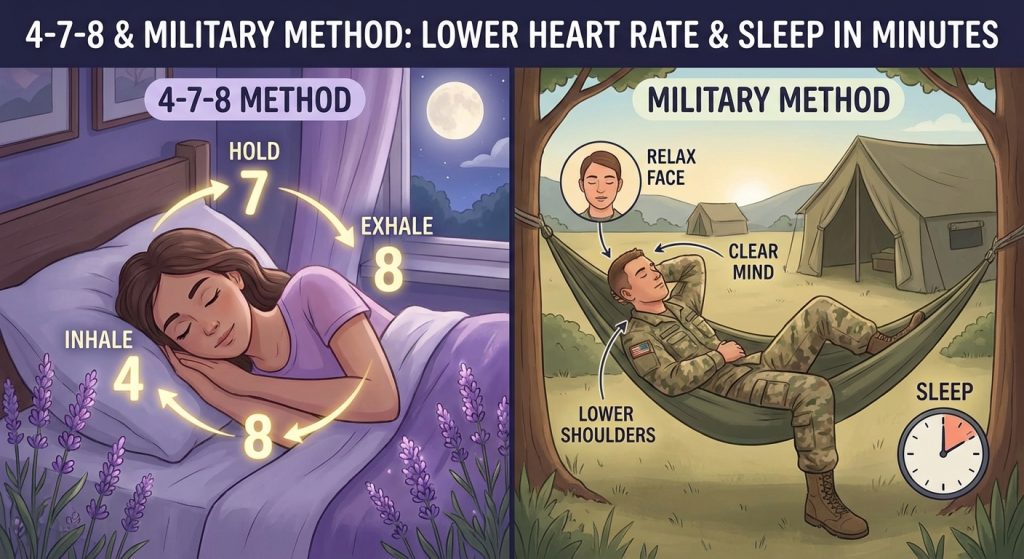
The 4-7-8 Breathing Technique: The “Tranquilizer”
This is one of the most commonly suggested wind-down breathing patterns; the core idea is simply slowing the breath and keeping the exhale unforced and longer—very similar to the basic stress-breathing drills described by the NHS.
How It Works (The Science)
The magic of 4-7-8 isn’t the counting; it’s the ratio. Specifically, the long exhalation. When you inhale, your diaphragm moves down and your heart rate slightly increases (this is called Respiratory Sinus Arrhythmia). When you exhale—especially with a longer, comfortable exhale—parasympathetic (vagal) activity tends to increase, and heart rate often drifts down. The counting mostly helps you keep that exhale longer than the inhale without overthinking it.
The Protocol
- 1. Position: Lie comfortably on your back. Place the tip of your tongue against the ridge of tissue just behind your upper front teeth. Keep it there.
- 2. Exhale: Let all the air out of your lungs through your mouth with a whoosh sound.
- 3. Inhale (4 seconds): Close your mouth and inhale quietly through your nose to a mental count of 4.
- 4. Hold (7 seconds): Hold your breath for a count of 7.
- 5. Exhale (8 seconds): Exhale completely through your mouth, making a whoosh sound to a count of 8.
- 6. Repeat: Do this cycle for a total of 4 breaths.
Alex’s Experience & Community Feedback
Does it work? Yes, but with a major caveat.
When I first tried this, I hated it. The 7-second hold felt like torture. Instead of relaxing, I felt “air hunger” (the desperate need to breathe). My heart rate would actually spike on the Apple Watch during the hold because I was panicking about not breathing.
I am not alone in this. Digging through Reddit threads from 2024 and 2025, a distinct pattern emerges. The reactions are genuinely split: some people swear by the structure, while others find the breath retention activating and distracting.
My Advice: If the breath-hold feels comfortable, 4-7-8 can be a solid nightly ritual. If the hold makes you tense, shorten it (for example, 4-4-6) or move to the no-hold methods lower in this list—relaxation should feel easier, not harder.
The Real-World Ranking: What Actually Works (Beyond 4-7-8)
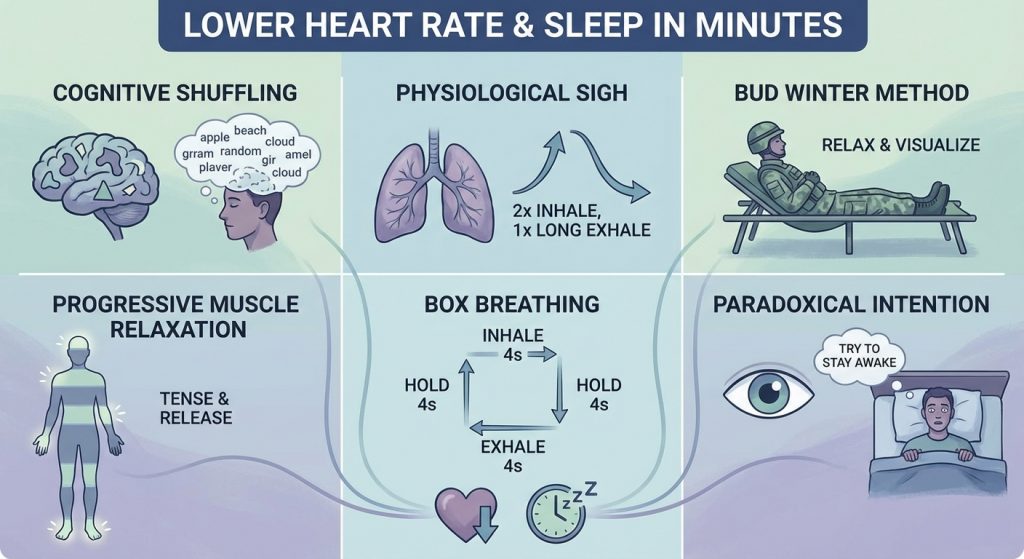
While 4-7-8 is the most famous, it is not necessarily the most effective for the “monkey mind“—that state where your brain is replaying an embarrassing conversation from 2008 or worrying about a meeting tomorrow.
Based on my testing, data from the Quantified Scientist, and consensus from thousands of user comments on sleep forums, here is the hierarchy of manual sleep induction methods.
Top 1. Cognitive Shuffling (The “Brain Scrambler”)
This is, without a doubt, the most effective method I have ever found for shutting off a racing mind. It was developed by Luc Beaudoin, a cognitive scientist at Simon Fraser University.
The Problem: You cannot “force” yourself to sleep. Sleep is a passive process. When you are lying in bed thinking, “I need to sleep, I have work tomorrow,” your brain remains in “sense-making” mode. It is analyzing, planning, and problem-solving. This is hyper-arousal.
The Solution: Cognitive Shuffling forces your brain into “micro-dreams” or random associations, mimicking the onset of sleep. It jams the “sense-making” machinery so your brain thinks, “Oh, we are thinking nonsense? We must be falling asleep.”
How To Do It (DIY Version)
You don’t need an app for this, though apps like mySleepButton exist. Here is the analog method that saved my sanity:
- 1. Pick a Seed Word: Choose a neutral, emotionally empty word with at least 5 letters. Let’s say: BEDTIME.
- 2. Spell it out: Start with the first letter, B.
- 3. Visualize: Think of words that start with B and visualize them for a few seconds each.
- Ball (See a bouncing ball)
- Bat (See a baseball bat)
- Bear (See a brown bear)
- Bus (See a yellow bus)
- 4. Move on: When you run out of B words, move to the next letter, E.
- Elephant
- Egg
- Ear
- 5. The Rule: Do not create a story. The bear shouldn’t get on the bus. The images must be random, disconnected, and unlinked.
- 6. Repeat: Continue through the letters D-T-I-M-E.
Why it works: It occupies the verbal part of your brain (so you can’t worry) and the visual part of your brain (creating images). It uses up just enough cognitive energy to prevent looping thoughts, but not enough to keep you awake.
Alex’s Take: I rarely make it past the third letter of the seed word. This method is superior to breathing techniques if your primary issue is psychological anxiety or ruminating thoughts rather than physical heart racing.
Top 2. The Physiological Sigh (The “Panic Button”)
If 4-7-8 is a daily vitamin, the Physiological Sigh is the emergency brake. This pattern—often described as “cyclic sighing”—is basically an emergency brake for the body’s stress gear. It’s been discussed in mainstream research coverage, including a Stanford Medicine write-up on breathing drills and downshifting anxiety.
The Mechanism: The first deep inhale plus a short “top-up” inhale can help re-inflate under-ventilated parts of the lungs, and the long exhale helps offload carbon dioxide. For many people, that combination quickly reduces the “wired” body feeling.
How To Do It
- 1. Double Inhale: Inhale deeply through your nose. Then, when you think your lungs are full, take a second, sharp, shorter inhale on top of it. You are trying to maximally inflate the lungs.
- 2. Long Exhale: Exhale slowly and fully through your mouth (or nose, though mouth is often easier for dumping CO2) until your lungs are completely empty.
- 3. Repeat: Do this just 2 or 3 times.
Community Feedback: On r/Anxiety and sleep forums, this is consistently rated as the best method for “acute” onset insomnia—that moment when you lie down and your heart starts pounding for no reason. It doesn’t require the mental discipline of 4-7-8; it is purely mechanical.
Alex’s Data: I have tested this while watching my Apple Watch Ultra 2. I can drop my heart rate from 88 BPM to 74 BPM within 45 seconds using this method. It is highly effective for physical de-escalation.
Top 3. The Military Sleep Method (Bud Winter)
You have probably seen this on TikTok or YouTube titled “How to sleep in 2 minutes like a Navy SEAL.” The reality is a bit more nuanced. This method comes from the book Relax and Win: Championship Performance by Lloyd Bud Winter, originally designed to help WWII pilots sleep in noisy, stressful conditions so they wouldn’t crash due to fatigue.
The Reality Check: It is NOT a magic trick that works instantly the first night. Most versions that trace back to Bud Winter emphasize practice—think weeks of repetition, not one attempt. People try it once, fail, and call it a scam, but it behaves more like a learnable skill than a one-shot hack.
The Protocol
- 1. The Face: Close your eyes. Relax your entire face. This is critical. Relax your forehead (smooth it out). Relax your eyes (let them sink into the sockets). Relax your jaw (unclench). Relax your tongue (let it fall from the roof of the mouth).
- 2. The Shoulders: Drop your shoulders as low as they can go. Let them “fall” into the mattress. Let your arms hang loose by your sides. Imagine they are dead weight.
- 3. The Breath: Exhale, relaxing your chest.
- 4. The Legs: Relax your thighs, then your calves, then your ankles and feet. Imagine them sinking into the bed.
- 5. The Mind (10 Seconds): Now that you are a physical noodle, you must clear your mind. Winter suggests holding one of these three images:
- Lying in a canoe on a calm lake with nothing but blue sky above you.
- Snuggled in a black velvet hammock in a pitch-black room.
- Repeating “Don’t think, don’t think, don’t think” to yourself for 10 seconds.
Why it works: It combines Progressive Muscle Relaxation (PMR) with visualization. By systematically removing tension from the face and jaw (where we hold enormous amounts of stress), you send a feedback signal to the brain that it is safe to sleep.
Alex’s Take: I use a modified version of this. I focus heavily on the jaw and tongue. If you suffer from bruxism (grinding teeth) or TMJ, this step alone can save your sleep.
Top 4. Progressive Muscle Relaxation (PMR) & The Body Scan
If the Military Method feels too rigid, PMR is the broader medical alternative. This is one of the most researched relaxation techniques in clinical psychology.
The Concept: You cannot be mentally anxious if your body is physically relaxed. It’s hard to stay in full fight-or-flight while you are deliberately relaxing muscle groups on purpose—PMR uses that body-to-brain feedback loop. PMR involves tensing a muscle group hard, and then releasing it to feel the contrast.
The Protocol
- 1. Start at your toes. Curl them tight for 5 seconds.
- 2. Release suddenly. Feel the tension drain away for 10 seconds.
- 3. Move to your calves. Tense, then release.
- 4. Thighs. Buttocks. Stomach. Hands. Arms. Shoulders. Face.
User Experience: Many users on ApneaBoard who struggle with mask discomfort find this helps them tolerate the CPAP machine. By focusing on the body sensation, you stop focusing on the plastic on your face.
Top 5. Box Breathing (Tactical Breathing)
This technique is often used by law enforcement and Navy SEALs for focus and composure in high-stress situations. While it is excellent for calming anxiety during the day, I find it ranks lower for sleep specifically.
The Protocol
- 1. Inhale for 4 seconds.
- 2. Hold for 4 seconds.
- 3. Exhale for 4 seconds.
- 4. Hold (lungs empty) for 4 seconds.
The Problem for Sleep: That final hold—holding your breath with empty lungs—can be alerting for some people. It requires effort. Sleep requires the absence of effort. While it stabilizes the nervous system, it doesn’t necessarily induce the “hypnagogic” state we want for sleep.
Modification: If you use this for sleep, I recommend removing the empty-lung hold. Do a 4-4-6 pattern instead (Inhale 4, Hold 4, Exhale 6).
Top 6. Paradoxical Intention
This is a psychological biohack for those who suffer from “sleep performance anxiety”—the fear that “if I don’t sleep now, I will be wrecked tomorrow.”
The Method: Instead of trying to sleep, try to stay awake.
Lie in bed with your eyes gently open. Tell yourself, “I am going to just rest here and stay awake for a while. I am just going to enjoy the comfort of the mattress.”
Why it works: It removes the pressure. The anxiety about not sleeping is often what keeps you awake. By giving yourself permission to stay awake, the anxiety dissipates, your heart rate lowers, and ironically, you fall asleep.
2. Advanced Protocol: The “Manual Shutdown” Stack
If you have had a terrible day, high cortisol, or you accidentally drank coffee too late (check my Caffeine Half-Life Calculator article to avoid this next time), using just one method might not be enough.
Here is the “Stack” I use when I am in the red zone (Heart Rate > 80 BPM in bed).
- Step 1: The Physiology Reset (1 Minute)
- Sit on the edge of the bed or lie down. Perform 3 rounds of the Physiological Sigh.
- Goal: Dump CO2, mechanically open the lungs, signal safety to the brain.
- Step 2: The Body Shutdown (2 Minutes)
- Lie down. Do a quick Military Method scan.
- Relax the jaw.
- Drop the shoulders.
- Unclench the glutes.
- Goal: Remove physical tension signals.
- Step 3: The Brain Scramble (Until Sleep)
- Transition immediately into Cognitive Shuffling.
- “A… Apple, Ant, Anchor…”
- “B… Ball, Bread, Basket…”
- Goal: Occupy the Default Mode Network of the brain to prevent rumination.
This sequence addresses the three pillars of wakefulness: Chemical (CO2/Oxygen), Physical (Muscle Tension), and Mental (Rumination).
3. The “Cold Water” Emergency Trick (The Diving Reflex)
There is one more method that deserves mention, though it requires getting out of bed. It stimulates the Mammalian Diving Reflex.
If you are in that “adrenaline surge” moment—heart racing, body buzzing—and you need a hard pattern break, some clinicians describe a simple “diving reflex” style maneuver (see Cleveland Clinic):
- Get up.
- Run cool-to-cold water.
- Splash your face and hold a cold pack against the cheeks/around the eyes for 10–20 seconds.
- Then return to slow, comfortable exhalations for a minute.
The Science: Cold stimulation around the face can trigger reflex pathways that often slow heart rate and help shift the body toward calm.
More specifically, cold stimulation around the eyes can activate the mammalian diving reflex, which can lower heart rate to conserve oxygen. It is an evolutionary holdover from when we were aquatic ancestors. It physically forces your heart rate down.
I have used this twice in the last five years. It is unpleasant, but it is effectively a “hard reboot” for your nervous system.
4. Why Breathing Might Not Be Working For You
If you have tried 4-7-8 and Box Breathing and you are still awake, we need to look at the hardware, not just the software.
1. Airway Restriction (UARS/Apnea)
If you have Upper Airway Resistance Syndrome (UARS) or sleep apnea (or you strongly suspect it), slower breathing can feel unsettling because airflow may be limited when throat muscles relax. In that scenario, your brain can respond with a jolt of alertness to keep breathing steady—so the issue is less “software” and more “airflow mechanics.”
Check: Do you wake up with a dry mouth? Do you have forward head posture? Check my article on O2Ring Data Analysis to see if your oxygen is dropping.
2. The Magnesium Deficiency
Magnesium is involved in normal nerve and muscle function, and a lot of people experiment with it as part of a wind-down routine—especially if nighttime tension, twitchiness, or cramps are part of their pattern. I personally use Magnesium L-Threonate as my go-to option, but I treat it as “support,” not a guaranteed on/off switch. See my review on the Core Stack for details.
3. The Blue Light Factor
You can breathe like a zen master, but if you blasted your retinas with blue light from your phone 5 minutes ago, your melatonin is suppressed.
Check: Ensure you are using Blue Light Blocking Glasses at least 2 hours before bed.
4. Orthosomnia (The Tracker Trap)
Are you checking your Apple Watch or Oura Ring gen 4 or Whoop 4.0 every time you finish a breathing cycle to see if it worked?
This pattern even has a name—“https://www.nighttimecomfort.com/orthosomnia/”>orthosomnia,” a term coined in the Journal of Clinical Sleep Medicine.
The more you audit each breathing cycle in real time, the more you train your brain that bedtime is a performance.
Rule: Once the lights are out, do not look at the watch. Use the data the next morning, never in the moment.
Summary
We often treat sleep as something that just “happens” to us. But when you are a modern human, surrounded by artificial light, high stress, and endless dopamine loops, the natural transition to sleep is broken.
You have to build a bridge between the chaos of the day and the stillness of the night.
- For the Panic Attack / High Heart Rate: Use the Physiological Sigh.
- For the “Busy Brain” / Rumination: Use Cognitive Shuffling.
- For the Tense Body: Use the Military Method / PMR.
- For the Daily Maintenance: Use 4-7-8 (if you can tolerate the hold).
These tools are free. They are always with you. And unlike a glass of wine or a sleeping pill, they actually restore your body rather than just knocking you out.
Give the Cognitive Shuffle a try tonight. Just don’t let the bear get on the bus.

By: Alex Warenstein.
Bio: Alex Warenstein is a sleep biohacker and founder of Night Time Comfort. After battling chronic insomnia and circadian disruption, he now helps others optimize their sleep using data-driven protocols. Read full story.
Disclaimer: Alex is not a doctor. This content is for educational purposes only. Always consult a specialist.