If you have read my story, you know that I have spent the better part of the last few years waging a war against insomnia. I have strapped almost every sensor imaginable to my body—from the Wellue O2Ring on my thumb to the Apple Watch on my wrist, and even EEG headbands on my forehead. I do this because I believe you cannot manage what you do not measure.
For a long time, the “smart ring” market was a monopoly dominated by Oura. But in 2025, the landscape shifted. The Samsung Galaxy Ring arrived, promising to be the ultimate android smart ring solution—a subscription-free, titanium-clad answer to our sleep tracking prayers.
I bought one immediately. As a man who values data but hates the feeling of a bulky watch pressing into his wrist while trying to side-sleep, the appeal was obvious. But after weeks of testing, comparing it against my reference devices, and diving deep into the scientific data, the question remains: is this the tool that will finally help you fix your circadian rhythms, or is it just another piece of jewelry?
This is my honest Samsung Galaxy Ring review. I am not a tech influencer paid to hype products. I am a 47-year-old man who just wants to wake up feeling rested.
The Form Factor: Why We Want This to Work
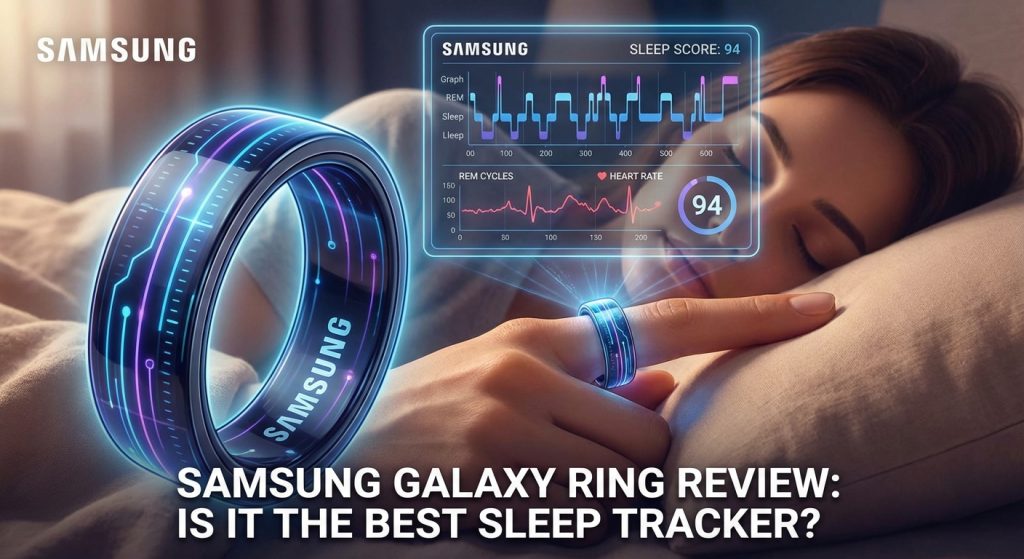
Before we dive into the data, we have to acknowledge why this product exists. Sleeping with a watch is annoying. Even my Apple Watch Ultra 2, which offers the gold standard in wrist-based tracking, can be intrusive. If you sleep with your hand under your pillow, a watch digs into your face. If you move around, the screen might light up (unless in theater mode).
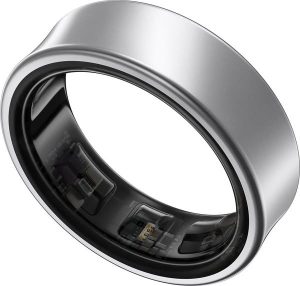
The Samsung Galaxy Ring solves the physical problem of sleep tracking beautifully. It is concave, lightweight (titanium), and comfortable. It comes in a distinct charging case that looks like a jewelry box. For a person suffering from chronic insomnia, removing physical irritants is step one in the sleep hygiene checklist.
However, comfort is useless if the data is wrong. If a device tells me I had an hour of deep sleep when I actually stared at the ceiling for forty minutes, it is not a tool; it is a hallucination.
The Technology: What Is It Actually Measuring?
To understand if the Samsung sleep tracker capabilities are accurate, we need to look at the sensors. The ring uses optical sensors (PPG – photoplethysmography) to measure blood volume changes in your finger. From this, it derives:
- Heart Rate (HR): How fast your heart is beating.
- Heart Rate Variability (HRV): The variation between beats (a key metric for stress and recovery).
- Blood Oxygen (SpO2): Estimates of oxygen saturation.
- Movement (Accelerometers): Tossing and turning.
- Skin Temperature: Variations in surface temp.
The ring sends this data to the Samsung Health app via Bluetooth. Unlike Oura Ring gen 4, there is no monthly subscription fee. You buy the hardware, you own the data. This is a massive plus for the Samsung Galaxy Ring.
But here is the catch: The finger is a great place to measure heart rate because the arteries are close to the surface. However, accurate sleep staging (determining if you are in REM, Light, or Deep sleep) requires incredibly complex algorithms to interpret those optical signals.
Deep Dive: Sleep Tracking Accuracy
This is the most critical section for us. You are likely here because you wake up tired, or perhaps you are worried about sleep apnea or UARS.
Sleep Stages and The Hypnogram
The “hypnogram” is that colorful chart that shows your journey through the night: Awake, REM, Light, and Deep (NREM3).
In my testing, and according to the most recent data available in late 2025, the Samsung Galaxy Ring struggles here.
When I compare the Samsung hypnogram to the Apple Watch sleep tracking accuracy (which currently has a high correlation with clinical Polysomnography, or PSG), the Samsung ring often “smooths out” the night. It tends to miss micro-awakenings—those brief moments where you wake up, adjust the blanket, and fall back asleep. For a healthy person, this doesn’t matter. But for someone with sleep maintenance insomnia or fragmented sleep, seeing those awakenings is vital to understanding your problem.
Independent analysis from trusted sources like The Quantified Scientist and various sleep lab comparisons suggests that the Galaxy Ring has a harder time distinguishing between REM and Light sleep compared to the Oura Ring Gen 4.
There is a phenomenon I noticed where the ring would credit me with deep sleep early in the night when I knew for a fact I was still reading or lying awake trying to calm my racing mind. This is a common issue with wrist and finger-based wearables that rely heavily on low heart rate to guess sleep stages. If your heart rate drops while you are reading in bed, the Samsung Ring might think you are in NREM3.
Blood Oxygen (SpO2) and Apnea Detection
If you suspect you have Sleep Apnea or Upper Airway Resistance Syndrome (UARS), you are looking for drops in oxygen (desaturations).
The Galaxy Ring does measure SpO2 during sleep. However, the sampling frequency is the issue. Unlike the Wellue O2Ring, which captures data every second (or every 4 seconds depending on the mode) specifically to catch rapid drops, the Galaxy Ring samples less frequently to save battery.
In my experience, the SpO2 data from the Samsung Ring is “smoothed.” It gives you a general average. If you have severe apnea with massive drops, it might catch it. But for UARS, where the drops are subtle (often not triggering a full 4% desaturation but still causing a cortisol spike), the Galaxy Ring is not sensitive enough.
Important Note: Do not use the Galaxy Ring to diagnose a medical condition. If you need to know if your airway is collapsing, you need a dedicated Home Sleep Apnea Test or at least a high-frequency pulse oximeter like the O2Ring.
Heart Rate and HRV
Here, the ring performs better. The heart rate tracking during sleep generally aligns well with chest straps and the Apple Watch. The Resting Heart Rate (RHR) trends are accurate.
This is useful for tracking metabolic health. For example, if you eat a heavy meal or drink alcohol before bed, you will see your RHR spike on the Samsung app just as you would on other devices. It is a reliable tool for seeing how lifestyle choices—like taking Magnesium L-Threonate or practicing Yoga Nidra – affect your baseline physiology.
Battery Life: The “Up to 7 Days” Myth
One of the main selling points of the android smart ring ecosystem is battery life. Samsung claims up to 7 days.
In reality, if you want high-quality sleep tracking, you will not get 7 days. When you enable all the advanced features—continuous SpO2 monitoring, skin temperature sensing, and frequent heart rate checks—the Galaxy ring battery drains much faster.
In my testing (Size 12 ring), I was getting about 4 days. This is still respectable, especially compared to the Apple Watch which needs daily charging (or every 2 days for the Ultra). But do not expect to go a full week without the charger if you are a power user who wants every data point.
The charging case is excellent, though. It holds extra charges and is easy to travel with, which makes managing the battery anxiety much easier than with proprietary watch cables.
The Samsung Ecosystem Requirement
This is a major friction point. While the ring works with other Android phones, it is heavily optimized for Samsung Galaxy devices.
Some features, particularly those involving AI analysis of your sleep and “Energy Scores” (which combine sleep, activity, and HRV), work best or exclusively when paired with a Samsung phone. If you are a Pixel or OnePlus user, you might find the experience slightly more disjointed. If you have an iPhone, this device is essentially a paperweight—it is not compatible with iOS at all.
This is a strategic move by Samsung, but for the consumer, it is limiting. In contrast, Oura works seamlessly across both Android and iOS.
Comparison: Samsung Galaxy Ring vs. The Competitors
To understand if this is the right choice for you, we have to look at the alternatives.
vs. Oura Ring Gen 4
The Oura competitor narrative is strong here.
- Accuracy: Oura Gen 4 (and even Gen 3) currently has a stronger scientific backing for sleep staging accuracy (Kappa scores around 0.65 vs PSG in some studies). Oura’s algorithm has had years of refinement.
- Cost: Samsung wins. You pay once. Oura requires a monthly subscription (roughly $6/month) to see your data. Over 3 years, Oura becomes significantly more expensive.
- Comfort: Both are excellent and titanium.
- Verdict: If money is no object and data accuracy is paramount, Oura still holds the edge in 2025. If you hate subscriptions, Samsung is the only viable alternative.
vs. Apple Watch 11 (or Ultra 2)
- Accuracy: The Apple Watch is currently the king of consumer sleep tracking. Its correlation with PSG is the highest among non-EEG devices. It captures wake/sleep transitions much better than the Galaxy Ring.
- Comfort: The Ring wins effortlessly.
- Data Density: The Apple Watch captures way more data points.
- Verdict: If you can tolerate sleeping with a watch, the Apple Watch gives better data. If you cannot, the Ring is a compromise on accuracy for the sake of comfort.
vs. Whoop 4.0
- Accuracy: Whoop is fantastic for “Strain” and cardiovascular load, but its sleep staging (specifically differentiating Light vs. REM) has historically lagged behind Apple and Oura. Recent peer reviews place its Kappa score lower than the leaders.
- Form Factor: Whoop is a strap (wrist or bicep). It has no screen.
- Cost: Whoop is purely subscription-based. You never own the device; you rent the service.
- Verdict: Whoop is for athletes who want to know how hard to train. Samsung Ring is for general health tracking.
What The Community Says (Reddit & Forums)
I spend hours every week on the Biohackers subreddit, SleepHQ, and specialized forums to see what real users are experiencing. I look for patterns, not just individual complaints. Here is the consensus on the Samsung Galaxy Ring as of late 2025:
The Positive Consensus:
- 1. “Finally, no subscription!” This is the single most praised feature. Users are tired of renting their hardware features.
- 2. Comfort: Users almost universally agree it is more comfortable than any smartwatch. Many people who gave up on sleep tracking because of bulky watches have returned to it because of the Ring.
- 3. Charging Case: The design of the case is frequently cited as superior to Oura’s simple dock.
The Negative Consensus (The “Mixed Bag”):
- 1. “Ghost Sleep”: A frequent complaint on Reddit is the ring recording sleep when the user is simply relaxing, watching TV, or reading. This skews the “Sleep Score” to be artificially high.
- 2. Step Counting: While not sleep-related, many users note that the ring counts hand movements (like typing or washing dishes) as steps, leading to inflated activity numbers that mess up the “Energy Score.”
- 3. Data Sync: Non-Samsung phone users often report connection drops or delays in syncing data to the Samsung Health app.
- 4. Scratches: The finish, particularly on the darker colors, is prone to scratching. Users recommend the silver or gold finish for longevity.
Scientific Community Input:
Reviews from data-driven sources like The Quantified Scientist highlight that while the heart rate tracking is solid, the sleep stage categorization is mediocre. The correlation with professional EEG equipment is not as tight as with the Apple Watch. The general sentiment is that Samsung hardware is excellent, but the sleep algorithm needs a “Gen 2” software update to truly compete with Oura’s precision.
Using Raw Data: Android Apps
One of the hidden powers of the Android ecosystem is flexibility. If you are dissatisfied with the Samsung Health sleep analysis, can you use the raw data?
Yes, to an extent. The app Sleep As Android—a legendary tool in the sleep community—supports integration with Samsung wearables. This allows you to use the Galaxy Ring’s sensors but process the data through Sleep As Android’s algorithms, which many biohackers find to be more customizable and transparent. This effectively bypasses some of Samsung’s native smoothing, giving you a more granular look at your night, although it requires a bit of technical setup.
Does It Help You Fix Your Sleep?
This is the ultimate question. A tracker is only useful if it changes your behavior.
The Samsung Galaxy Ring provides an “Energy Score” which simplifies your data into a “Go” or “Rest” recommendation. For the average person (35+), this is helpful. It tells you, “Hey, you slept poorly, maybe don’t do a HIIT workout today.”
However, if you are trying to biohack a specific problem—like waking up at 4 AM or figuring out if Ashwagandha KSM-66 is causing you to have fragmented REM sleep—the data might be too “noisy” to give you a clear answer. The margin of error in the sleep staging means you might not be able to confidently say that a specific supplement improved your Deep Sleep by 10%, because the variance of the ring itself could be 15%.
For identifying major trends (e.g., “Alcohol destroys my sleep“), it works. For fine-tuning your stack or protocol, it lacks precision.
Alex’s Personal Review: Samsung Galaxy Ring
My Rating: 5.5 out of 10.
My daily driver is the Apple Watch Ultra 2, but I purchased the Samsung Galaxy Ring to test its capabilities specifically for sleep tracking over a two-week period.
My conclusion after using this ring is straightforward: the data quality is too low for a serious biohacker. The sampling rate—how often it checks your pulse and oxygen—feels too infrequent compared to my other devices. I suspect Samsung aggressively optimized the firmware to save battery life, but they did so at the cost of data density. Every time the LED fires, it costs power, and they clearly chose longevity over granularity.
The hypnogram I received from the Samsung Ring was frustrating. It consistently presented a “cleaner” version of my sleep than reality. I would wake up, check the app, and see a solid block of sleep during a time when I distinctly remembered waking up, checking the clock, and feeling annoyed. Comparing the Samsung chart to my Apple Watch Ultra 2 (and my own memory), the discrepancies were glaring. The Apple Watch caught the fragmentation; the Ring smoothed it over.
Ultimately, I sold the Samsung Galaxy Ring on the secondary market. I cannot justify using a device that requires me to carry a Samsung phone (or jump through hoops) to get full functionality, only to receive data that I don’t fully trust. Since the Samsung Galaxy Watch 7 and 8 use the same sensor array and software algorithms, I suspect the sleep staging issues are systemic to their ecosystem right now.
If you disagree with me, I propose a simple test: wear an Apple Watch on one hand and the Samsung Ring on the other for three nights. Note your bathroom trips and wake-ups. In the morning, look at the charts. It will become obvious which device is hallucinating and which one is watching.
Note: For absolute precision, remember that only EEG devices (like the Hypnodyne ZMax or a properly working Muse S) can generate a true medical-grade hypnogram. Everything else is an estimation.
Summary: Is It For You?
The Samsung Galaxy Ring is a triumph of engineering but a compromise on data.
Buy this if:
- You absolutely cannot sleep with a watch.
- You use a Samsung phone.
- You want to track general trends (total sleep time, resting heart rate) without paying a monthly subscription.
- You value comfort and aesthetics over clinical precision.
Do not buy this if:
- You are actively trying to diagnose a sleep disorder (Apnea, UARS).
- You want to measure the exact impact of a new supplement on your Deep Sleep stages.
- You use an iPhone.
- You want the most accurate data available on the consumer market (Get an Apple Watch instead).
The smart ring market is evolving. Samsung has made a strong first attempt, but in the world of sleep tracking, accurate data is the only currency that matters. Right now, Samsung is a few cents short.

By: Alex Warenstein.
Bio: Alex Warenstein is a sleep biohacker and founder of Night Time Comfort. After battling chronic insomnia and circadian disruption, he now helps others optimize their sleep using data-driven protocols. Read full story.
Disclaimer: Alex is not a doctor. This content is for educational purposes only. Always consult a specialist.