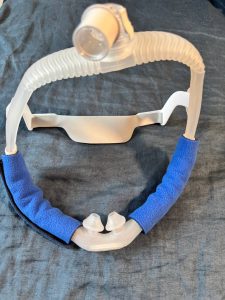
If you have ever felt like a fighter pilot in a cockpit while trying to sleep in your own bedroom, you understand the struggle of the “Elephant” mask. That is the nickname the community has given to traditional CPAP masks where the hose hangs off the front of your nose, dragging, pulling, and getting tangled in the sheets.
I am Josh. I am a friend of Alex, and unlike him, I don’t suffer from “just” insomnia or complex circadian rhythm disorders. I have Obstructive Sleep Apnea (OSA), and I rely on CPAP therapy night after night. My daily driver is the ResMed AirSense 11 AutoSet, and for travel, I reluctantly use the ResMed AirMini.
For years, I searched for a mask that would allow me to sleep on my side and toss and turn without breaking the seal. Enter the ResMed AirFit P30i, a mask that belongs to the “Unicorn” family—where the connection is on top of the head.
In this extensive review, I am going to compare the P30i (nasal pillows) directly against its sibling, the N30i (nasal cradle). I will break down why I rated the standard silicone versions lower than you might expect, what changed for me with the AirTouch N30i cushion, and I’ll anchor the “pillow vs cradle vs full-face” basics to Sleep Foundation and Mayo Clinic, alongside what I’ve seen users discuss on Reddit, ApneaBoard, and other sleep forums in late 2025.
The “Unicorn” Concept: Top-of-Head Tube Design
Before we dive into the battle of the cushions, we need to address the frame. Both the P30i and N30i utilize the same “hollow frame” design.
In a traditional mask, air travels from the machine, through a hose, directly into your nose. In the P30i/N30i system, the air travels up the side of your face (through flattened silicone tubes that act as the frame) and meets at the top of your head.
Why does this matter?
- 1. Freedom: The hose connects to a swivel on the crown of your head. You can roll from your back to your stomach to your side, and the hose stays out of your way.
- 2. Vision: There is nothing in front of your eyes. You can wear glasses, watch TV, or doom-scroll on your phone before falling asleep without a plastic trunk blocking your view.
This design is the primary reason active sleepers flock to this mask. But the frame is just the delivery system. The war is won or lost at the interface with your nose.
The Great Debate: P30i (Pillows) vs. N30i (Cradle)
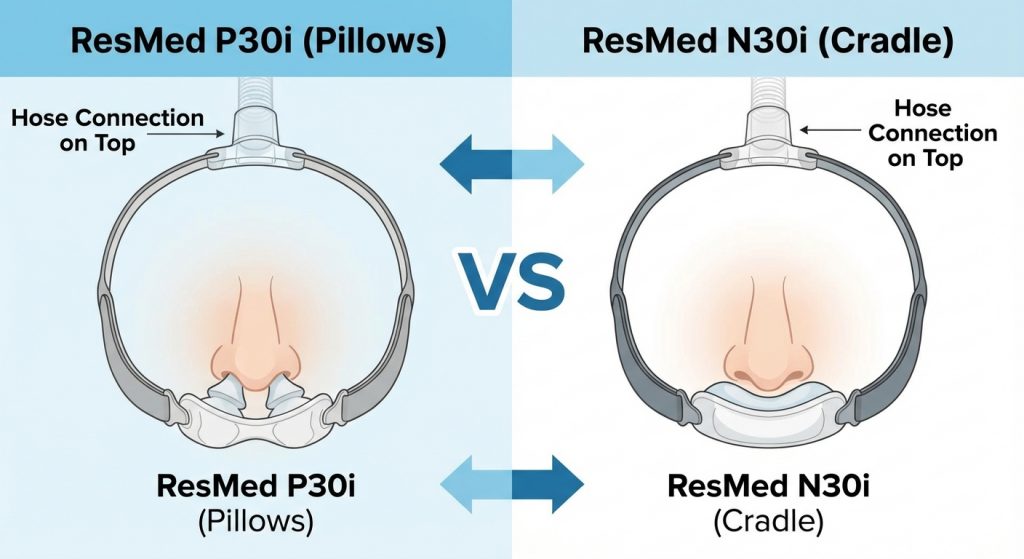
The genius of ResMed’s “i” series is modularity—ResMed’s combined product guide shows the same platform can use different cushions while keeping the same core frame/headgear. You can switch between them simply by popping out the cushion. This allows you to experiment without buying a whole new mask.
Here is the fundamental difference:
The P30i (Nasal Pillows)
This uses silicone “prongs” or pillows that insert slightly into your nostrils. Air pressure from the machine inflates these pillows, creating a mechanical seal against the inside of your nostrils.
- Pros: Incredible seal stability. Because it physically sits inside the nostril, it is very hard to dislodge.
- Cons: Direct contact with sensitive mucosal tissue. If the sizing is wrong, your nostrils will hurt in the morning.
The N30i (Nasal Cradle)
This is a curved cushion that sits under the nose. It hugs the nostrils but does not enter them. It relies on the air pressure to “float” the cushion against the opening of the nose.
- Pros: Nothing inside the nose. Less intrusive.
- Cons: It is a “surface” seal. If you shove your face into a pillow, it is much easier to push the cradle out of alignment, causing a leak.
My Personal Experience and Ratings
I have spent months with both, testing them on my ResMed AirSense 11 at home and the AirMini on the road.
Here is my honest breakdown—and why my scores might seem harsh compared to the marketing hype.
ResMed AirFit P30i (Standard Silicone): 7.0 / 10
I wanted to love this. The seal is absolute. As an active sleeper who performs a “rotisserie chicken” routine throughout the night, the P30i stays put. However, the standard silicone pillows are rigid. After three nights, my nostrils were raw. I found myself waking up not from apnea events, but from the stinging sensation of silicone rubbing against my septum. It works, but at a cost to comfort.
ResMed AirFit N30i (Standard Silicone): 7.5 / 10
I switched to the N30i cradle to give my nostrils a break. The comfort was immediately better because nothing was invading my nose. However, the top-of-head tube design can create a tension issue when paired with a cradle cushion. When I moved violently, the frame would pull the cradle slightly to the side, creating a “hissing” leak right into my eye. To stop the leaks, I had to overtighten the strap, which then gave me a “pig nose” look and soreness on the tip of my nose.
The Game Changer: ResMed AirTouch N30i (Soft Fabric Cradle): 8.5 / 10
This is the only reason I am still using this system. ResMed released the AirTouch version for the N30i, and the big difference is feel: instead of bare silicone at the contact point, the under-the-nose cradle uses a soft fabric-style cushion surface, which changed the comfort “friction” profile for me compared to the standard cradle.
This was the turning point for me. The AirTouch cradle handled small face movements better than the standard silicone cradle on my face, without the “inside-the-nostril” feel of pillows. For many people, that can mean fewer red marks and less irritation—especially if you have sensitive skin or facial hair.
Community Consensus: What The Data Says
I am just one guy. To give you a broader perspective, I analyzed late 2025 data from Trustpilot, sleep/apnea forums, and Reddit (r/CPAP, r/SleepApnea).
The “Active Sleeper” Verdict
If you identify as an active sleeper or a “gymnast” in bed, the community overwhelmingly favors the P30i.
In late-2025 Reddit threads where people compared “flip-flop” sleeping, the pattern was consistent: active sleepers tended to recommend the P30i over the N30i because the pillows are harder to knock out of place during movement. The mechanical lock of the pillows inside the nostrils provides a safety net that the cradle lacks.
The Satisfaction Rate
Across supplier reviews and community write-ups, feedback on the P30i tends to split into two consistent camps: “rock-solid seal during movement” versus “nostril irritation.” That matches my experience—if your anatomy doesn’t match the pillow angle (or the size is off), comfort can fall apart even when the seal is great.
The N30i “Comfort” Factor
The N30i (Cradle) ratings are generally more consistent but slightly lower on “seal” scores. It is viewed as the “safer” bet for beginners who are terrified of putting things up their nose. However, experienced users on ApneaBoard often warn that the N30i requires a looser fit than you think. Overtightening it (to stop leaks) actually crushes the cradle and causes more leaks.
Performance Analysis: Seal, Sound, and Side Sleeping
1. Seal Integrity
The P30i vs N30i battle is won by the P30i for seal integrity. When the machine ramps up pressure (I run pressures up to 14–15 cmH2O on my ResMed AirSense 11), the pillows inflate and lock in. The N30i cradle can sometimes “float” away if the pressure gets too high or if you push your face into the pillow.
- Pro Tip: With travel setups (including the AirMini), a stable seal can matter even more—less leak often means less “air hiss,” regardless of which machine you’re using.
2. Noise and Venting
ResMed uses “QuietAir” mesh venting on the front of these masks. It diffuses the exhaled air so it doesn’t blast your bed partner in the face.
The community consensus is that the “i” series is significantly quieter than older generations. However, some users note that because the air travels past your ears in the hollow frame, you might hear a “whooshing” sound of your own breathing. I found it rhythmic and actually helpful for falling asleep—somewhat like white noise—but if you require absolute silence, this is a factor to consider.
3. Side Sleeping
Both masks are marketed for side sleepers, but they behave differently.
When you lie on your side, the weight of your head presses against one side of the hollow frame. That lower side of the frame can partially flatten under pillow pressure. In normal use, the dual-path frame is designed to keep airflow going via the opposite side—so you may feel more frame contact, but airflow shouldn’t abruptly “cut out” just because one side is compressed.
However, the P30i is superior for side sleeping because the “prongs” act as a pivot point. You can smash your face into a Tempur Sonata or a specific CPAP Pillow, and the mask stays sealed. The N30i cradle is wider; if the pillow pushes against the side of the cradle, it creates a lever effect that breaks the seal on the opposite nostril.
Troubleshooting: The “Unicorn” Problems
No mask is perfect. Here are the most common issues reported by the community and how to fix them.
- The “Slipping Strap” Issue
A persistent complaint I kept running into is that the back strap of the headgear can slide up the back of the head over time, causing the mask to loosen.
The Fix: This usually happens if you have fine hair or a flat back of your head. Some users swap the strap for a “DreamWear” brand strap (which has arms that grip better), or they buy 3D-printed clips to lock the size. I found that simply washing the strap weekly to remove hair oils restores the grip.
- Nasal Soreness (The P30i Curse)
If you choose the P30i for the seal but wake up with a sore nose:
- The Fix: Many CPAP users swear by lanolin as a friction barrier. A tiny dab of Lansinoh (yes, the breastfeeding nipple cream) on the outer edge of the nostrils before bed can reduce rubbing for some people—and it may also make the seal feel a bit less “slippery.”
- Size Matters: Most people assume they are a “Medium.” With pillows, you might be a “Large” even if you have a small nose. If the pillow is too small, it creeps too far up the nostril and stretches the skin. It should sit at the entrance, not deep inside.
- Mouth Leaks
Since these are nasal masks, if your jaw drops, the air shoots out of your mouth. This dries out your throat and ruins your therapy data (and wakes you up).
The Fix: Mouth Taping or a chin strap. I personally use Mouth Taping with sensitive micropore tape, and many users like it because the P30i doesn’t block the mouth area. If you suspect mouth leaks, confirm the pattern in OSCAR (and/or notice dry mouth), then pick the approach that’s most tolerable for you—some do better with a chin strap, and if leaks remain stubborn, that’s when people often trial a full-face option like the F30i.
AirFit vs. AirTouch: Why Material Matters
I touched on this in my ratings, but it deserves its own section. The AirTouch N30i cushion is a relatively new addition that many people miss.
- Standard silicone (AirFit) is durable and easy to clean, but it can get slippery with facial oils, leading to “micro-leaks” that tickle your face.
- The AirTouch N30i cushion uses a softer, fabric-like contact surface, which many people find less slick than bare silicone. The seal can feel more like a gentle gasket than a suction cup.
!!! Important: Caring for the AirTouch N30i is a bit different from caring for standard silicone—follow the manufacturer’s cleaning steps, and expect the soft-touch surface to show wear sooner than plain silicone if you’re rough with cleaning or you side-sleep hard on the cushion. For me, the cost is worth the comfort trade-off.
Comparison to Competitors
To be thorough, we must look at what else is on the market.
vs. Philips DreamWear
Philips popularized the “top-of-head” DreamWear concept, and the overall idea is very similar: tube-up routing and a platform approach where cushion style can be swapped without rethinking the whole setup.
ResMed Advantage: The ResMed “accordion” frame (the spring-like ridges on the top) adapts better to different head shapes. The DreamWear frame is smooth and can sometimes slide around more. Also, the ResMed P30i pillows are generally considered more stable than the DreamWear Gel Pillows, which can be a bit “bouncy.”
vs. ResMed AirFit P10
The P10 is the legendary “minimalist” mask with the elephant trunk (hose from the nose).
Comparison: The P10 is quieter and lighter. However, the hose in front is a dealbreaker for active sleepers. If you sleep like a vampire (on your back, arms crossed), the P10 is better. If you move, the P30i wins.
Who Should Buy Which?
Based on my experience and the massive amount of data from the sleep apnea community, here is the breakdown.
Choose the ResMed AirFit P30i (Pillows) if:
- You are an active sleeper (toss and turn).
- You sleep on your stomach.
- You have facial hair (mustache) that interferes with cradles.
- You need a “bomb-proof” seal because you run high pressures (12+ cmH2O).
- You are willing to use Lanolin for the first two weeks while your nose adapts.
Choose the ResMed AirFit N30i (Cradle) if:
- You have a sensitive septum or are prone to nosebleeds.
- The idea of inserting anything into your nose triggers anxiety.
- You sleep relatively calmly but still want the top-tube freedom.
Choose the ResMed AirTouch N30i (Foam Cradle) if:
- You loved the N30i concept but the silicone gave you a rash or red ring under the nose.
- You have oily skin that makes silicone slide around.
Summary
The “Unicorn” mask revolution is real. Moving the hose to the top of the head is the single biggest quality-of-life upgrade you can make if you are fighting your CPAP equipment.
While I personally rated the P30i lower (7.0) due to my sensitive nose, I acknowledge that the community rates it very highly for maintaining a seal during movement—and for active sleepers, it’s generally the better choice. It is the closest thing to a “set and forget” mask for the restless sleeper.
However, do not ignore the AirTouch N30i option. For me, that 8.5 rating is hard-earned. It combines the freedom of the unicorn frame with the cloud-like comfort of foam.
Remember, both masks use the same frame. If you buy the P30i and hate the pillows, you don’t have to throw the whole thing away—just buy the N30i cushion. It’s a modular system that respects your wallet and your sleep therapy journey.
If you are using this mask to treat suspected UARS (Upper Airway Resistance Syndrome) or flow limitations, the stability of the P30i is generally preferred. The pillows prevent the mask from shifting during those critical moments of REM sleep where airway resistance is highest, ensuring your ResMed AirSense 11 or BiPAP can deliver the precise pressure needed without leak compensation throwing off the algorithm.
Ultimately, the best mask is the one you will actually wear. For me, that’s the one that lets me read a book, roll over, and wake up without red marks on my face. The “i” series delivers that, provided you choose the right interface for your nose.

By: Alex Warenstein.
Bio: Alex Warenstein is a sleep biohacker and founder of Night Time Comfort. After battling chronic insomnia and circadian disruption, he now helps others optimize their sleep using data-driven protocols. Read full story.
Disclaimer: Alex is not a doctor. This content is for educational purposes only. Always consult a specialist.