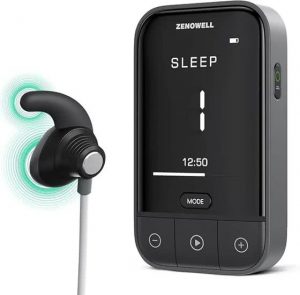
If you have read my story, you know that my insomnia often feels like an engine that refuses to shut down. The doctors call it “hyperarousal.” I call it “tired but wired.” You are exhausted, your eyes are burning, but your heart rate is just slightly too high, and your mind is looping through thoughts at 100 miles per hour.
For years, I attacked this problem chemically—using supplements like Magnesium L-Threonate or Apigenin to sedation the brain. But recently, the biohacking community has shifted its focus from chemistry to electricity. The theory is seductive: instead of swallowing a pill to calm down, what if you could just press a button and manually switch your nervous system from “Fight or Flight” (Sympathetic) to “Rest and Digest” (Parasympathetic)?
This is the promise of Vagus Nerve Stimulation (VNS).
I kept seeing ads for the Zenowell device, often touted by German athletes and popping up in my recommended feeds alongside other gadgets like the O2Ring. The promise? A non-invasive ear clip that sends electrical signals directly into your vagus nerve to lower heart rate, boost HRV (Heart Rate Variability), and force your body into a state of deep sleep.
I am a skeptic by nature. I have been burned by gadgets before (looking at you, Muse S). But the science behind Vagus stimulation is legitimate. So, I bought the Zenowell Luna (their advanced model) and put it to the test for 10 days. I tracked my data using my Apple Watch for sleep stages and a Polar H10 chest strap for accurate HRV monitoring.
Here is the truth about electric ear stimulation, stripped of the marketing hype.
Part 1: The Theory. Why Zap Your Ear?
Before we talk about the plastic gadget, we need to talk about the biology. Why on earth would electrocuting your ear help you sleep?
The Vagus Nerve (Cranial Nerve X) is the longest nerve in your body. It is the superhighway of the parasympathetic nervous system. It wanders from your brainstem down to your heart, lungs, and gut. When the Vagus nerve is active, your heart rate slows, your digestion turns on, and—crucially for us—your body prepares for rest.
For decades, Vagus Nerve Stimulation was a surgical procedure. Doctors would implant a pacemaker-like device in the chest of epilepsy patients to stimulate the nerve. But researchers discovered something interesting: a branch of the vagus nerve, called the Auricular Branch, surfaces in a very specific part of the outer ear.
This is the concept behind taVNS (transcutaneous auricular Vagus Nerve Stimulation). It suggests that by applying a mild electrical current to this specific skin area on the ear, you can send a signal backward up the nerve, into the brainstem (specifically the Nucleus Tractus Solitarius), and hack your system into relaxation.
The Science: Is it Real or Placebo?
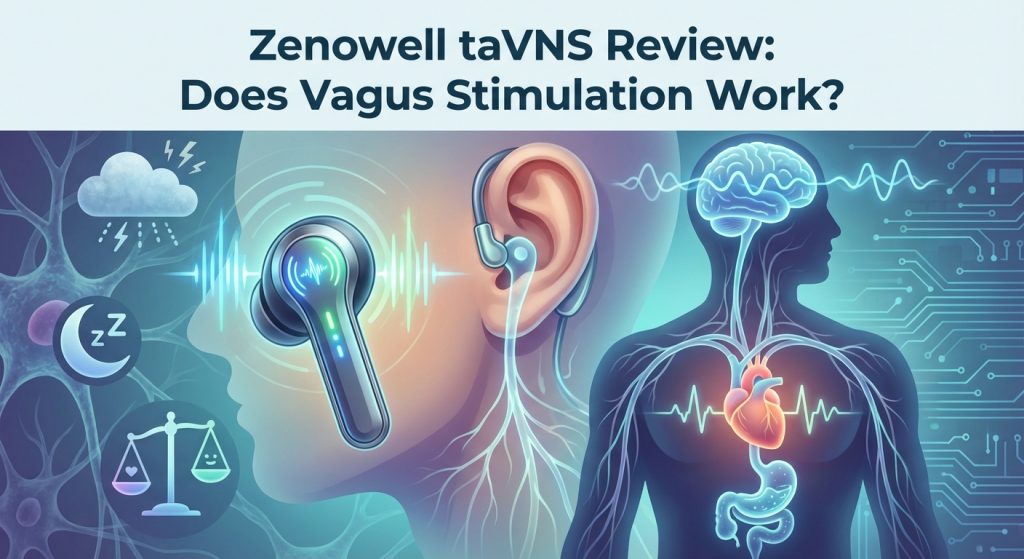
I dug deep into the research available as of late 2025 because I don’t trust manufacturer claims. The good news is that taVNS as a method is backed by solid data.
- Chronic Insomnia (JAMA 2024): A pivotal Randomized Clinical Trial published in JAMA Network Open showed that 8 weeks of active taVNS significantly improved sleep quality (measured by PSQI scores) compared to a “sham” (fake) device. The clinical effect was strong, suggesting this isn’t just placebo.
- HRV and Sleep (Scientific Reports, Dec 2025): A very fresh study I found from late 2025 indicated that nightly taVNS not only reduced wake-ups but actually increased HRV in patients. This is the holy grail for us—higher HRV usually correlates with better recovery and lower stress.
- Meta-Analysis (Nov 2025): A systematic review in Current Sleep Medicine Reports aggregated data from nearly 300 participants, confirming that taVNS has a statistical benefit for sleep latency (how fast you fall asleep) and sleep efficiency.
So, the method works in clinical settings. The question is: does a consumer device like Zenowell actually replicate those clinical results at home?
Part 2: What is the Zenowell (Vita/Luna)?
The market is currently flooded with “vagus nerve” devices. You have the Pulsetto (which wraps around the neck), the Nurosym (a very expensive, medically certified device), and then you have Zenowell.
I chose Zenowell because it seemed to occupy the middle ground—claiming “German quality” and engineering, but accessible without a prescription.
The Hardware
The device consists of a main unit (about the size of a large MP3 player from 2005) connected by a wire to a special ear clip.
- Zenowell Vita: This is the standard model. It has modes for Sleep, Relax, and Meditate.
- Zenowell Luna: This is the model I tested. It is marketed as the “Pro” version with a longer battery life and an extra “Relief” mode for pain management.
The crucial component is the ear electrode. Unlike Chinese clips you might find on AliExpress that simply pinch the earlobe (which, by the way, contains no vagus nerve endings), the Zenowell ear piece is designed to sit inside the ear shell.
The Target: Cymba Concha
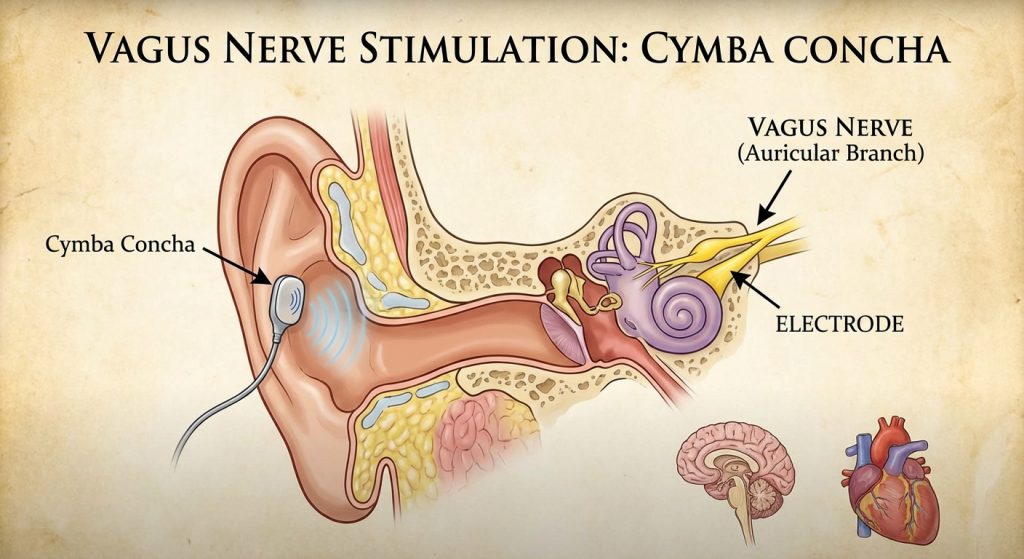
The specific anatomy matters here. The auricular branch of the vagus nerve is accessible primarily in the Cymba Concha (the upper hollow of the ear) and the Cavum Concha (the lower hollow). If you stimulate the earlobe, you are hitting the Great Auricular Nerve, which might hurt, but it won’t help your sleep.
Zenowell’s design attempts to place a conductive head right into that Concha region. The device uses electrical impulses (you feel a tingling or a buzzing sensation) to trigger the nerve.
Zenowell vs. Generic “AliExpress” Clips
This is a common question I see on Reddit: “Why not buy a $30 TENS unit and an ear clip from Amazon?”
Theoretically, you can. But safety and parameters matter. The Vagus nerve requires specific pulse widths and frequencies to respond. If the frequency is too high or the pulse width too wide, you are just shocking your skin and creating pain signals (sympathetic arousal)—the exact opposite of what we want. Zenowell claims their pre-set programs (Sleep/Relax) are tuned specifically for vagal tone activation, similar to the medical-grade Nurosym, sparing you the risk of configuring a generic TENS unit incorrectly.
Part 3: My 10-Day Experiment
I wanted to love this. I really did. As someone who has spent a fortune on Liposomal Apigenin and CBD vs CBN experiments, a one-time purchase for a device that works forever sounds like a financial win.
Here is exactly how I used it and what happened.
The Setup
- Device: Zenowell Luna.
- Protocol: Every night, 30 minutes before bed.
- Placement: Left Ear. (Why the left? In the medical literature, the right vagus nerve has more direct control over the heart’s sinoatrial node. Over-stimulating the right side could theoretically cause bradycardia—slow heart rate. The left side is considered safer for general CNS modulation).
- Conduction: I used the included conductive gel (similar to ultrasound gel) to ensure a good connection.
- Tracking:
- Subjective: Sleep diary.
- Objective Sleep: Apple Watch Ultra 2 tracking Sleep Stages.
- Objective Stress: Polar H10 chest strap (using the EliteHRV app) for a 20-minute morning readiness reading and spot checks during the session.
The Experience: The “Fit” Problem
This was my first hurdle. The ear electrode provided with the Zenowell Luna is a standard size. I am a 47-year-old male, and my ears are apparently larger than the average German engineer’s test dummy. Or perhaps the shape of my Concha is different.
The sensor felt small. It didn’t sit snugly in the Cymba Concha on its own. It kept slipping out or losing contact.
On Reddit forums like r/VagusNerve, this is the number one complaint about ear-based taVNS devices: Contact Quality. If the electrode isn’t touching the skin firmly, the electrical circuit breaks. You feel a sharp “bite” or nothing at all.
To ensure I was actually stimulating the nerve and not just wasting my time, I had to hold the sensor in place with my hand (insulated, obviously). I spent 10 nights sitting on the edge of my bed, pressing the plastic bud into my ear, hunting for that “deep” sensation.
How do you know if it’s working?
When you hit the right spot, it shouldn’t hurt. It feels like a rhythmic tingling or a deep thumping sensation inside the ear canal. If it feels like a sharp needle on the skin, you simply have a bad connection or no gel. I dialed the intensity up—usually settling between levels 12 and 16. I felt the pulse. I knew electricity was flowing.
The Data Results
I monitored my HRV using the Polar H10 in real-time during two sessions.
The theory says that successful vagal activation should cause an immediate, acute rise in HRV (specifically the RMSSD metric).
- Baseline RMSSD: 34ms.
- During Stimulation (20 mins): Fluctuated between 32ms and 36ms.
- Result: No significant change.
I did not see the “spike” in parasympathetic activity that some biohackers talk about.
Sleep Data (Apple Watch):
Over the 10 days, my Deep Sleep (NREM3) average did not move. It stayed stubbornly around my baseline of 30-40 minutes (which I have achieved thanks to sleep hygiene and cooling habits, up from my historical 20 minutes).
My Sleep Onset Latency (time to fall asleep) also didn’t change. I still had to do my 4-7-8 breathing to wind down.
The Side Effect: The “Ulcer”
Around day 8, I noticed my left ear was sore. By day 10, a small sore—basically a tiny ulcer or pressure wound—had formed exactly where the metal electrode made contact with the skin.
This likely happened because I was pressing the device into my ear to maintain contact, combined with the electrical current.
I had to stop the experiment. The sore healed after about a week, but it was a clear sign that the ergonomics of this device were not compatible with my anatomy.
Part 4: The Broader Context (Community & Research)
Just because it failed for me doesn’t mean it’s a scam. I am just one data point. To give you a fair review, I looked at what the broader community is saying as of late 2025.
The Reddit Consensus
On communities like r/Biohackers and r/VagusNerve, the sentiment on Zenowell is mixed.
- The “Viktor Thorup” Effect: Many users came to the device via the speed skater Viktor Thorup’s YouTube channel. There are genuine reports of people saying it knocks them out cold. For these people, the “sleep latency” benefit is real.
- The Connection Struggle: My issue with the ear fit is echoed by many. Unlike the Nurosym, which has a very specifically designed earpiece, the Zenowell bud is a “one size fits all” that doesn’t fit all.
- HRV Disappointment: Similar to my experience, many users on the forums report that they don’t see massive jumps in their Oura 4 or Whoop 4 data immediately. The biohacking consensus seems to be that taVNS is cumulative—it takes weeks to retrain the nervous system, not days.
Comparison to Competitors
- Pulsetto: This device sits on the neck. It is easier to use (hands-free), but stimulating the vagus nerve at the neck (cervical branch) carries different risks and targets than the ear. Some find the neck sensation choking.
- Nurosym: Considered the “gold standard” of consumer taVNS. It is significantly more expensive than Zenowell. The main difference is the clinical validation of their specific waveform and the better ear-hook design.
- TENS (Generic): The cheapest option. If you are technically inclined and know how to set pulse width to 200-250µs and frequency to 20-30Hz, you can mimic the effect. But it’s clunky and requires wires everywhere.
Part 5: Alex’s Personal Take
My Rating: 6.5 / 10
This is a complicated device to review. The science behind it is fascinating and real. The potential to fix tired but wired syndrome without drugs is massive. But the execution of the Zenowell Luna, specifically regarding ergonomics, failed me.
The Pros:
- The build quality is decent; it doesn’t feel like a cheap toy.
- It comes with everything you need: the case, the gel, the cables.
- The theory is sound—this isn’t homeopathy; it’s neurobiology.
- 30-Day Money-Back Guarantee (which is critical).
The Cons:
- Ergonomics: The sensor is too small for larger ears. If it doesn’t touch the Cymba Concha perfectly, it does nothing.
- Skin Irritation: The electrical contact caused a small ulcer in my ear.
- No Data Shift: I saw no change in my Polar H10 HRV data or Apple Watch sleep tracking.
Important Note: I verified the location of the Vagus nerve exit points meticulously. I know where the Cymba Concha is. I used the gel. I manually held the sensor to ensure contact. Even with all that effort, my nervous system didn’t respond the way I hoped.
However, I cannot say “this doesn’t work.” I can only say “this didn’t work for Alex.” Human anatomy varies. Your vagus nerve branching might be more accessible than mine, or your ear shape might hold the clip perfectly. There are enough positive anecdotes on the forums to suggest it helps some people, particularly with anxiety-driven insomnia.
Updates as of December 2025:
1. The strongest new clinical signal in 2025: a larger sham-controlled insomnia trial
In May 2025, a double-blind, randomized, sham-controlled trial (n=40) in Sleep Medicine reported that daily 30-minute taVNS for 6 weeks improved chronic insomnia more than sham on the Pittsburgh Sleep Quality Index (PSQI) and Insomnia Severity Index (ISI)—with a large effect size for PSQI (Cohen’s d ≈ -1.21). The taVNS group also showed better quality-of-life scores, and the study reported no significant adverse events. Fitbit was used for objective sleep measurement (still a consumer-grade tool, but directionally useful).
Why this matters for my Zenowell write-up: my original test window (10 days) now looks even more “underpowered” relative to the 6-week protocol used in a controlled trial.
2. The 2025 meta-analysis that tightened expectations (and downgraded certainty)
A 2025 systematic review and meta-analysis in Neuromodulation pooled 6 clinical trials (336 total patients) and found taVNS improved:
PSQI by about -3.6 points (mean difference; 95% CI roughly -5.0 to -2.2)
ISI by about -5.2 points (mean difference; wider CI)
But the authors graded the certainty as Low / Very Low (GRADE)—mostly because many studies are small, protocols vary (site, frequency, duty cycle, intensity, duration), and sham conditions are not always truly inert. Adverse effects were described as minimal and manageable across included trials.
Translation for non-specialists: taVNS looks promising for insomnia on average, but 2025 evidence still supports a “try-and-measure” mindset rather than certainty.
3. 2025 added something I care about: HRV moved in a nightly taVNS study
A 2025 Scientific Reports paper tracked insomnia outcomes alongside nightly sleep biometrics (actigraphy + heart-rate PPG during sleep) during two weeks of nightly taVNS. Beyond improvements in sleep latency / awakenings / sleep efficiency, they also reported that RMSSD (an HRV metric) increased versus baseline (ANOVA p=0.004; week-1 post-hoc p≈0.03).
Why this matters for my Zenowell question (“is it really vagus?”): HRV changes measured during sleep are one of the more plausible “non-marketing” physiological correlates of increased parasympathetic tone that showed up in 2025, even if that study was not specifically Zenowell-branded.
4. 2025 started to explain “responders vs. non-responders”
Two 2025 lines of work moved the conversation away from “does taVNS work?” and toward “for whom and why”:
A 2025 BMC Medicine paper reported that baseline brain connectivity patterns (they focus on basal-forebrain–related networks) were associated with subsequent improvements in insomnia after taVNS, suggesting predictable responder phenotypes may exist.
A 2025 Frontiers in Neurology article (accepted in 2025) explicitly discusses biomarkers that predict response to taVNS for chronic insomnia, reinforcing the idea that anatomy, autonomic baseline, and CNS state can change outcomes.
My practical takeaway (as Alex): “no HRV shift in 10 days” is not a definitive negative—2025 literature increasingly supports variability and the need for a longer, standardized run.
5. A 2025 Zenowell manual finally makes my “ear ulcer” outcome feel less surprising
Zenowell’s March 24, 2025 user manual (A100 / Vita) contains several details directly relevant to my experience:
- Avoid use on wounds, inflamed skin, abrasions, and discontinue if excessive skin irritation occurs.
- It explicitly flags pacemakers / implantable devices as a “do not use” category.
- It recommends a practical regimen: 20 minutes, twice daily, and highlights that bedtime use is “especially helpful for sleep.”
- It includes a simple but important ergonomics tip: secure the wire to clothing to reduce slip/fall-off and contact loss.
What I’d change in my own protocol (based on 2025):
- I would prioritize a hands-free stable fit (wire clip + moisture + zero pressing) over higher intensity.
- I would treat any “sharp bite” sensation as a contact/placement failure, not a sign of stronger vagal stimulation (the manual aligns with this in plainer language).
Summary
Should you buy the Zenowell taVNS?
If you have exhausted the “basics”—you have fixed your sleep hygiene, you are taking Magnesium L-Threonate, you have ruled out Sleep Apnea with an O2Ring, and you are still lying awake with a racing heart—then yes, this is worth a try.
Why? Because they offer a return policy.
The mechanisms of Vagus Stimulation for sleep are supported by 2024/2025 clinical literature. It is a legitimate therapeutic pathway.
My advice: Buy it, test it for 14 days.
- Use a heart rate monitor (like a chest strap or your watch) to see if it actually lowers your resting heart rate during the session.
- If you feel the calm, keep it.
- If you struggle with the fit or get an ulcer like I did, return it.

By: Alex Warenstein.
Bio: Alex Warenstein is a sleep biohacker and founder of Night Time Comfort. After battling chronic insomnia and circadian disruption, he now helps others optimize their sleep using data-driven protocols. Read full story.
Disclaimer: Alex is not a doctor. This content is for educational purposes only. Always consult a specialist.