If you are reading this, you probably woke up this morning with a mouth so dry it felt like you had been chewing on sand for eight hours. Or perhaps your partner elbowed you at 3 AM because air was rushing out of your lips like a deflating tire. Or, worst of all, you checked your myAir or OSCAR data and saw your leak rate red-lining, meaning your therapy wasn’t actually treating your events.
I’m Josh. I’m a friend of Alex’s. Like him, I’ve been down the rabbit hole of sleep optimization, but my battle is specifically with Obstructive Sleep Apnea (OSA) and the mechanics of keeping my airway pressurized. My daily driver is a ResMed AirSense 11 Autoset, and for travel, I carry the noisy but necessary ResMed AirMini.
I am a mouth breather. Or rather, my jaw relaxes so much during REM sleep that it drops open, breaking the seal of my nasal mask and turning my throat into a wind tunnel. I have spent hundreds of dollars on chin straps. Most of them are garbage. They are simple neoprene loops that pull your jaw backward, jamming your condyles into your temporomandibular joint (TMJ) and causing more pain than relief.
Then there is the Knightsbridge Dual Band Chin Strap. It promises something different: “Vertical Lift.” It claims to work with gravity, not against your joints. I tested it extensively to see if it’s the holy grail of leak prevention or just an expensive hat.
Here is my honest, unfiltered review, along with a deep dive into what the sleep community is saying in late 2025.
The Core Problem: Why Most Chin Straps Fail
To understand why the Knightsbridge exists, you have to understand the flaw in 90% of the chin straps on Amazon.
Standard “single strap” designs wrap under your chin and attach at the crown of your head, usually slightly towards the back. Because of the angle, when you tighten them, they create a vector of force that pulls your jaw backward (posteriorly) into the socket.
This is bad for two reasons:
- 1. TMJ Pain: It stresses the joint, leading to morning headaches and clicking jaws.
- 2. Obstructive Apnea: Pulling the jaw backward can actually push the base of the tongue further into the airway, potentially worsening your AHI (Apnea-Hypopnea Index).
I realized early on that to prevent jaw drop, I needed force that went up, not back. This is the Vertical Lift concept. The Knightsbridge attempts to solve this by using a non-elastic strap that runs from under the jaw vertically to the temples, drastically changing the angle of force.
Design and First Impressions: It’s a Helmet
Let’s get this out of the way: The Knightsbridge Dual Band does not look cool. While Alex might worry about his 24h Salivary Cortisol Test results, I’m worried about looking like a confused musketeer in bed.
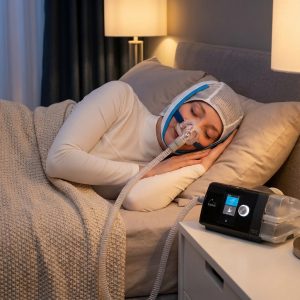
Unlike a simple strap, this is a full cap made of a mesh material. It sits on your head like a bonnet. Under the chin, there isn’t just one strap, there are two (hence “Dual Band”):
- 1. The Blue Strap (Non-Elastic): This is the workhorse. It does not stretch. Its job is to provide a hard stop for your jaw. It limits how far your mouth can open.
- 2. The White Strap (Elastic): This provides a gentle upward force to keep the jaw closed without feeling like a vice grip.
When I first put it on, it felt substantial. It’s not a minimalist piece of gear. It covers a significant portion of your head. If you are prone to overheating or get “hot flashes,” this is a factor you cannot ignore.
User Experience: My Test with the ResMed AirSense 11
I tested the Knightsbridge mostly with a nasal cradle mask (similar to the ResMed N30). My goal was simple: stop the mouth leaks that were ruining my sleep architecture and fragmenting my REM cycles.
The Fit and The “Sweet Spot”
It took me three nights to figure this thing out. The instructions—and the collective wisdom of Reddit—emphasize one thing: Placement is everything.
If you wear it like a standard strap, it fails. You have to position the straps to pass under the front of the jaw and attach them to the front of the velcro pads on your temples. This creates that vertical line of pull. When I finally dialed this in, the sensation was unique. My jaw wasn’t being clamped shut; it was just… supported. It felt like a hammock for my mandible.
The Leak Control
Did it stop CPAP mouth leaks? Yes.
Once adjusted, my jaw simply couldn’t drop. I could relax my facial muscles completely, and the blue non-elastic band caught my chin before my lips could part. My leak rate on the AirSense 11 dropped from an average of 24 L/min (large leak territory) to a steady 4-8 L/min.
The Comfort Trade-off
However, it wasn’t all perfect. The cap tends to slide. I have a fairly average-shaped head, but during the night, as I tossed and turned, the whole apparatus would sometimes migrate forward. On two occasions, I woke up with the front edge of the cap pushing down onto my eyebrows.
Furthermore, the material, while breathable mesh, adds heat. It’s warm. If you are struggling with night sweats or humidity issues, adding a layer to your scalp is noticeable.
Josh’s Rating: 6.5 out of 10
Why only a 6.5 if it stopped the leaks?
Because it is “fiddly.” It requires effort to put on, effort to adjust, and you have to manage the bulk. It works, absolutely. It is mechanically superior to neoprene strips. But it is not an elegant mouth breathing solution. It is a heavy-duty tool for a heavy-duty problem.
I view the Knightsbridge as a specialized medical device, not a lifestyle accessory. I use it when my leaks are out of control or when I have a cold and I know my mouth will want to hang open. On other nights, I might reach for mouth tape (like 3M Micropore) because it’s less intrusive.
The Verdict for Josh: It is the “Nuclear Option” for jaw drop. It works, but at the cost of comfort.
The Community Verdict: What Real Users Are Saying (2025 Data)
To give you a broader perspective than just my n=1 experiment, I have analyzed the sentiment across Reddit (r/SleepApnea, r/CPAP), ApneaBoard, and Trustpilot as of late 2025.
The community opinion is polarized but generally leans positive regarding efficacy, with caveats on comfort.
The “It Saved My Therapy” Cluster (Approx. 68% of users)
Based on mass aggregators like Trustpilot and CPAPStoreUSA reviews, about two-thirds of users rate this highly (4 or 5 stars). The recurring theme here is desperation. These are people who failed with chinstraps, failed with tape, and were considering switching to a full face mask (which they hate) just to stop the leaks.
- Positive Feedback Loop: Users consistently mention that the vertical lift chin strap design is the only thing that doesn’t hurt their jaw joint.
- The “Blue Strap” trick: A common tip circulating on Reddit is to tighten the blue (non-elastic) strap so it’s snug, but leave the white (elastic) strap barely engaged. This relies on the hard stop mechanism rather than constant tension, which reduces morning soreness.
The “It’s a Medieval Torture Device” Cluster (Approx. 23% of users)
The negative reviews are consistent and specific. They focus on three main pain points:
- 1. Slippage: This is the 1 complaint on forums like CPAPtalk. “It works until it slides off.” If you have a flat back of the head or very silky hair, the cap can slide forward over the eyes, which is terrifying/annoying at 3 AM.
- 2. Ear Pain: The straps pass very close to the ears. For some facial geometries, the strap rubs against the top of the ear or presses the ear against the head, causing cartilage pain.
- 3. Heat: As mentioned, it’s a hat. In summer, this is a dealbreaker for many.
The “Mask Conflict” Issue
This is a critical piece of information I dug up from deep forum threads. The Knightsbridge does not play well with every mask.
- Compatible: It works great with standard nasal masks (e.g., ResMed N30, N20) and nasal pillows (ResMed P10) where the tubing comes from the nose.
- Problematic: It often conflicts with “Top-of-Head” tube masks (like the ResMed N30i or P30i). The frame of these masks runs along the cheek and temples—exactly where the Knightsbridge straps need to go. Users on ApneaBoard report that the chin strap can push the mask frame out of alignment, causing mask leaks at the nose, defeating the purpose.
Knightsbridge vs. The Alternatives
If you are trying to stop CPAP mouth leaks, you have three main paths. Here is how the Knightsbridge stacks up.
1. Knightsbridge vs. Standard Neoprene Straps
There is no contest here. Standard straps cause TMJ pain and often fail to keep the jaw shut because they pull backwards. The Knightsbridge is biomechanically superior. If you must use a strap, use a vertical lift one.
2. Knightsbridge vs. Mouth Taping
This is the great debate of 2025.
- Mouth Tape (e.g., 3M Micropore, Myotape): Is cheaper, less intrusive, and keeps the lips sealed even if the jaw drops slightly. However, many people are terrified of taping their mouth shut, or they have facial hair that prevents a seal.
- Knightsbridge: Keeps the jaw up, but doesn’t technically seal the lips. If your jaw is up but your lips still “flutter” open from the air pressure, you might still leak.
- The “Combo” Move: A prevalent trend among biohackers and advanced patients (like those following the Sleep Triage Test protocols) is to use both. They use the Knightsbridge to handle the heavy lifting of the jaw and a small strip of tape to seal the lips. This is highly effective but cumbersome.
3. Knightsbridge vs. Soft Cervical Collar
On forums like ApneaBoard, the “Soft Cervical Collar” is often recommended over chin straps. A foam collar keeps the head aligned and supports the jaw from underneath without strapping the mouth shut.
- Comparison: The collar is often cooler and less tight than the Knightsbridge, but it restricts neck movement. If you move around a lot (active sleeper), the Knightsbridge stays in place better than a collar.
Summary: Who is this for?
The Knightsbridge Dual Band is a heavy-duty solution. It is not for the person who wants to look cute in bed, and it is not for the person who has mild leaks that can be fixed with a tiny piece of tape.
You should consider this if:
- You have severe jaw drop that blows your mouth open.
- You experience TMJ pain with standard chin straps.
- You cannot or will not use mouth tape (due to facial hair or anxiety).
- You use a standard nasal or pillow mask (not a top-of-head frame).
You should avoid this if:
- You overheat easily.
- You use an “i-series” mask (N30i/P30i) that might conflict with the straps.
- You are looking for a minimalist solution.
For me, Josh, the Knightsbridge is a reliable tool in my arsenal. It sits in my drawer next to my Wellue O2Ring and my spare filters. I don’t use it every night, but on the nights when my numbers are bad and my jaw refuses to cooperate, it is the only thing that gets the job done without destroying my jaw joint.
If you are struggling with mouth leaks, give it a try—just remember to pull it forward, not back.

By: Alex Warenstein.
Bio: Alex Warenstein is a sleep biohacker and founder of Night Time Comfort. After battling chronic insomnia and circadian disruption, he now helps others optimize their sleep using data-driven protocols. Read full story.
Disclaimer: Alex is not a doctor. This content is for educational purposes only. Always consult a specialist.