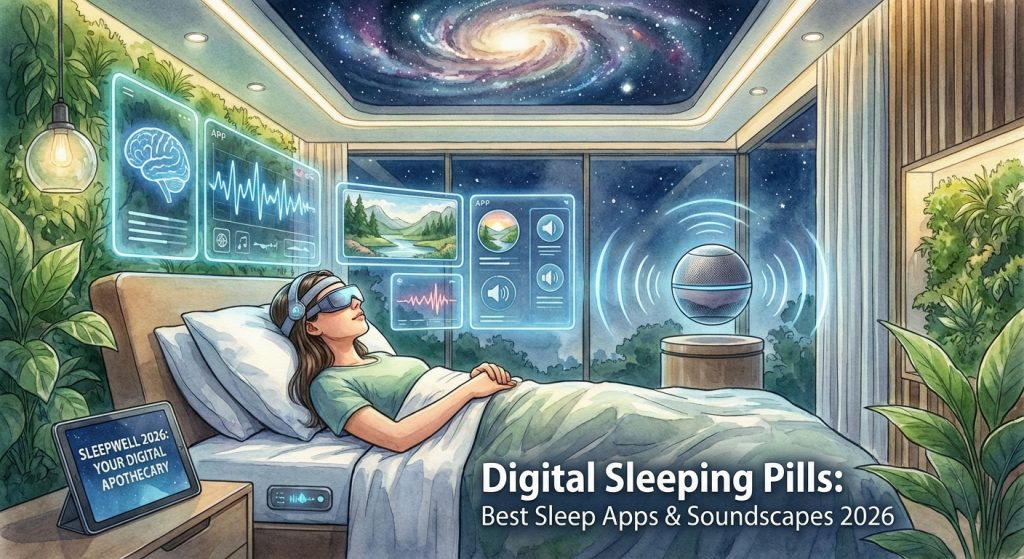
I used to think the phrase “digital sleeping pill” was just Silicon Valley marketing — a clever name designed to sell subscriptions. I was a purist: if I couldn’t sleep, I assumed I needed a stronger supplement, a better mattress, or a more “perfect” sleep hygiene routine.
But if you’ve ever stared at the ceiling at 3:00 AM after doing everything “right,” you know the real problem often isn’t physical comfort. It’s cognitive load — the monkey mind that keeps scanning, planning, replaying, and rehearsing.
A lot of sleep audio doesn’t “knock you out.” It reduces the conditions that keep you awake: noise sensitivity, pre-sleep arousal, and mental momentum.
How I tested (method)
Over the last couple of years, I rotated apps and sound types in consistent, repeatable scenarios: (1) travel/hotels, (2) noisy home nights (neighbors / street noise), and (3) “tired but wired” evenings. I logged subjective sleep-onset time and next-day grogginess, and I used basic wearable/phone sleep metrics only as a secondary signal (because they’re directionally useful, not perfect).
This isn’t a list of “cool apps.” It’s a practical breakdown of tools that can function like a digital sleeping pill — replacing or augmenting your stack.
The mechanism: why sound works when willpower fails
Before you pay for a subscription, you need to know what you’re trying to solve. Most sleep audio falls into one (or more) of these buckets:
1) Acoustic masking (the shield)
Masking is simple: you raise the ambient “noise floor,” so sharp changes (a door slam, a honk, a snore peak) feel less salient to the brain.
Who it’s for: light sleepers, city dwellers, people with snoring partners.
2) Cognitive distraction (the anchor)
If your insomnia is mostly rumination, “trying to stop thinking” usually fails. Sleep stories and guided visualizations work by replacing active worry with passive attention — enough engagement to interrupt loops, not enough excitement to keep you awake.
Who it’s for: the “tired but wired” crowd, ruminators, anxiety-driven insomniacs.
3) Rhythm / entrainment (the hack — evidence is mixed)
This is the binaural beats / isochronic tones world. The theory: rhythmic stimulation can nudge the brain toward relaxed states. In practice, results vary: some people feel a reliable downshift; others feel nothing.
I treat this category less like a “chemical substitute” and more like a conditioning tool: a consistent cue that tells your brain “this is the sleep ritual now.”
Who it’s for: biohackers, optimizers, people who enjoy structured sleep rituals.
The “big three” ecosystems: Headspace vs Calm vs BetterSleep
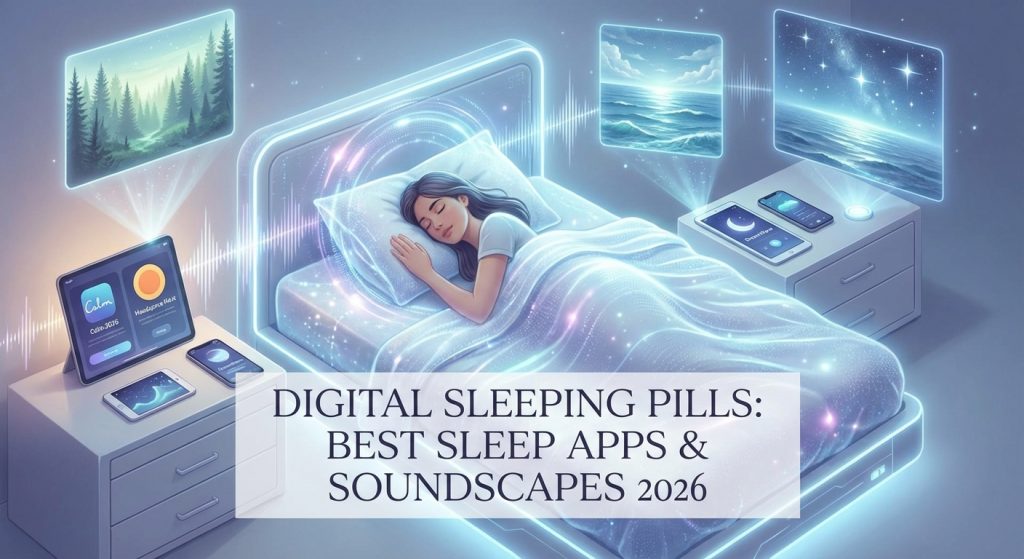
Headspace: the clinical-leaning option
Headspace has leaned harder into structured sleep programming (not just “nice sounds”). In 2025, a randomized controlled trial evaluated the Headspace Sleep Program in adults with clinical insomnia and found improvements on standard insomnia outcomes (including the Insomnia Severity Index).
My take: Headspace is at its best when you want a program — not just background noise. If your problem is “sleep anxiety + habits + conditioned arousal,” a CBT-I-inspired structure can be more useful than another rain loop.
Best for: people who want a behavior-first approach, delivered like an app program.
Cost: subscription tiering varies by region and promos.
# Calm: the narrative specialist
Calm is famous for Sleep Stories — and there is at least one well-cited randomized trial showing Calm use can improve pre-sleep arousal and related sleep outcomes in adults with sleep disturbance.
My take: Calm works best when I’m physically tired but mentally “spinning.” The production quality (cadence, tone, low-stakes narration) is a feature — it reduces the urge to “follow the plot.”
Best for: racing minds that need a gentle narrative to latch onto.
Cost: subscription tiering varies by region and promos.
BetterSleep (formerly Relax Melodies): the mixer
BetterSleep is the “soundscape builder” category: you mix components (rain + fan + distant thunder + noise color + tones) into your own environment.
My take: this is ideal if you know exactly what you like and want control. The downside is that many apps in this category aggressively upsell or lock “convenience features” behind premium tiers, which can be frustrating over time.
Best for: control-oriented sleepers who want a custom audio environment.
Cost: freemium; pricing and feature gating changes frequently by platform.
The engineers: pure noise and the “free” tier
myNoise: the gold standard for customization
myNoise is built by sound engineer Stéphane Pigeon and is known for calibrated generators and deep control (EQ-like sliders per soundscape). It’s one of the few places where you can shape noise until it matches *your* brain’s preferences, not a generic preset.
Why it wins: customization (especially if certain frequencies irritate you).
Best for: travel, hotels, inconsistent environments.
# White Noise (TMSoft) and Rain Rain: the reliable workhorses
If you just want “digital fan energy,” simple apps often beat premium platforms:
- White Noise / White Noise Lite: minimal UI, minimal battery drama.
- Rain Rain app: high-fidelity water loops; great if you specifically calm down to rainfall.
This category is underrated: for many people, masking alone solves 80% of the problem.
The science-of-frequencies corner (binaural beats, acoustic stimulation)
This is where language gets exaggerated online, so here’s the grounded version:
- The idea that rhythmic audio can influence relaxation is plausible.
- The effect size in real life is variable.
- The best use case is often *ritual + consistency* rather than “audio as a drug.”
If you want a stronger “science-first” framing, there are systematic reviews/meta-analyses looking at acoustic stimulation approaches for insomnia outcomes — generally suggesting potential benefit, with major differences across methods and study designs.
*** Practical rule: if it helps you downshift reliably, it’s useful. If it doesn’t, don’t force it.
The digital/electrical pill: taVNS vs VNS (and what’s actually being stimulated)
This topic is easy to confuse because the acronyms are similar:
- VNS usually refers to implantable vagus nerve stimulation (device in the body stimulating the cervical vagus nerve). This is a medical therapy used in specific indications (e.g., difficult-to-control epilepsy and some depression contexts).
- taVNS refers to transcutaneous auricular vagus nerve stimulation — stimulation through the ear (auricular branch region), typically with external devices.
Does taVNS help sleep?
There is real research here:
- A 2024 randomized clinical trial reported improvements in insomnia outcomes with taVNS compared with control conditions.
- A 2025 systematic review/meta-analysis examined taVNS for insomnia using common scales like PSQI/ISI and found overall improvements across included trials (with the usual limitations you’d expect: population concentration, protocol differences, heterogeneity).
My take (practical): taVNS is an interesting frontier, but consumer devices vary widely in electrode placement, stimulation parameters, and comfort. In my own testing, the biggest “real-world limiter” wasn’t theory — it was practicality: skin/ear irritation, consistency, and whether the sensation is relaxing or simply distracting.
Hardware matters: Soundcore Sleep A30
You can’t talk about digital sleep tools without the delivery mechanism. Side sleepers don’t want bulky headphones, and speakers can disrupt a partner.
I use Soundcore Sleep A30 because the form factor is designed for bed, not commuting.
What changed (and what to know in 2026)
- Sleep A30 includes ANC (active noise cancellation) plus passive isolation, and adds features like adaptive snore masking depending on the bundle/version and app ecosystem.
- Battery life depends on whether you’re playing onboard sleep sounds or streaming, and whether ANC features are enabled (real-world usage profiles differ).
My protocol
- I treat sleep earbuds as a tactical tool, not an every-night dependency.
- Most nights: nothing.
- Noisy nights: pink/brown-leaning noise + low volume, set and forget.
If your goal is snore management, the best results usually come from combining physical isolation (tips/fit) + masking audio — not relying on one feature alone.
Free protocols that often outperform paid audio: NSDR / Yoga Nidra
If I wake up too early and can’t fall back asleep, I often skip apps and use a guided body-scan protocol. “NSDR” is a modern label for a family of practices that overlaps heavily with Yoga Nidra.
There are randomized trials on Yoga Nidra for chronic insomnia reporting improvements in sleep outcomes.
Best for: “maintenance insomnia” (waking too early), stress-loaded evenings, and nights when you don’t want a subscription.
FAQ
# Is green noise “better” than white noise?
“Color noise” is a spectrum concept, and “green noise” isn’t standardized the way white/pink/brown are. Practically:
- Some people find white noise too sharp.
- Pink noise often feels softer for long listening.
The best choice is the one you can tolerate at low volume for long periods.
Do sleep earbuds block snoring?
They mostly reduce and mask it. Fit/tips matter as much as any digital feature. In many real bedrooms, the best outcome comes from the combo: seal + masking track.
Is Headspace worth it in 2026?
If you use it as a structured sleep program (not just “sounds”), it can be worth paying for — especially given published RCT evidence on its sleep program in insomnia populations. If you only want rain loops, free tools can be enough.
Summary: which “digital pill” fits your insomnia pattern?
1) The ruminator (racing thoughts)
Tool: cognitive distraction (stories / guided downshift)
Pick: Calm; or Headspace if you want a structured program.
2) The light sleeper (noise sensitivity)
Tool: masking (noise colors, fans, rain)
Pick: myNoise or simple noise apps.
3) The optimizer (ritual + consistency)
Tool: a repeatable sleep cue (beats/tones/structured audio)
Pick: mixer apps + a consistent track you only use for sleep.
4) The budget-conscious (and often the most effective)
Tool: free guided protocols (NSDR / Yoga Nidra)
Pick: YouTube + one saved session.
Where to get it: You don’t need an app. Search “Huberman NSDR” or “Yoga Nidra for Sleep” on YouTube. It is free. It is powerful. It is my #1 recommendation for “maintenance insomnia” (waking up too early).
Audio can be a potent lever because it changes what your brain pays attention to at the exact moment you’re trying to let go. Treat it like an environment design problem — not a miracle product — and it becomes far more reliable.
*** This guide covers: masking (noise), sleep stories, structured sleep programs, binaural/entrainment audio, sleep earbuds, and taVNS research.
By: Alex Warenstein.
Bio: Alex Warenstein is a sleep biohacker and founder of Night Time Comfort. After battling chronic insomnia and circadian disruption, he now helps others optimize their sleep using data-driven protocols. Read full story.
Disclaimer: Alex is not a doctor. This content is for educational purposes only. Always consult a specialist.