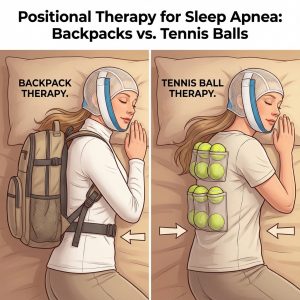
If you are reading this, you probably know the feeling. You wake up on your back, mouth dry as the Sahara, head pounding, with your partner staring at you in frustration because you’ve been rattling the windows for the last three hours. Or perhaps you’ve looked at your data and seen the ugly truth: your AHI (Apnea-Hypopnea Index) is manageable when you are on your side, but the moment gravity takes over and you roll onto your back, your airway collapses like a cheap tent.
I’m not a doctor; I’m a patient sharing what has helped me and what reputable sleep-medicine sources describe, and I treat this as peer-to-peer information—not a substitute for a sleep clinician’s advice. I am a guy who has spent years fighting the war against gravity. My primary weapon is a ResMed AirSense 11 Autoset, and for travel, I carry a ResMed AirMini. But even with the best machines in the world, physics is physics. If your jaw drops back and your tongue slides into your throat, pressure can only do so much.
For a big share of people with OSA—often reported as roughly half to three-quarters, especially in mild-to-moderate cases—the problem is “positional” (a pattern commonly described in the literature, e.g., on SpringerLink).
This is known as POSA (Positional Obstructive Sleep Apnea). The solution sounds simple: stop sleeping on your back.
But if you have ever tried to consciously control your body while unconscious, you know it is anything but simple. I have strapped backpacks to my torso, sewn tennis balls into shirts, and let expensive electronics buzz against my chest. I’ve tested a bunch of approaches, read the better-known studies and reviews up through late 2025, and dug through thousands of comments on ApneaBoard, SleepHQ, and Reddit.
This is a practical guide to what tends to keep you off your back—and what often just makes people miserable.
The Physics of the Problem: Why Supine is the Enemy
Before we spend money on gear, we need to understand the mechanism. When you sleep on your back (the supine position), gravity pulls the soft tissues of your palate and your tongue directly backward, narrowing or closing the airway.
For many of us, this creates a massive discrepancy in our numbers. You might have an AHI around 5 on your side (near the commonly used “normal” threshold) and an AHI of 35 on your back (well into the “severe” range as commonly defined, for example by Cleveland Clinic).
I’ve seen my own O2Ring trends line up with this pattern again and again. On nights where I manage to stay lateral, my oxygen levels remain stable.
On nights where I roll supine, I tend to see spikes in heart rate and drops in SpO2; if something looks consistently off, it’s worth bringing that context to your clinician.
Many clinicians treat positional therapy as an adjunct option: sometimes enough on its own for mild positional OSA, and often a way to make PAP easier to tolerate. Both NHLBI (NIH) and Mayo Clinic explicitly mention avoiding back-sleeping as a practical lever for keeping the airway more open. For those of us on PAP therapy, staying lateral can also lower the pressure the machine needs to deliver, which may reduce leaks and aerophagia (swallowing air).
But how do you force a sleeping body to obey?
The Rankings: What Actually Works (Patient Experience 2025/2026)
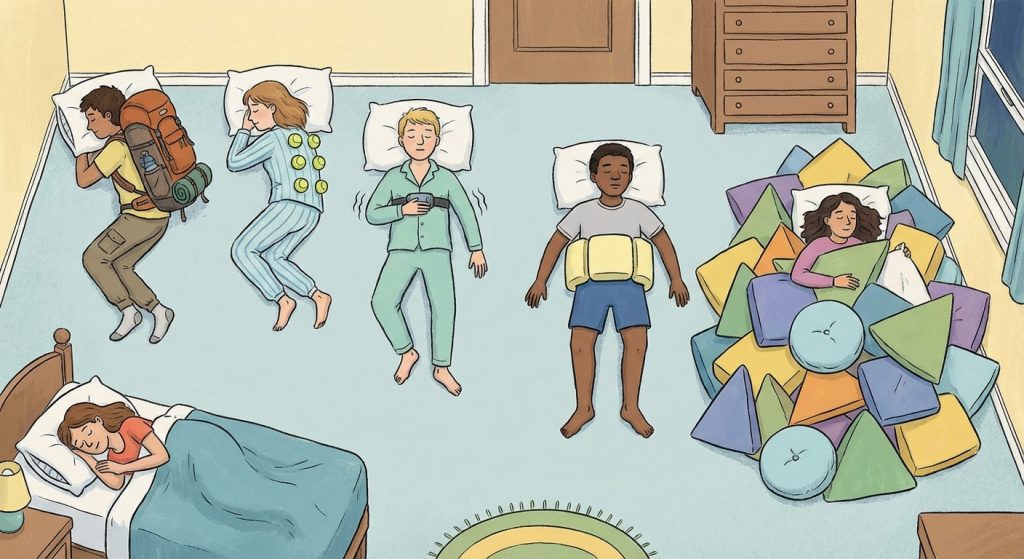
I have compiled this ranking not based on what should work in a lab, but based on what real people—myself included—actually tolerate long-term. We are looking for the sweet spot between “effective” (it keeps you off your back) and “livable” (you don’t throw it across the room at 3 AM).
1. The Vibration Trainers (Positional Vibe Device)
Examples: Philips NightBalance, NightShift, and generic “Smart Buzzers”.
In the battle of backpacks vs. tennis balls, the winner is actually neither. It’s the robot.
Over the last few years, both published research and patient reports have increasingly focused on vibro-tactile “position trainers” as a more tolerable alternative to pain-based hacks. A systematic review in the Journal of Clinical Sleep Medicine reported high short-term use for newer positional devices (often defined as ≥4 hours/night), with many studies landing in the ~76–96% range.
These are small sensors worn either on a strap around your chest (like a heart rate monitor) or on the back of your neck. They detect when you roll onto your back and deliver a vibration that increases in intensity until you roll over.
The “Training” Effect:
The genius of these devices is that they don’t rely on pain. They rely on conditioning. Over time, your brain learns to associate the supine position with the annoyance of vibration. Eventually, many users report they stop rolling onto their back entirely, even before the device vibrates. It becomes a subconscious reflex.
What the Community Says:
Clinical studies aren’t perfect (definitions of “use” vary), but the direction is consistent: short-term adoption tends to be solid, and longer-term adherence is more mixed. For example, a 6-month cohort study in the SLEEP journal reported objective adherence of about 64% when “use” was defined as ≥4 hours/night.
In the forums, the sentiment matches the stats. Users who failed with the tennis ball trick often find success here. One recurring comment on Reddit captures the vibe perfectly: “After failing with the tennis ball (it hurt, and I just slept on top of it), I switched to a sleep repositioner. It’s the only thing I haven’t quit.”
The Downsides:
It isn’t perfect. A minority of users report that the vibration doesn’t just nudge them—it wakes them up fully and fragments their sleep. If you are sensitive to fragmentation, this can make you feel as tired as the apnea itself.
There are also complaints about price; these are regulated devices rather than novelty gadgets, and insurance coverage varies widely.
My Take:
This is the gold standard for comfort. It allows you to move naturally until you hit the “danger zone.” If you can afford it, start here.
2. The “Bumper” Belts
Examples: Rematee, SlumberBump, Zzoma.
If you don’t trust batteries, or if the vibration wakes you up, the “Bumper Belt” is the next logical step. These are wide neoprene belts that strap around your chest, featuring inflatable bladders or foam blocks on the back.
Unlike a backpack, these are designed specifically for sleep. They are usually contoured and breathable. They work on a simple principle: if you roll back, you land on a foam block that makes it physically impossible (or at least very awkward) to stay there.
What the Community Says:
These are effective. Mechanically, they get the job done for a lower price point than the electronic options. However, the “comfort tax” is higher.
A common theme in reviews is the trade-off between effectiveness and pain. One user on SleepHQ noted: “It works almost too well. I can’t roll back, but staying on one hip all night gives me severe bursitis pain.”
This is a critical point. If you use a bumper belt, you need a mattress that forgives pressure points. If you are on a firm mattress and locked into a side position for 8 hours, your hips and shoulders will scream.
My Take:
A solid reliable option. It won’t run out of battery, and it won’t buzz. But be prepared to adjust your bedding to accommodate the constant side-sleeping pressure.
3. The Sleep Apnea Backpack (The Nuclear Option)
Examples: WoodyKnows, DIY trekking backpacks filled with towels.
This is exactly what it sounds like. You wear a backpack to bed. The idea is that the bulk of the pack makes supine sleep physically impossible.
The Reality of the “Rotisserie Chicken” Effect:
I call this the “Nuclear Option” because it is undeniable. You cannot sleep on your back wearing a filled backpack. However, the user experience is often brutal.
The biggest complaint—echoed repeatedly in forum discussions—is the heat and sense of restraint.
You feel trapped. Strapping a polyester bag to your back generates immense heat. Night sweats are common. Furthermore, the straps dig into your armpits.
What the Community Says:
“It works perfect… when I keep it on.” That is the catch. Many people wake up at 4 AM to find they have unclipped the backpack in a semi-conscious rage just to get comfortable.
There is also the issue of “The Twist.” A backpack can shift. Some users report waking up with their body on its side but their neck twisted at a 90-degree angle because the backpack caught on the sheets.
My Take:
Use this only if your POSA is severe and lighter methods fail. It is effective, but it is a miserable way to live every night.
4. The Pillow Fortress (Soft Geometry)
Examples: Pregnancy pillows, body pillows, “The Great Wall of Buckwheat.”
This is the most inviting option. You build a wall behind you. You use a U-shaped pregnancy pillow or a heavy buckwheat pillow wedged against your spine.
Why It Often Fails:
It feels safe and cozy. It helps with sleep hygiene because it’s relaxing. But statistically, it is the least reliable supine apnea treatment.
In REM sleep, muscle tone drops sharply (atonia), and in deeper sleep you’re simply less “in control.” A pillow, no matter how firm, is still compressible. We simply roll over it. Or, in a fit of sleep-movement, we push the pillow onto the floor.
What the Community Says:
Reviews are mixed. Some people swear a large, firm pillow at the back did the trick. But plenty of others admit they still wake up flat on their back, having found that the pillow has migrated somewhere useless (often on the floor… or on their chest).
My Take:
Great for comfort, not great for enforcement. If your oxygen desaturations are mild, this might be enough. If you see big drops, treat the pillow fortress as a comfort layer and verify with objective data that it’s actually keeping you non-supine.
5. The Tennis Ball Technique (TBT)
Examples: A tennis ball sewn into a pocket on the back of a t-shirt.
This is the classic advice doctors have given since the 1980s. “Just sew a tennis ball into your pajamas!” It is cheap, low-tech, and accessible.
In real life, it’s cheap and accessible—but long-term adherence tends to be poor.
The Data on Failure:
Long-term compliance with the tennis ball technique is abysmal. A published follow-up of the tennis-ball technique reported that continued use was in the single digits roughly 30 months after prescription (see PubMed). Why? Because it’s uncomfortable.
The sensation of a hard rubber ball digging into your spine is not a gentle reminder; it is a localized pain point. It causes micro-arousals. You wake up, shift, and try to sleep again.
The “Princess and the Pea” Immunity:
Even worse, many of us develop immunity. Some users report: “The tennis balls do nothing for me… I just sleep on them.”
Especially with modern memory foam mattresses, the ball just sinks into the foam, and your back remains flat.
My Take:
For many people, it’s not worth the discomfort. It’s an outdated hack that ruins sleep quality in the name of fixing sleep position. We have better tools now.
The “Side Effect” of Side Sleeping: Pain Management
If you successfully transition to 100% side sleeping, you are going to encounter new problems. We are not designed to lie on one trochanter (hip bone) and one deltoid (shoulder) for 8 hours straight.
The Hip and Shoulder Crisis
When you prevent supine sleep, you double the pressure on your side. This leads to hip bursitis and shoulder impingement. I found that I had to completely change my pillow setup.
I used to use a random foam pillow. Once I committed to side sleeping, I had to upgrade to a Tempur Sonata. The curve of the pillow allows room for the shoulder so it doesn’t bunch up toward the ear. If you are forcing side sleep, your pillow height must be exact to keep the cervical spine aligned. If it’s too low, your neck kinks down. Too high, it kinks up.
For the hips, a pillow between the knees is non-negotiable. It aligns the pelvis and prevents the top leg from dragging the spine into a twist.
The Ear Issue
Sleeping on your side means your ear is pressed against the pillow all night. This can cause Chondrodermatitis (painful ear cartilage) or simply block the ear canal, causing a heartbeat sound in your ear. I’ve found that using a pillow with a softer top layer, or a “donut” hole style pillow, helps mitigate this.
Integrating Positional Therapy with CPAP
Many people ask: “If I have a CPAP, why do I need positional therapy?”
I use my ResMed AirSense 11 Autoset every night. However, I still pay attention to my position. Why? Because pressure requirements change based on gravity.
When I am on my back, my machine has to ramp up the pressure (often to 14-15 cmH2O) to blast the airway open. High pressure means a higher chance of mask leaks. It means more air entering the stomach (aerophagia), which leads to painful bloating in the morning.
When I stay on my side, my machine purrs along at a gentle 8-9 cmH2O. The seal on my mask holds better. The noise is lower. The sleep is deeper.
Positional therapy isn’t a guaranteed replacement for CPAP; evidence reviews (including the Cochrane Library) generally find CPAP reduces AHI more than positional therapy, but positioning can be a very practical supplement that makes CPAP more tolerable.
For those traveling with a ResMed AirMini, which can be louder and harsher than the home units, staying on your side is critical. The lower the pressure needed, the quieter the travel machine will run.
DIY vs. Medical Grade: Is the Price Worth It?
There is a massive price gap. A tennis ball costs $1. A Philips NightBalance can cost hundreds. A generic sleep apnea backpack on Amazon is somewhere in the middle.
The “Fanny Pack” Hack:
If you want to try the “bumper” method without buying a $100 belt, here is a popular hack from the forums:
Take a standard fanny pack (waist bag). Stuff it with two rolled-up pairs of thick socks or a small foam football. Wear it backwards, so the pouch is on your spine.
- Pros: Cheap, adjustable.
- Cons: The strap is usually thin and cuts into your stomach. It tends to rotate during the night.
The “Towels in a Backpack” Hack:
If you try the backpack method, do not use books or hard objects. Use tightly rolled towels. You want bulk, not hardness. You are trying to create a shape that rolls you off, not a rock that bruises you.
The Verdict on Investment:
If you have confirmed POSA (via a sleep study or O2Ring data), invest in the comfortable gear. Sleep is a nightly event. Saving $50 to be in pain every night is bad math. The electronic vibration devices offer the highest quality of life because they allow the most freedom of movement until the critical moment.
Summary: Training the Brain
The goal of positional therapy is not to punish you for sleeping on your back. It is to retrain your brain’s spatial awareness during sleep.
The clinical data is clear: gravity is a major factor in apnea severity. The user experience data is equally clear: brute force methods like tennis balls and hard backpacks have high failure rates because they destroy sleep quality in other ways.
If you are going down this road:
- 1. Prioritize Vibration: Try the tech-based solutions first if budget allows. They are the most humane.
- 2. Respect the Hips: If you use a mechanical blocker (backpack/belt), you must upgrade your mattress topper or use knee pillows.
- 3. Monitor the Data: Don’t guess. Use your Apple Watch sleep tracking or an Oximeter to verify that your interventions are actually keeping your oxygen stable.
Gravity never sleeps, but with the right gear, you might finally beat it.

By: Alex Warenstein.
Bio: Alex Warenstein is a sleep biohacker and founder of Night Time Comfort. After battling chronic insomnia and circadian disruption, he now helps others optimize their sleep using data-driven protocols. Read full story.
Disclaimer: Alex is not a doctor. This content is for educational purposes only. Always consult a specialist.