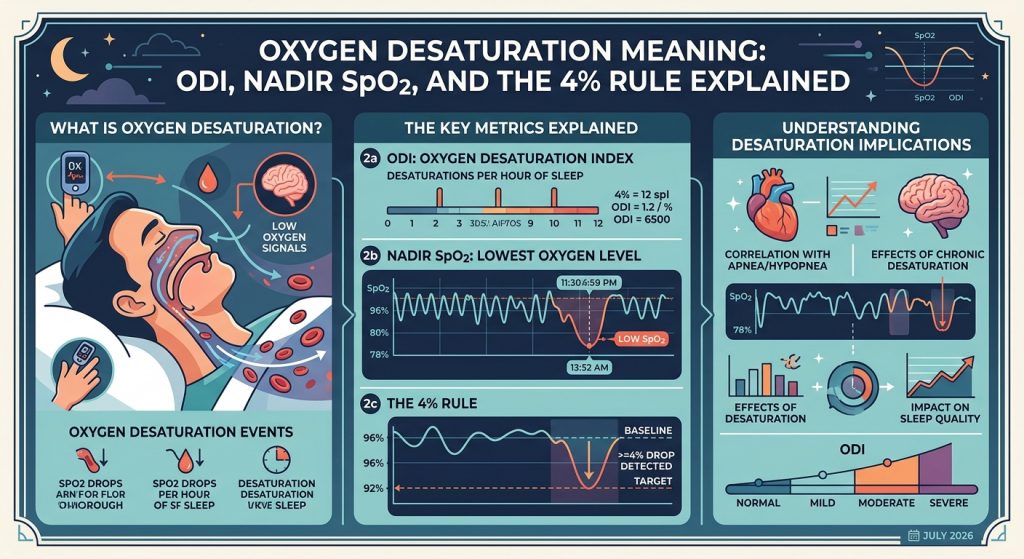
Oxygen desaturation means a drop in the oxygen saturation of your blood below its baseline level. In sleep medicine, it specifically refers to your blood oxygen (SpO2) falling by a defined amount — usually 3% or 4% — from the level just before the event. When it happens repeatedly through the night, it’s usually a sign that your breathing is being interrupted.
That’s the definition most people arrive here looking for. Below, I’ll unpack the terms you’ll see on a sleep report or in your home oximeter app, because the numbers are meaningless until you know what they’re measuring.
The core terms, defined
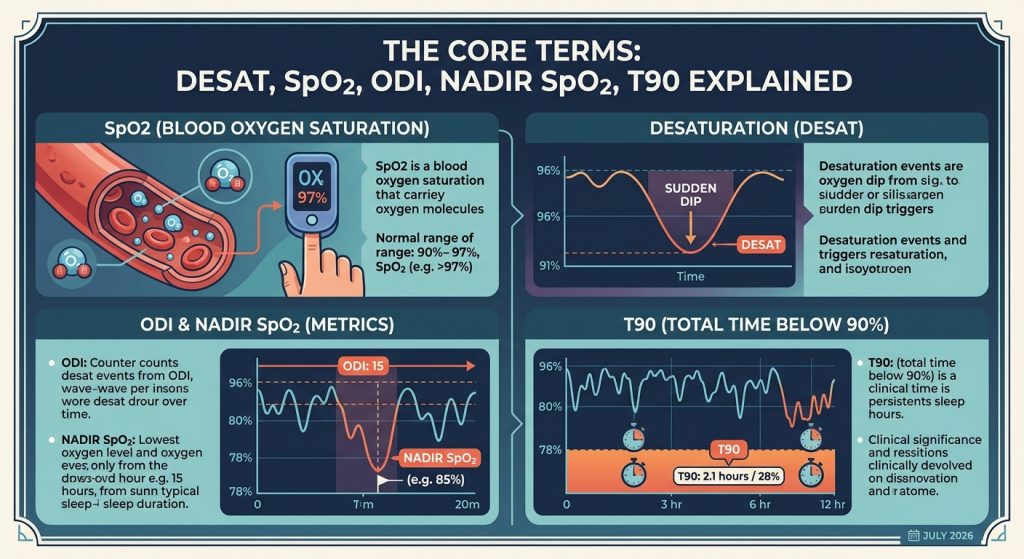
Desaturation. A drop in SpO2 from baseline. In sleep scoring, an event is counted when the drop meets a threshold — typically ≥3% or ≥4%.
Desat (medical shorthand). Clinicians say “desat” for the same thing. “The patient desatted to 88%” means their oxygen saturation fell to 88%.
SpO2. Peripheral oxygen saturation — the percentage of hemoglobin carrying oxygen, measured through the skin by a pulse oximeter. Normal awake values run roughly 95–100%.
ODI (Oxygen Desaturation Index). The number of desaturation events per hour of sleep. This is the headline number on most home oximetry reports.
Nadir SpO2. The lowest oxygen saturation reached during the night. “Nadir” simply means lowest point. A report might show a mean SpO2 of 95% with a nadir of 82% — meaning that on average you were fine, but at some moment you dropped substantially.
T90. The percentage of sleep time spent with SpO2 below 90%. It captures duration, which ODI ignores.
Hypoxemia. The medical term for abnormally low blood oxygen. Desaturation describes the drop; hypoxemia describes the resulting state.
How to read your ODI
ODI counts events per hour. The commonly used interpretation bands, using the 4% threshold:
- Under 5 — considered normal range
- 5 to 15 — mild
- 15 to 30 — moderate
- Over 30 — severe
These bands mirror the AHI (apnea-hypopnea index) categories used for sleep apnea severity, and clinical sources note an ODI of 5 or above may indicate mild sleep-disordered breathing, with 15 or above suggesting moderate to severe.
A critical caveat: ODI is not AHI. AHI counts breathing events scored from airflow and effort signals; ODI counts oxygen drops. They correlate but they are not interchangeable, and either can be elevated without the other. A home oximeter gives you ODI, not AHI — it can flag a problem, but it cannot diagnose sleep apnea.
A second caveat that matters more than most people realize: ODI measures oxygen drops from any cause. Lung disease, obesity-related hypoventilation, altitude, and even artifacts can raise it without any airway collapse involved.
The 3% vs 4% rule — why your report might disagree with itself
This confuses everyone, so here it is plainly.
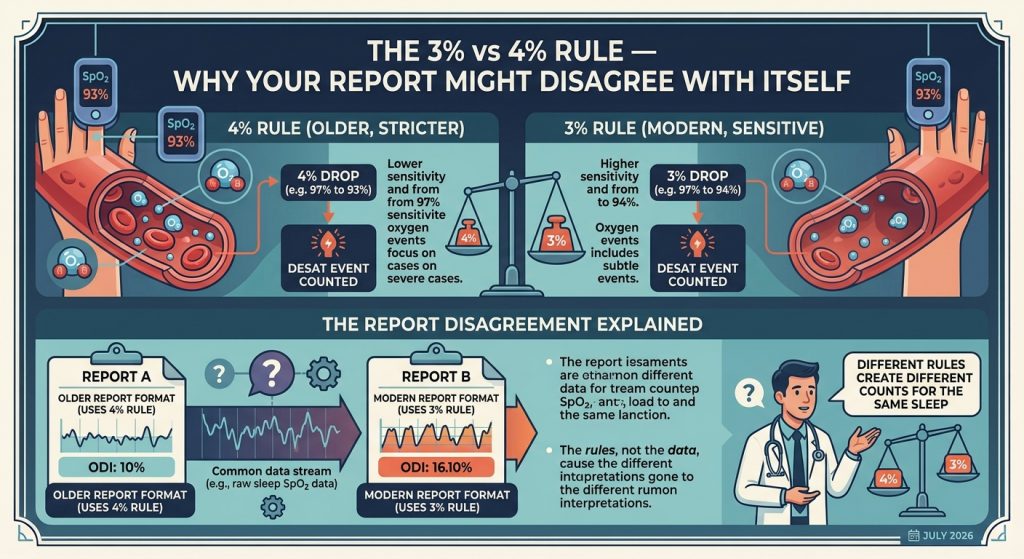
Scoring a hypopnea (a partial breathing reduction) requires an airflow drop plus either an oxygen desaturation or an arousal. The American Academy of Sleep Medicine’s recommended rule (1A) counts a hypopnea when airflow drops ≥30% for ≥10 seconds with a ≥3% desaturation and/or an arousal. The acceptable alternative rule (1B) requires a ≥4% desaturation and excludes the arousal criterion.
The consequence: the same night of sleep can produce two different severity scores depending on which rule was applied. The 4% rule is stricter and yields lower numbers. AASM guidance requires labs to state which rule was used in the report — so check yours.
This is not academic. It has real consequences for insurance coverage in some systems, and it’s a major reason people with genuine symptoms get told their study was “normal.”
Where this bites hardest is uars. In upper airway resistance syndrome, breathing is disturbed enough to fragment sleep through arousals, but oxygen often barely moves. Under a 4%-only rule, a UARS patient can look entirely normal on paper while feeling wrecked. Young, thin patients are especially prone to arousing before desaturating — which is exactly why a low ODI doesn’t mean nothing is wrong.
Nadir SpO2: how low is too low?
Nadir is the number that frightens people most, and it deserves context.
Brief dips are common and not automatically alarming — a single transient drop during REM in an otherwise clean night means something different from repeated deep desaturations all night. What clinicians generally weigh is the pattern: how low, how often, how long, and what else is going on.
As rough orientation only: nadir values in the low 90s are frequently seen and often unremarkable; sustained values below 90% attract clinical attention; and drops into the low 80s or below, particularly if repeated, are typically considered significant. These are not diagnostic thresholds, and I’m not giving you one — the same nadir means different things in a healthy 30-year-old and someone with COPD.
If your nadir is low, the correct action is showing it to a doctor, not interpreting it yourself.
What ODI misses: the newer metrics
Here’s where the field has moved, and it’s worth knowing because it explains why ODI alone can be misleading.
ODI is a count. It ignores depth and duration. A 4% dip lasting five seconds and a 15% plunge lasting a minute both count as exactly one event. That’s obviously losing information — as one review of oximetry parameters put it, the severity information beyond the arbitrary threshold is simply lost.
Two metrics address this:
T90 — the time spent below 90% saturation — captures duration. Its limitation is dependence on your baseline SpO2, which can be affected by lung disease or altitude rather than apnea.
Hypoxic burden — a more sophisticated measure integrating the area under each desaturation curve, capturing both depth and duration together. Research increasingly suggests hypoxic burden predicts cardiovascular outcomes better than AHI or ODI alone. You likely won’t see it on a consumer report yet, but it’s where the science is heading, and it’s a good reason not to over-invest in a single ODI number.
There’s a solid open-access review of these oximetry parameters in Diagnostics if you want the depth.
Reading your home oximeter data
This is where I can offer something the definitional pages can’t: I’ve spent years staring at my own overnight traces.
What a home oximeter genuinely gives you: an ODI, a mean and nadir SpO2, T90, and — crucially — a shape. The shape is what matters. Regular, repetitive sawtooth desaturations through the night look completely different from one isolated dip. The wellue o2ring is the device I’ve used most; I break down the interpretation process in o2ring data analysis.
Things that will fool you:
- Motion artifacts. Rolling over, a loose fit, or cold fingers produce sudden implausible drops. Real desaturations have a characteristic gradual descent and recovery; artifacts tend to be jagged and instantaneous.
- Positional patterns. If your desaturations cluster when you’re on your back, that’s meaningful — see positional therapy.
- Normal REM dips. Breathing is naturally less regulated in REM, and mild dips there can be normal.
- Altitude. Baseline SpO2 falls with elevation. Data from a mountain trip is not comparable to home.
The most important thing a home oximeter can tell you is whether to pursue a real test. A concerning pattern should send you toward a proper home sleep apnea tests or a lab study — the difference between them is covered in polysomnography vs home tests. And remember: a clean oximetry night does not rule out a sleep breathing problem, because of the UARS issue above.
Why any of this matters
Repeated desaturation isn’t just about feeling tired. The cyclical pattern of oxygen dropping and recovering — intermittent hypoxia and reoxygenation — resembles ischemia-reperfusion injury and drives oxidative stress. Research consistently associates elevated ODI with cardiovascular outcomes, including hypertension, and in some studies ODI predicts adverse cardiovascular outcomes better than AHI does.
That’s the reason to take a persistently elevated ODI to a doctor rather than filing it away.
What the community says
The sleep apnea communities — r/SleepApnea, r/CPAP, r/UARS, and ApneaBoard — are where people actually learn to read this data, and the recurring themes are worth summarizing:
- “My ODI is X, is that bad?” is one of the most-asked questions, and the most valuable community answer is consistently: the number alone doesn’t tell you — look at the shape, the position, and your symptoms.
- Enormous frustration about the 3% vs 4% rule. A recurring story is someone with clear symptoms told their study was normal, then discovering it was scored under the 4% rule without arousals. Experienced forum members routinely advise people to request their raw data and check the scoring rule.
- The UARS community is the loudest on this, precisely because their whole diagnostic experience hinges on arousals that oximetry misses. “Normal ODI, still exhausted” is practically the UARS origin story.
- Home oximeters are widely recommended as a first screening step — cheap, informative, and the thing that pushed many people to finally get tested. The standard caution attached is equally consistent: it screens, it doesn’t diagnose.
- Artifact identification is a genuine community skill. Regulars are good at spotting a movement artifact versus a real event in a posted graph, and often better than the device’s own software.
- Positional patterns get discovered constantly — people finding their desaturations happen almost exclusively supine, which changes their whole approach.
None of that replaces a clinician. But learning to read your own trace, with appropriate humility, made me a far better participant in my own care.
When to see a doctor
See a physician if you have: an elevated ODI on home screening; a low nadir SpO2, particularly if repeated; loud snoring, witnessed breathing pauses, or waking gasping; unrefreshing sleep and daytime sleepiness regardless of hours; morning headaches; or high blood pressure that’s difficult to control.
And especially: if you have symptoms but a “normal” study, ask which scoring rule was used and whether UARS was considered. That single question has changed a lot of people’s outcomes.
Emergency care is warranted for severe breathlessness, chest pain, or blue lips or fingertips.
FAQ
What does desaturation mean?
A drop in blood oxygen saturation below baseline. In sleep studies it’s counted when SpO2 falls by 3% or 4% from the immediately preceding level.
What is a normal ODI?
Under 5 events per hour is generally considered normal, 5–15 mild, 15–30 moderate, and above 30 severe. But ODI isn’t AHI, and a normal ODI doesn’t exclude sleep-disordered breathing — especially UARS.
What does nadir SpO2 mean?
The lowest oxygen saturation recorded during the night. It’s one data point among several; the pattern and duration matter as much as the single lowest value.
Is 88% oxygen dangerous during sleep?
A brief isolated dip and repeated sustained drops to that level mean very different things. Sustained values below 90% generally warrant medical attention. Take the actual trace to a doctor rather than judging a single number.
What’s the difference between the 3% and 4% rule?
They’re two AASM criteria for scoring hypopneas. The recommended rule uses a 3% desaturation and/or an arousal; the acceptable alternative uses 4% and excludes arousals. The 4% rule produces lower severity scores, which is why the same night can yield two different results.
Can a smartwatch measure oxygen desaturation?
Consumer wearables report SpO2 but are generally not accurate or continuous enough for reliable overnight desaturation analysis. A dedicated recording oximeter is a substantially better tool — and neither one diagnoses anything.

By: Alex Warenstein.
Bio: Alex Warenstein is a sleep biohacker and founder of Night Time Comfort. After battling chronic insomnia and circadian disruption, he now helps others optimize their sleep using data-driven protocols. Read full story.
Disclaimer: Alex is not a doctor. This content is for educational purposes only. Always consult a specialist.