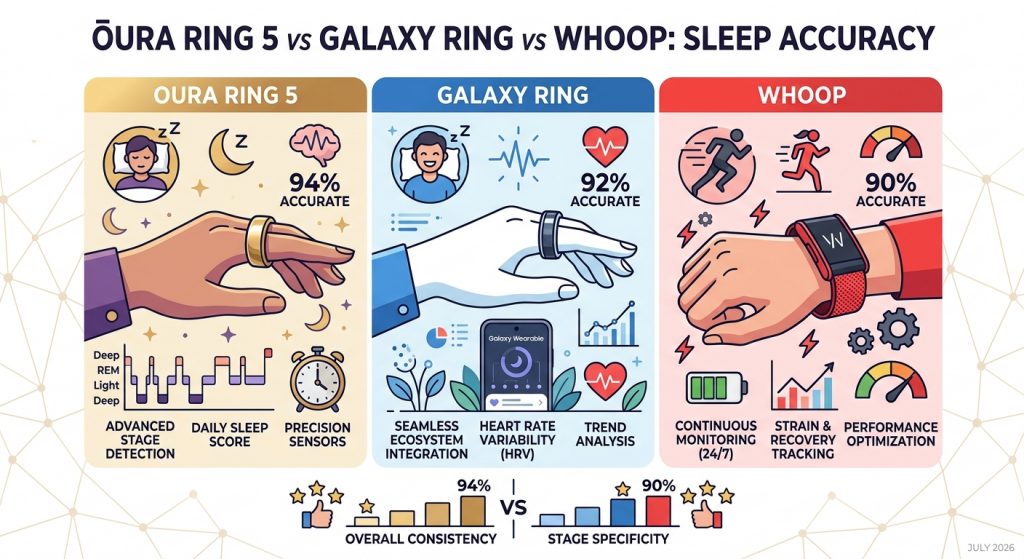
Here is the one thing to understand before buying any of them: Oura Ring 5, Samsung Galaxy Ring and Whoop do not measure sleep stages directly. They estimate them.
They see your pulse, small changes between beats, movement, temperature and sometimes blood oxygen. Then software guesses whether you were awake, in light sleep, deep sleep or REM. None reads brain activity. None is a medical sleep test, and none can diagnose insomnia or sleep apnea.
I am Alex Warenstein, 48, a sleep biohacker—not a doctor. I bought and used these trackers with my own money. Below I separate published research, my own comparisons and common user reports.
My answer in 30 seconds
- Best overall for sleep: Oura Ring 5. It has the best sleep-focused app, the most comfortable design of the three and the strongest body of published research behind earlier Oura generations. But the exact stage graph is still an estimate.
- Best without a subscription: Samsung Galaxy Ring. It is easy to wear, integrates well with Samsung Health and costs no monthly fee. Its weakness is evidence: I could not find an independent, peer-reviewed sleep-lab validation of the Galaxy Ring itself as of July 18, 2026.
- Best for training and recovery: Whoop 5.0. It is excellent at connecting sleep with strain, exercise and recovery. For a person whose main problem is waking at 3 a.m., it is usually more system—and more subscription—than necessary.
- Best for chronic insomnia or suspected apnea: possibly none of them. A tracker can show patterns. It cannot tell you why your sleep is broken.
What these devices really measure
A ring or wrist strap feels whether you move and watches the pulse signal under your skin. Sleeping people usually move less, their heart rate changes, and their beat-to-beat pattern shifts. The algorithm learns common patterns and assigns a sleep stage.
That works reasonably well when the question is simply, “Were you mostly asleep?” It becomes much harder when you lie still but awake. To the tracker, quiet wakefulness can look almost identical to sleep.
This is the central weakness for people with sleep-maintenance insomnia. Healthy sleepers make consumer trackers look better. Fragmented, restless nights expose the error.
What independent studies say
Oura: the strongest evidence, but not for Ring 5 yet
A 2024 Oura Gen3 validation study in healthy adults reported about 94.5% sensitivity for detecting sleep and roughly 73–75% specificity for detecting wakefulness.
In plain English: it usually recognized sleep, but it was less reliable when deciding that a motionless person was awake. Reported stage performance ranged from about 76% for light sleep to about 91% for REM, depending on how “accuracy” was calculated.
The more revealing result came from a 2025 clinical sleep-lab study of finger rings. In patients with varied sleep problems, Oura Gen3 detected only about 46% of wake periods, and four-stage classification accuracy was about 53%. It tended to miss wake after sleep onset and overestimate REM. Errors became more important on nights with more disrupted sleep.
The new Oura Ring 5 starts at $399. Oura advertises 95% sleep-staging accuracy, 99% heart-rate accuracy and 6–9 days of battery life. Those are manufacturer figures.
I did not find a peer-reviewed, independent polysomnography study specifically validating Ring 5 hardware and its current algorithm. Most independent evidence still comes from Gen3, with some newer physiological work including Gen4.
That does not make Oura useless. It means the answer to oura ring 5 accuracy is more nuanced than the product page suggests: pulse trends are strong; exact sleep stages deserve caution.
Whoop: good at sleep-versus-wake, modest at stages
A 2024 systematic review of Whoop, Fitbit and Garmin found that Whoop’s average sleep sensitivity was about 92%, while wake specificity averaged about 56%.
Stage sensitivity was roughly 60% for light sleep, 65% for deep sleep and 67% for REM, with overall stage agreement around 62%. These results mainly concern earlier Whoop versions and algorithms, not the current Whoop 5.0 system.
Whoop released a new sleep-staging algorithm in 2025 and says it improved stage detection by more than 7% and sleep-versus-wake classification by more than 3%. That is encouraging, but it remains a company-reported result until an independent research group reproduces it.
For overnight heart rate and HRV, Whoop performs much better than its stage labels suggest. A 2025 comparison found strong agreement for Oura Gen3, Oura Gen4 and Whoop 4.0, with Oura Gen4 performing best in that study.
This is why I trust multi-night recovery trends more than a single result claiming exactly 43 minutes of deep sleep.
Samsung Galaxy Ring: useful product, thin validation
The Samsung Galaxy Ring tracks movement, pulse, temperature and blood oxygen, then produces sleep stages and a sleep score. It costs $399.99 in the US, has up to seven days of battery life and does not require a paid subscription.
The problem is not the feature list. It is the lack of independent evidence. I found Samsung material and many user reports, but no peer-reviewed study comparing the Galaxy Ring itself against a full sleep-lab test.
Samsung has regulatory clearance for sleep-apnea detection on certain Galaxy Watches in some markets, but that should not be confused with the Ring diagnosing apnea.
For buyers asking for the most accurate sleep tracker, that evidence gap matters. Galaxy Ring may be adequate for trends, but its sleep-stage claims are less independently supported than Oura’s.
My brief comparison with real EEG
I borrowed a Hypnodyne ZMax from a friend and wore it alongside consumer rings on selected nights. On one night, a ring showed a clean block of “deep sleep,” while the brain signal did not support that neat block.
This was not a formal study. It was a personal check. But the pattern matched the published research: total sleep and general timing were often directionally useful; stage-by-stage charts and quiet nighttime wakefulness were much less dependable.
That is the practical difference in sleep tracker vs polysomnography. A clinical test observes signals that define sleep. A consumer tracker observes body signals that correlate with sleep and makes a probability-based guess. For a fuller explanation, see polysomnography vs home tests.
Where each tracker wins
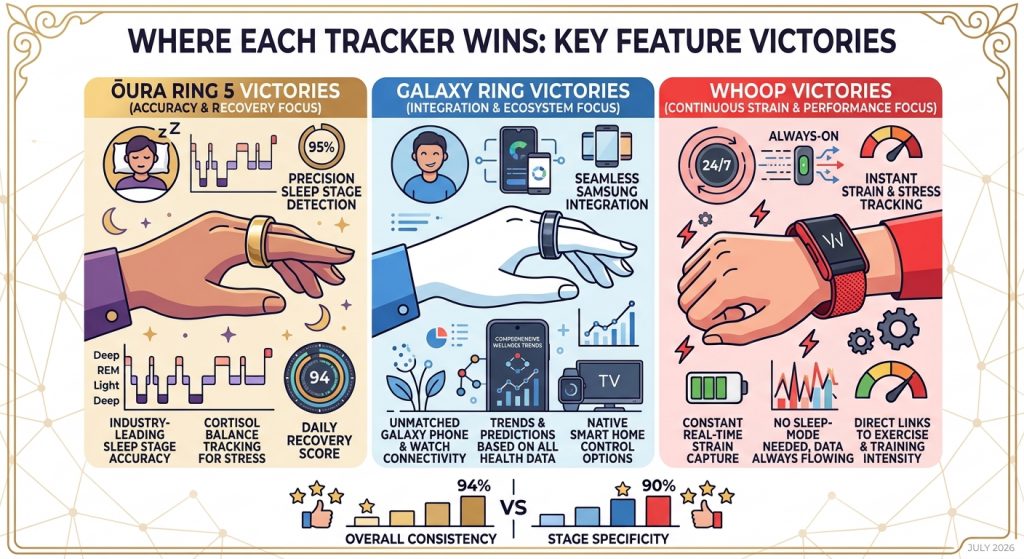
Oura Ring 5: best pure sleep experience
Oura is my first choice for someone who mainly wants sleep, recovery and health trends. The app is clear. Tags make experiments easy. The ring is smaller and lighter than earlier models, and its 6–9-day battery is practical.
Oura also has more independent sleep research than the other two, even though much of it is based on Oura Ring Gen 4 and Gen3-era methods rather than Ring 5 itself.
Its disadvantages are the $5.99 monthly membership and the risk of treating its polished graphs as ground truth. At $399 plus monthly membership, approximate ownership is $543 over two years and $615 over three years.
Samsung Galaxy Ring: best no-subscription choice
Galaxy Ring is the cleanest purchase for a Samsung phone owner who wants basic sleep trends without another recurring bill. Approximate two- and three-year cost remains $400, excluding replacement or damage.
I would choose it for comfort, battery life and ecosystem—not because it has proven superior sleep accuracy. Read my dedicated Samsung Galaxy Ring review before buying.
Whoop 5.0: best for athletes
The whoop vs oura decision is simple. Choose Oura when sleep and everyday health are the priority. Choose Whoop when training load, recovery and behavior coaching are the priority.
Regular US pricing for Whoop 5.0 membership is approximately $199 per year for One and $239 per year for Peak. That makes three-year ownership roughly $597 to $717. Promotional first-year prices may be lower.
Battery life is 14+ days. There is no screen, and the device can be charged while you wear it.
For an athlete, that recurring analysis may be worth it. For a poor sleeper who does not train seriously, Whoop 4.0 and 5.0 can bury a simple sleep question under recovery scores.
What users consistently report
Across Reddit sleep, Oura, Whoop, Galaxy and quantified-self communities, four themes repeat.
- First, allow a calibration period. Whoop needs time to build a baseline. Oura and Galaxy also become more useful after several consistent weeks, even when they produce scores immediately.
- Second, trust trends more than exact nightly numbers. Users commonly notice that reading quietly in bed becomes “sleep,” that nighttime wakefulness is shortened, or that stage totals change after an algorithm update.
- Third, each device has characteristic complaints. Oura users mention false sleep during stillness and frustration with membership. Whoop users mention changing recovery or sleep results after software updates and the annual cost. Galaxy Ring users praise the lack of subscription but report occasional missing sleep, syncing or battery problems.
These are community observations, not controlled evidence.
- Fourth, the score can become the problem. Some people feel rested until the app gives them a bad score. Others extend time in bed trying to “earn” more deep sleep. That can make insomnia worse.
Orthosomnia: when tracking harms sleep
Orthosomnia means becoming preoccupied with obtaining perfect sleep data. Sleep clinicians introduced the term after seeing patients whose tracker-driven efforts were increasing anxiety.
A 2024 study estimated that roughly 3–14% of adults may meet proposed criteria, depending on the definition used.
Take the tracker off for at least two weeks when:
- your morning mood depends on the score;
- you check the app during nighttime awakenings;
- you stay in bed longer to improve the number;
- you distrust feeling rested because the graph says otherwise;
- tracking makes bedtime feel like a test.
A tracker should reduce uncertainty. When it increases uncertainty, it has stopped doing its job.
Do not use a ring to rule out sleep apnea
Snoring, gasping, witnessed breathing pauses, morning headaches, frequent urination at night and strong daytime sleepiness deserve proper evaluation. Neither Oura, Galaxy Ring nor Whoop can exclude obstructive sleep apnea OSA.
Blood-oxygen and breathing-disturbance graphs can suggest that something deserves attention, but a normal-looking night does not clear you.
A Wellue O2Ring can provide denser oxygen trends, and careful O2Ring data analysis may help you document a pattern. It still does not diagnose the cause.
The next step is usually a clinician and, when appropriate, one of the validated home sleep apnea tests.
How to use tracker data without fooling yourself
Wear the device consistently for two or three weeks before judging your baseline. Then change one variable at a time for at least seven nights. Examples include an earlier caffeine cutoff, no alcohol, a cooler bedroom, a fixed wake time or morning outdoor light.
Watch four things:
- 1. total sleep time as a multi-night trend;
- 2. bedtime and wake-time consistency;
- 3. resting heart rate and HRV trends;
- 4. how you actually feel and function the next day.
Do not optimize isolated deep-sleep or REM minutes. Do not change five habits together. Write a simple prediction before each experiment, then compare weekly averages.
The device is useful when it helps you make a decision, not when it gives you another graph to admire.
Final verdict
For most people asking oura vs galaxy ring vs whoop, my ranking is:
Oura Ring 5 is the best overall sleep tracker, because the product is comfortable, the app is mature and Oura has the strongest research base. I still would not trust its exact stage minutes.
Samsung Galaxy Ring is the best value over several years, especially for Samsung users who refuse subscriptions. Its trade-off is the weakest independent validation.
Whoop 5.0 is the best recovery system for serious training, but not the best-value purchase for insomnia alone.
And for people who become anxious about numbers, wake repeatedly at night or need to investigate apnea, the best choice may be no consumer tracker at all.
FAQ
Do sleep trackers work?
Yes, for broad patterns such as bedtime, wake time, total sleep trends, resting pulse and HRV. No, not as exact measurements of each sleep stage or as diagnostic tools.
Which device is the most accurate for sleep?
Oura has the strongest independent evidence and is my overall pick. That does not mean every Oura stage label is correct, especially during fragmented sleep or quiet wakefulness.
Is Oura Ring 5 clinically validated?
Oura publishes strong internal accuracy claims, but I did not find an independent, peer-reviewed sleep-lab validation specific to Ring 5 by July 18, 2026. Evidence from older Oura generations is useful but not identical.
Is Whoop more accurate than Oura?
For exercise and recovery coaching, Whoop is more complete. For sleep-focused use and independent research depth, Oura has the advantage. Neither should be treated as an EEG.
Can Samsung Galaxy Ring detect sleep apnea?
It may show blood-oxygen and sleep-related trends, but the ring is not a diagnostic apnea test. Samsung’s regulated apnea feature applies to compatible Galaxy Watches in supported markets, not to a medical diagnosis made by Galaxy Ring.
Should I buy a tracker to understand why I cannot sleep?
Only when you will use it for controlled habit experiments and long-term patterns. A tracker can show when sleep changes. It usually cannot identify the medical or psychological reason by itself.

By: Alex Warenstein.
Bio: Alex Warenstein is a sleep biohacker and founder of Night Time Comfort. After battling chronic insomnia and circadian disruption, he now helps others optimize their sleep using data-driven protocols. Read full story.
Disclaimer: Alex is not a doctor. This content is for educational purposes only. Always consult a specialist.