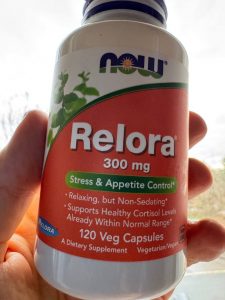
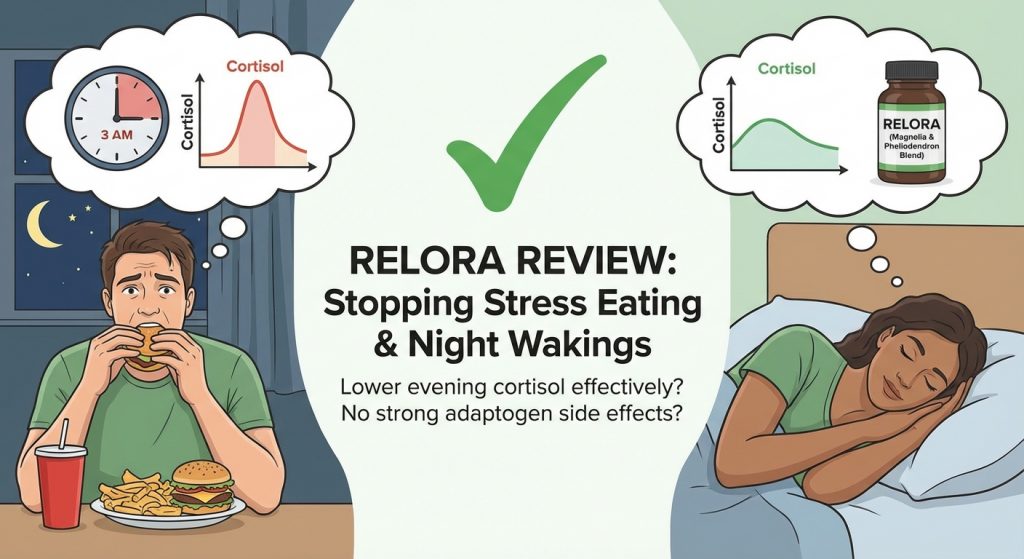
You eat well all day. You exercise. But at 8:00 PM, the cravings hit. You raid the pantry for sugar or carbs. Or, you fall asleep fine, but wake up at 3:00 AM with a racing heart and a gnawing hunger that sends you to the kitchen.
This is not always a lack of willpower. For many people, it’s physiology: when your stress system stays “on” late in the day, cravings and middle-of-the-night wakeups become more likely.
Elevated evening stress signaling (including cortisol) is often discussed as a driver of “stress eating” and sleep fragmentation. Cortisol normally follows a strong day–night rhythm, but stress, inconsistent light exposure, and lifestyle patterns can nudge that curve later into the evening (Endocrine Reviews). Ashwagandha can feel like a heavy hitter for perceived stress, but a subset of people report feeling emotionally “flat,” and some prefer to avoid it if they have thyroid-related concerns (NCCIH).
Enter Relora.
It is a patented blend of two ancient tree barks: Magnolia officinalis and Phellodendron amurense. Although it is marketed primarily for “cortisol belly” and stress eating, biohackers are increasingly using it as a sleep aid for maintenance insomnia.
In this review, I analyze the science behind magnolia bark’s sleep benefits, investigate whether it can really stop the 3 AM wake-up call, and share my 7.5/10 experience using it as an Ashwagandha alternative.
What is Relora?
The Blend:
Relora is a proprietary mix of:
- 1. Magnolia Bark: Rich in honokiol and magnolol. These compounds interact with GABA-A receptors (similar to Valerian) but without heavy sedation. They are potent anxiolytics.
- 2. Phellodendron Bark: Traditionally used to reduce “heat” (inflammation) and dampen the stress response.
Mechanism of Action:
It binds to stress receptors in the nervous system to promote relaxation and normalize the HPA (Hypothalamus-Pituitary-Adrenal) axis. Unlike sedatives that force sleep, Relora lowers the “activation energy” of stress, making it easier to drift off and stay asleep.
Does Relora contain berberine?
While Phellodendron bark naturally contains berberine, Relora is standardized for specific amounts of honokiol and berberine, but it is not a high-dose berberine supplement.
Efficacy: Cortisol and Weight
Does Relora help with weight loss?
It is not a fat burner. However, in placebo-controlled studies, Relora has been associated with lower salivary cortisol exposure (about 18% vs placebo over ~4 weeks) and improved mood/stress scores (Journal of the International Society of Sports Nutrition). In a separate pilot trial in healthy women, researchers reported improvements in stress/anxiety measures (with sleep tracked as a secondary outcome) (Nutrition Journal).
The Sleep Link: If your 3 AM wake-ups come with that “wired + hungry” feeling, it’s often a mix of stress physiology and habit (late snacking, alcohol, long fasting windows, etc.). Sleep-maintenance insomnia has many causes, but stress and circadian disruption are common contributors (Sleep Foundation).
What immediately lowers cortisol?
Deep breathing and acute stress reduction techniques work instantly. Relora works over hours to lower the baseline so the spike doesn’t happen.
Relora vs. The Competition
What is the best herb to reduce perceived stress (and the evening “wired” feeling)?
- Ashwagandha (e.g., KSM-66): Often feels stronger for perceived stress, but not everyone tolerates it (some report feeling emotionally “flat,” and some avoid it with thyroid concerns). Best for people who respond well to it.
- Relora: Often feels milder and more “evening-friendly,” especially for people who associate stress with cravings. Best for evening stress.
- Phosphatidylserine: Best for blunting acute exercise-induced cortisol spikes.
Is it safe to take valerian root every night for sleep?
Many people use Valerian nightly, but it’s more of a sedative. Relora is typically used more as a calming, stress-response tool.
Verdict: If you can’t sleep because your body hurts/is tense, take Valerian. If you can’t sleep because you are stressed/hungry, take Relora.
Reddit & Community Consensus
I analyzed threads on r/Biohackers, r/Supplements, and r/PCOS (where it is popular for hormonal stress).
The Good:
- 1. “The Snack Stopper”: The most consistent report is the death of evening cravings. Users report simply “forgetting” to eat junk food after dinner.
- 2. “No Hangover”: Unlike melatonin or antihistamines, users wake up clear-headed.
- 3. “Gentle Calm”: Users describe it as taking the “edge” off without feeling drugged. It is often compared to a “glass of wine without the alcohol.”
The Bad:
- 1. “Too Weak for Insomnia”: For severe sleep onset insomnia (staring at the ceiling for hours), users find it insufficient. It helps you stay asleep better than it helps you fall asleep.
- 2. “Digestive Issues”: A small minority report loose stools, likely due to the Phellodendron.
- 3. “Tolerance”: Some users report the effects fade after 2-3 months, requiring a cycle break.
Alex’s Personal Review
The following is based on my personal logs.
I swapped out my Liposomal Apigenin for Relora (300mg x 2) for one week to see if it could handle my evening wind-down.
My Experience:
I took one capsule (300mg) at dinner (6 PM) and one capsule 90 minutes before bed (9:30 PM).
- The Feeling: It is subtle. I didn’t feel “sleepy.” However, I noticed I wasn’t pacing around the kitchen looking for snacks. The evening felt smoother.
- Sleep Onset: It took me longer to fall asleep than with Apigenin. Apigenin actively quiets my thoughts; Relora just lowered my physical stress.
- Sleep Maintenance: This was the win. My Apple Watch showed solid Deep Sleep numbers, and I slept through the night without the 4 AM wake-up on 5 out of 7 nights.
My Rating: 7.5/10
It works well as a cortisol manager. If your sleep issues are tied to stress-eating or waking up anxious/hungry, this is a top-tier supplement. If you just have a “racing mind” (thoughts looping), Apigenin or Magnesium L-Threonate are better tools.
Where to Buy:
NOW Foods and Source Naturals both sell the patented Relora blend on iHerb.com. If you’re comparing brands, prioritize cGMP manufacturing and independent quality verification (for example, the USP dietary supplement program).
Safety & Side Effects
Does Relora have side effects?
- Drowsiness: Mild.
- Digestion: Potential for loose stools.
What medications should not be taken with Relora?
Because Relora leans on GABA-ergic calming, many people avoid stacking it with alcohol or prescription sedatives (like benzodiazepines) on the same night.
Update for January 2026:
Since September 2025, here are the most relevant updates for the “stress eating + night waking” use-case that Relora is commonly used for.
1. Chronic insomnia looks less “benign” than we used to think (Sep 2025).
A large cohort analysis linked chronic insomnia with a higher likelihood of later cognitive impairment/dementia markers—another reason to treat repeated night wakings as a real signal, not just an annoyance (Neurology).
2. Sleep quality is now being linked to “brain age” (Epub Sep 30, 2025).
A brain-imaging study found that poorer overall sleep health correlated with older-appearing brains, with systemic inflammation highlighted as one plausible bridge (The Lancet (EBioMedicine)).
3. Menopause/perimenopause management guidelines were updated (Oct 2025).
The European Society of Endocrinology released a new guideline emphasizing that sleep disruption in the transition is multifactorial—and that lifestyle + behavioral strategies sit alongside medical options; supplements like Relora are best framed as adjunct tools (European Society of Endocrinology).
4. Chrononutrition got another credibility bump (Nov 2025).
A 2025 review pulled together evidence that what/when you eat can measurably shift daily cortisol secretion patterns—supporting the “earlier dinner + less late grazing” playbook that many stress-eaters report helps (International Journal of Molecular Sciences).
5. A simple “anti-craving” rule went mainstream (updated Dec 2025).
A behavioral trick popular in biohacking circles is to pre-decide that the “late-night you” has zero authority to negotiate snacks. Relora can reduce the physiological push for some people; this rule reduces the decision fatigue that makes cravings win (Hone Health).
Summary
Relora is the stress-eater’s sleep aid.
- Buy it if: You crave carbs at night, wake up hungry, or want a cortisol lowering agent without the risks of Ashwagandha.
- Skip it if: You need a heavy sedative for sleep onset.

By: Alex Warenstein.
Bio: Alex Warenstein is a sleep biohacker and founder of Night Time Comfort. After battling chronic insomnia and circadian disruption, he now helps others optimize their sleep using data-driven protocols. Read full story.
Disclaimer: Alex is not a doctor. This content is for educational purposes only. Always consult a specialist.