Introduction: The Silence of the Labs
I’m Josh. I am a friend of Alex, and while he navigates the complex world of sleep optimization from a biohacking perspective, I deal with the brute force reality of Obstructive Sleep Apnea (OSA). My throat closes when I sleep. It’s not subtle, it’s not just “tired but wired“—it is a mechanical failure of my airway.
For years, the gold standard in my world has been ResMed. If you go to a sleep lab study or undergo Polysomnography, you will likely see a ResMed device. But in the forums, specifically the deep corners of German and European sleep boards, there is a legendary whisper about a machine that is built like a tank but sounds like a ghost.
That machine is the Lowenstein Prisma Smart Max.
It is a polarizing device. To some, it is the quietest CPAP ever made, a savior for light sleepers and their partners. To others, it is a breathing nightmare that feels “out of sync” with their lungs. I have spent months analyzing this device, digging through Apneaboard threads, translating German user manuals, and comparing it directly against the popular ResMed AirSense 11.
If you are looking to treat OSA and are sensitive to noise, this might be your holy grail. But if you are coming from a ResMed background or have specific breathing rhythm needs, you need to read this review very carefully before you buy. This is not just about air pressure; it is about the philosophy of the algorithm.
The Hardware: German Engineering at Its Finest
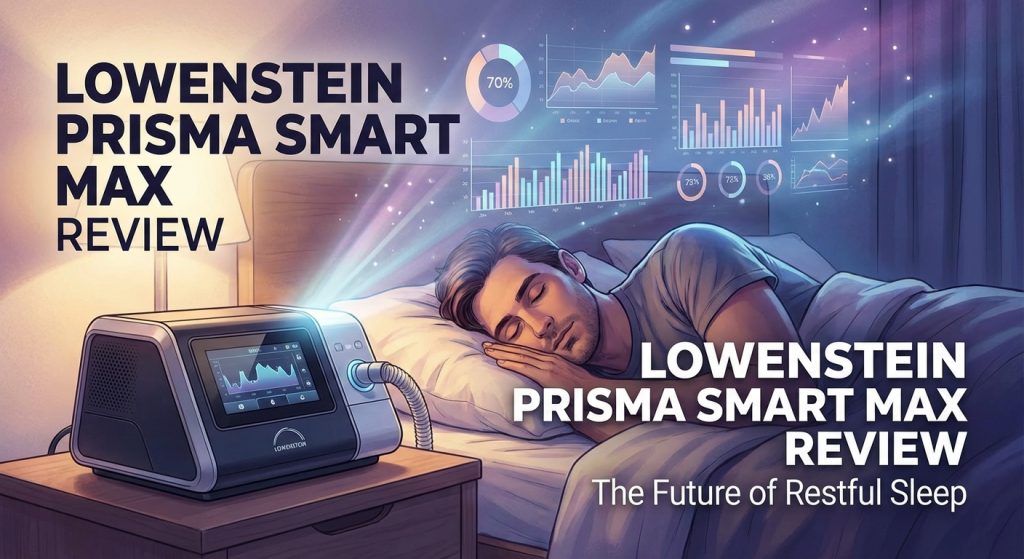
When you unbox the Prisma Smart Max, the first thing you notice is the build quality. Unlike the increasingly plastic and lightweight feel of the newer ResMed AirSense 11 Autoset, the Lowenstein feels substantial. It sits on the nightstand with authority. It doesn’t slide around when you pull on the hose.
The screen is large, the buttons are tactile (no finicky touchscreens here), and the water chamber for the humidifier is massive compared to the tiny tub in the AirSense 11. But the real engineering marvel is hidden inside the casing: the sound dampening.
The “Silent Sleep Machine” Claim
Marketing materials love to throw around decibel numbers, but in the real world, tone matters more than volume. The Prisma Smart Max is rated around 26 dB(A) at 10 hPa. On paper, this is similar to competitors. In reality, the sound profile is completely different.
The ResMed machines have a characteristic “whine” or “whoosh” as the turbine speeds up and slows down with your breath. The Lowenstein Prisma Smart Max absorbs that sound. The turbine noise is lower-pitched, a dull hum that disappears into the background noise of a room. For the user, the noise conducted through the tube is minimal. For the bed partner, the machine is virtually inaudible.
If your primary barrier to CPAP compliance is the noise of the motor keeping you or your spouse awake, the Lowenstein features win hands down. It is, without a doubt, the quietest machine I have encountered.
The Algorithm: Standard vs. Dynamic
The Prisma Smart Max operates on an APAP (Automatic Positive Airway Pressure) basis, meaning it adjusts pressure breath-by-breath to keep your airway open. However, unlike American machines that usually have one “Auto” mode, Lowenstein offers two distinct flavors of therapy response: Standard and Dynamic.
Standard Mode
This is the default “gentle” mode. It increases pressure slowly in response to obstructive events (apneas and hypopneas). It is designed for patients who are sensitive to rapid pressure changes and who might wake up if the machine “revs up” too quickly. It prioritizes sleep continuity over aggressively eliminating every single flow limitation immediately.
Dynamic Mode
This is where the machine flexes its muscles. In Dynamic mode, the pressure increase is faster and more aggressive. It responds more proactively to obstructive events and flow limitations.
In theory, Dynamic mode sounds superior. We all want our apnea treated, right? However, this aggressive rise in pressure can be jarring. Many users on European forums report that Dynamic mode can overshoot, leading to leak issues or mask blowouts if your mask fit isn’t perfect.
For UARS (Upper Airway Resistance Syndrome) sufferers, there is a common misconception that the Dynamic mode is the solution because it targets flow limitations. While logical, in practice, the machine’s synchronization issues (which we will discuss shortly) often make it unsuitable for UARS patients who are already hyper-sensitive to airflow changes. This machine is an OSA specialist; don’t try to force it to be a UARS bilevel.
The “SoftPAP” Controversy: Why It Is Not EPR
This is the most critical section of this review. If you take nothing else away, understand this: SoftPAP is not ResMed EPR.
Most people moving to the Prisma Smart Max are coming from a ResMed background where they used Expiratory Pressure Relief (EPR). EPR is intuitive. When you breathe out, the machine drops the pressure to make it easier. When you start to breathe in, it smoothly raises the pressure back up to support the airway. It feels like natural breathing, just amplified.
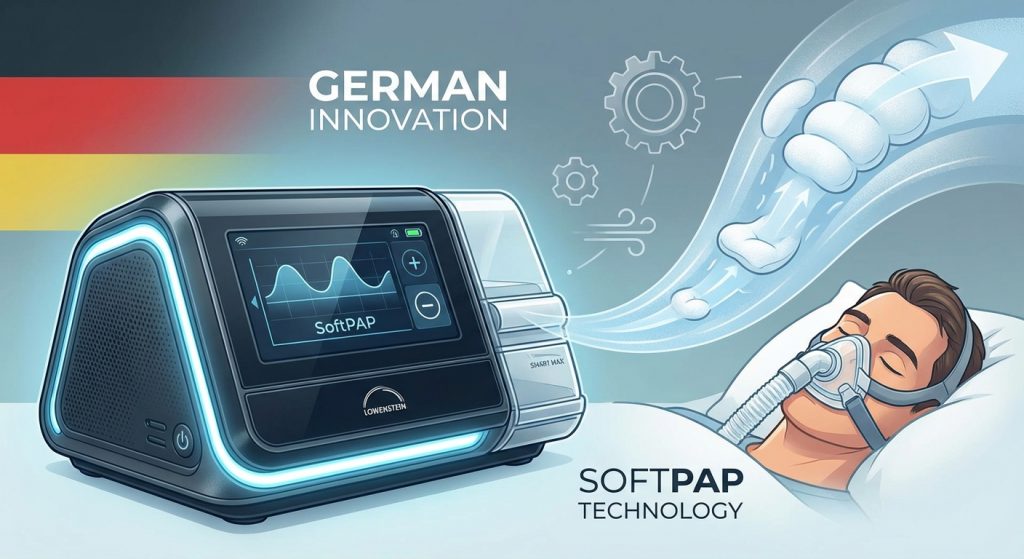
The SoftPAP algorithm is different. It is designed to lower pressure during exhalation, yes, but the timing of that drop and the subsequent rise is where the trouble begins for many users.
The Synchronization Issue (The “Hiccup”)
A significant number of users—enough to form a statistical trend on Reddit and Apneaboard – report a sensation of “fighting” the Prisma Smart Max.
The issue is often described as a “hiccup” or a “hole” in the breath. Here is what happens: You are finishing your exhalation and beginning to inhale. Your lungs expect the pressure to support you immediately. However, the SoftPAP algorithm sometimes lags or misinterprets the start of the inhalation phase. It keeps the pressure low for a split second too long, or worse, it drops the pressure prematurely while you are still finishing a deep inhalation.
This creates a feeling of air starvation or a mechanical “jerk” in the breathing rhythm. You feel like you are gasping for air for a fraction of a second before the machine catches up.
For a person with severe Obstructive Sleep Apnea who sleeps like a log, this might go unnoticed. But if you have any degree of sensitivity, or if you are used to the buttery-smooth synchronization of a ResMed AirSense 10 or 11, this can be a dealbreaker.
SoftPAP Levels
- SoftPAP 1 & 2: These offer mild pressure relief. Even at these lower settings, sensitive users report the “out of step” feeling.
- SoftPAP 3: This is only available on some specific models (like the Prisma 20A or the Lowenstein Prisma 25S BiPAP) and offers a more significant drop, but paradoxically, the sync issues can feel more pronounced because the pressure gap is wider.
The consensus from the community is clear: The Prisma vs ResMed debate ends here for many. ResMed’s Easy-Breathe motor follows your breath. Lowenstein’s SoftPAP feels like it is dictating your breath.
Treating Apnea: Does It Work?
Despite the comfort complaints regarding SoftPAP, does the machine actually stop breathing events? Yes.
The Prisma Smart Max is a medical-grade device approved for therapy in rigorous healthcare systems like Germany and France. When looking at the data, the machine is highly effective at stabilizing the airway and reducing the AHI (Apnea-Hypopnea Index).
Forced Oscillation Technique (FOT)
Like ResMed, the Prisma uses a Forced Oscillation Technique to distinguish between Obstructive Apnea (blockage) and Central Apnea (brain doesn’t signal to breathe). When you stop breathing, the machine pulses the air slightly. If the pulses bounce back, the airway is closed (Obstructive), and it raises pressure. If the pulses pass through, the airway is open (Central), and it does not raise pressure (which would be the wrong response).
The detection algorithm is top-tier. In bench tests and user reports, the Prisma Smart Max rarely misses an event. The issue is never “Does it treat the apnea?” The issue is “Can I stay asleep while it treats the apnea?”
Data Analysis: OSCAR Compatibility
We live in the era of the quantified self. Alex tracks his oxygen with a Wellue O2Ring and his glucose with a CGM. For us apnea patients, our data lives on the SD card.
The official Prisma APP is, to be polite, basic. It gives you a score and some hours of usage. It is not enough for anyone trying to optimize their therapy.
Fortunately, the Prisma Smart Max is compatible with OSCAR (Open Source CPAP Analysis Reporter). This is non-negotiable for anyone serious about sleep. You can take the SD card out of the Prisma, plug it into your computer, and import the data into OSCAR.
What You Can See in OSCAR
With this machine, you get detailed breath-by-breath data. You can see:
- Flow Rate: The shape of every breath.
- Leak Rate: Critical for knowing if your ResMed N30i AirTouch or Bleep mask is sealing correctly.
- Pressure Graph: Watching how the Standard or Dynamic mode responds to your events.
- Flow Limitations: Though users report that turning off SoftPAP changes how these are flagged.
A note on data transparency: Some users have noted that when SoftPAP is enabled, the flow limitation flags in the data can become erratic or disappear entirely in the reporting, even if the limitation is physically happening. This is another reason why advanced users often end up turning SoftPAP off entirely.
Daily Living with the German Tank
The Humidifier
The humidifier on the Prisma Smart Max is a large tub that slots deep into the machine. It has a huge capacity, which is excellent if you live in a dry climate or sleep for 10 hours. However, cleaning it is more difficult than the clamshell design of the AirSense 11. It has nooks and crannies that are hard to reach with a cloth. You will need to be diligent about hygiene to prevent mold, similar to the discipline required for a sleep hygiene checklist.
The Tube and Connections
The machine uses a standard ISO connection, meaning you can use any standard CPAP tubing. You can use a heated tube (Hybernite or the proprietary Lowenstein heated tube) to prevent rainout (condensation). This is compatible with almost all masks, from the ResMed N30i AirTouch to the Bleep Eclipse mask.
The Modem vs. SD Card
In Europe, specifically France and Germany, these machines are often equipped with modems for insurance compliance (telemonitoring). If you buy one privately (for example, in Greece or online export), ensure it comes with an SD card module. Without the SD card, you are blind to your therapy data.
Who is this Machine For? (Patient Groups Analysis)
Based on a massive aggregation of user reports from late 2024 through the end of 2025, I have categorized the experiences into two distinct camps.
Group A: The Happy Sleepers (It Helps)
These users generally report high satisfaction.
- 1. The Noise-Phobics: People who simply could not sleep with the whining noise of a ResMed or DreamStation. The silence of the Prisma is the only thing that allows them to keep the mask on.
- 2. The “Raw” CPAP Users: Patients who do not care about expiratory pressure relief. They turn SoftPAP off completely. Without the sync issues of SoftPAP, the machine is a smooth, quiet pneumatic splint.
- 3. The High-Pressure Sleepers: Users requiring pressures of 15+ cmH2O often find the steady, strong motor of the Prisma more reassuring than lighter travel-friendly motors.
- 4. The Data Nerds: Users who appreciate that the machine writes detailed data to the SD card for OSCAR analysis, allowing them to fine-tune the “Standard vs Dynamic” setting.
- 5. The Build-Quality Enthusiasts: People tired of flimsy medical equipment. This machine feels like it will last a decade.
- 6. The Mouth Breathers: Users with full face masks who find the reservoir capacity allows for higher humidity all night without running dry.
Group B: The Frustrated Fighters (It Fails)
These users often end up selling the machine or returning it.
- 1. The Ex-ResMed Users: If you have spent 5 years on an AirSense 10, the Prisma will feel “wrong.” The breathing rhythm is just different enough to cause anxiety.
- 2. The UARS Crowd: People with Upper Airway Resistance Syndrome often have highly fragmented sleep and nervous systems that are “tired but wired.” The SoftPAP hiccups trigger micro-arousals, destroying sleep architecture even if the airway is technically open.
- 3. The “Air Starvation” Victims: Users who experience the pressure drop during inhalation. This panic-inducing sensation leads to ripping the mask off.
- 4. The Dynamic Mode Victims: Users who tried Dynamic mode to fix flow limitations but found the pressure swings too wild, causing leaks and wake-ups.
- 5. The Sensitive Exhalers: People who need strong EPR (Level 3) to breathe out against pressure. SoftPAP Level 3 is often described as jerky compared to ResMed EPR 3.
- 6. The Automation Reliant: Users who want the “set it and forget it” simplicity of ResMed’s For Her algorithm. The Prisma requires more manual tinkering with Standard/Dynamic and SoftPAP to get right.
The European Context: Insurance vs. Pocket
The availability and perception of this machine depend heavily on where you live.
- Germany & France: Here, the Prisma Smart Max is the standard. It is fully covered by statutory health insurance (like the GKV in Germany). Patients often get this machine by default. Support networks are robust, and doctors are familiar with the data reports.
- Rest of Europe (e.g., Greece, Spain, etc): In countries where patients often have to buy machines out of pocket or deal with partial reimbursement, the Prisma Smart Max is a strong contender on the private market because it is often priced competitively compared to the ResMed AirSense 11. In Europe, CPAP and BiPAP devices (including masks) are sold without a prescription, unlike in the USA.
However, buyers here take a risk: if they fall into “Group B” (synchronization issues), they typically cannot return the device easily.
- USA: The device is rarer, often imported or sold through niche channels. Support is limited. If you are in the US, buying this is a commitment to self-management.
*** Disclaimer: I am a patient, not a doctor. This review is based on personal research, community data, and user experiences. Always consult your sleep specialist regarding your therapy settings!!!
Optimization Guide: Making it Work
If you already own a Prisma Smart Max, or if the silence is too tempting to pass up, here is how the community recommends you set it up to avoid the common pitfalls.
- 1. Kill the SoftPAP
This is the number one fix. If you feel like you are fighting the machine, turn SoftPAP off. Yes, breathing out against pressure is hard at first, but your chest muscles will adapt in about a week. A constant pressure is infinitely better than a chaotic, out-of-sync pressure.
- 2. Start with Standard Mode
Do not jump to Dynamic mode immediately. Start with Standard. It provides a smoother ride. Only switch to Dynamic if your O2Ring data analysis or OSCAR data shows you are having residual events that the Standard mode is too slow to catch.
- 3. Use OSCAR to Spot RERAs
Respiratory Effort Related Arousals (RERAs) are subtle. Import your data into OSCAR. If you see a jagged flow rate (flat tops on your breath) and you feel tired, you might need to increase your minimum pressure manually rather than relying on the algorithm to do it.
- 4. Check Your Hose Type
Ensure the machine is set to the correct hose diameter (15mm vs 22mm). A mismatch here can confuse the sensors and exacerbate the synchronization lag.
- 5. Manage the Humidity
Because the chamber is large, it takes time to heat up. If you need immediate humidity, pre-heat the water or the machine if the function allows, or use a heated tube to maintain the temperature all the way to the mask.
Summary
The Lowenstein Prisma Smart Max is a triumph of mechanical engineering and sound dampening. It achieves its goal of being a “silent sleep machine” brilliantly. For a patient with classic Obstructive Sleep Apnea who values silence above all else and can tolerate exhaling against pressure, this device is a 5-star piece of hardware.
However, the software—specifically the SoftPAP algorithm—lags behind the natural feel of ResMed’s EPR. The synchronization issues, the “hiccups” in pressure, and the feeling of air starvation are real and documented complaints from a significant minority of users.
If you are treating UARS, looking for that “natural breathing” feeling, or are migrating from a ResMed device, proceed with extreme caution. The silence of the room won’t matter if the machine itself is waking you up. But if you are ready to turn off the comfort features and let the German tank do its work in silence, you might finally get the deep sleep you’ve been missing.

By: Alex Warenstein.
Bio: Alex Warenstein is a sleep biohacker and founder of Night Time Comfort. After battling chronic insomnia and circadian disruption, he now helps others optimize their sleep using data-driven protocols. Read full story.
Disclaimer: Alex is not a doctor. This content is for educational purposes only. Always consult a specialist.