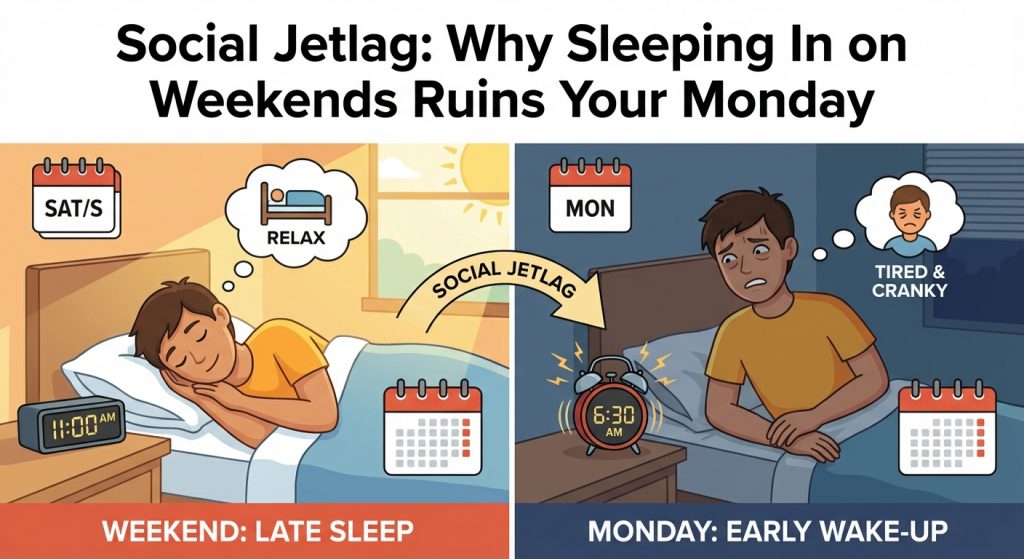
I used to love Saturday mornings. Or rather, I used to love Saturday afternoons.
For years, my Friday routine was sacred. After a week of grinding stress, I would stay up until 2:00 AM, smoking, drinking wine (which I now know destroys REM sleep), and watching movies. I told myself I earned it. Saturday was my “recovery day.” I would blackout the room and sleep until 11:00 AM or even noon.
I felt great for about an hour after waking up. But by Sunday night, a creeping anxiety—the “Sunday Scaries”—would set in. And Monday morning? Monday was a car crash. I would wake up at 7:00 AM feeling like I had been hit by a truck, drinking three espressos just to function, my brain in a complete fog until Wednesday.
I wasn’t lazy. I wasn’t depressed. I was jet-lagged.
I was flying from New York to London every Friday night and flying back every Monday morning, without ever leaving my house. This is Social Jetlag, and if you are reading this with a brain that feels like cotton wool, it’s probably happening to you too.
What Is Social Jetlag?
Social Jetlag is the discrepancy between your body’s internal biological clock (circadian rhythm) and your social clock (work, school, or social obligations).
In simple terms, it is calculated by the difference in your “mid-sleep point” on workdays versus free days.
- Workday: You sleep 23:00 to 07:00. Mid-sleep point is 03:00.
- Weekend: You sleep 01:00 to 11:00. Mid-sleep point is 06:00.
- Result: You have a 3-hour Social Jetlag.
Biologically, this is identical to crossing three time zones—a situation that typically requires a precise jet lag protocol to fix, but here it happens without you ever checking a bag. When your alarm goes off on Monday at 07:00, your body thinks it is 04:00. Your cortisol awakening response—that surge of energy meant to get you out of bed—hasn’t happened yet. You are literally dragging a sleeping body out of bed.
The Mechanism: Why You Can’t “Bank” Sleep
The biggest lie we tell ourselves is, “I’ll catch up on sleep this weekend.”
While you can pay back some “sleep debt” (adenosine buildup) by sleeping longer, you cannot trick your Suprachiasmatic Nucleus (SCN). The SCN is your master clock. It regulates every hormone in your body, from melatonin to insulin, based on light and consistency.
When you shift your sleep window by 2+ hours, you desynchronize your internal systems.
- 1. Melatonin Delay: By exposing your eyes to light at 11:00 AM on Saturday instead of 07:00 AM, you push your melatonin release time back. Sunday night, when you try to sleep at 23:00, your body isn’t ready. You lie there, tired but wired, staring at the ceiling.
- 2. Cortisol Misalignment: Your stress hormone, cortisol, is supposed to peak in the morning. When you have social jetlag, that peak often hits later, meaning you feel groggy in the morning and anxious in the evening.
- 3. Metabolic Chaos: Your pancreas operates on a clock. Eating a bagel at 11:00 AM on Saturday (when your body expects lunch) causes different insulin spikes sleep issues than eating it at 08:00 AM.
Symptoms: It’s Not Just “Hating Mondays”
If you think your hatred of Mondays is purely psychological, look for these physical markers of social jetlag:
- The “Monday Blues” Brain Fog: Severe sleep inertia that lasts 2-4 hours after waking up.
- Sunday Insomnia: The inability to fall asleep at a “normal” time on Sunday night, leading to sleep deprivation focus issues the next day.
- Gut Issues: Bloating or irregularity on Mondays (more on the gut microbiome connection in the research section below).
- Cravings: An intense desire for sugar and high-carb foods on Monday and Tuesday due to ghrelin/leptin imbalance.
The Fix: How to Have a Life Without Wrecking Your Clock
I know what you are thinking. “Alex, I want to have a social life. I can’t go to bed at 10 PM on a Friday.”
I get it. I still go out. But I have changed how I recover. Here is the protocol I used to stop the Monday crash.
1. The Golden Rule: Consistency Over Duration
This is the hardest pill to swallow. You must keep your wake-up time within 60 minutes of your weekday time, even if you stayed up late.
If you usually wake up at 07:00, do not sleep past 08:00 on Saturday, even if you went to bed at 02:00.
- Why? Waking up anchors your circadian rhythm. Sleeping in “drags” your clock forward, making Monday hell.
- The Cost: Yes, you will be tired on Saturday. But it is better to be tired and synchronized than rested and jet-lagged.
2. The “Nappuccino” Strategy
If you are exhausted from a late Friday night and woke up early (per rule 1), use a strategic nap to clear the adenosine buildup.
- Timing: Between 13:00 and 15:00 (the post-lunch dip).
- Duration: strictly 20 minutes. No more.
- Method: Drink a coffee immediately before lying down. The caffeine takes 20 minutes to kick in, which will wake you up just as the nap ends, preventing sleep inertia.
- Result: You recover energy without entering deep sleep, so your ability to fall asleep Sunday night remains intact.
3. Morning Light Anchoring (Huberman Protocol)
On Saturday and Sunday mornings, getting photons into your eyes is critical.
- View sunlight for 10-20 minutes immediately after waking up.
- If you stayed up late, this signal tells your brain: “The day has started, do not shift the clock.”
- If you live in a dark climate (like me in winter), use a 10,000 lux SAD lamp (like the Beurer TL45 I reviewed) for 15 minutes.
4. Melatonin Micro-Dosing
If you messed up and slept until noon on Saturday, you need to manually pull your clock back.
- Take 0.3mg to 1mg of Melatonin (I use a Melatonin spray for precision) 2 hours before your desired sleep time on Sunday.
- Note: Keep the dose low. High doses (5mg+) can cause grogginess and won’t shift the clock any faster.
The Diet Connection: “Eating Jetlag”
One huge mistake I made was shifting my meals. On weekends, I would eat “brunch” at noon and a heavy dinner at 22:00.
This is Chrononutrition suicide.
Your liver and gut have their own clocks. When you eat late at night on weekends, you force your digestion to work when it should be repairing. This leads to nocturnal hypoglycemia or glucose crashes that wake you up.
My Rule: Even if I stay up late, I stop eating 3 hours before sleep. And on weekends, I try to eat breakfast as close to my weekday time as possible to signal to my peripheral clocks that we are still on schedule.
Update: New Research & Trends (December 2025)
Since I started this site, the science on social jetlag has exploded. I spent the last few days digging through the latest papers from late 2025, parsing biohacker forums, and reading the debates on Reddit to see what’s new. Here is what you need to know right now.
1. The Gut Microbiome Connection (The “ZOE” Study)
This is the biggest news of 2025 regarding social jetlag. A major study (associated with King’s College London and ZOE) has found that even a 90-minute shift in your sleep midpoint is enough to alter the composition of your gut bacteria.
The Finding: People with social jetlag have a higher abundance of “unfavorable” bacteria associated with inflammation and obesity.
The Takeaway: If you have IBS or digestive issues that seem to flare up early in the week, it might not be what you ate—it might be when you slept. The misalignment causes “gut dysbiosis.”
2. The Heart Health Debate (To Catch Up or Not?)
There is a massive debate raging in the medical community right now.
The “Catch-Up” Argument: A study utilizing UK Biobank data (presented at the ESC Congress and discussed widely in 2025) suggests that people who “catch up” on sleep over the weekend might have a 20% lower risk of heart disease compared to those who just stay sleep-deprived.
The “Consistency” Argument: Biohackers and chronobiologists argue that while the heart might get a break, the metabolic and hormonal damage of the shift outweighs the benefit.
My Take: If you are severely sleep-deprived (less than 6 hours M-F), catching up is probably a necessary evil for survival. But for optimization? Consistency is still king. Don’t use the heart study as an excuse to party until 4 AM.
3. Bryan Johnson’s “Social” Protocol
I follow Bryan Johnson’s Blueprint updates closely. His stance on weekends is brutal but effective. He treats his bedtime as the “most important appointment of the day.”
He does not shift his wake time, ever.
If he attends a social event (which is rare), he utilizes chrononutrition—he stops eating very early in the day so that even if he goes to bed late, his resting heart rate can lower quickly.
Community Consensus: On the subreddit `r/Biohackers` and `r/SleepHQ`, the consensus for 2025 is moving away from “tracking orthosomnia” (obsessing over scores) and moving toward “Light Hygiene.” Users are reporting that using red lens glasses (blocking blue/green light) at social events allows them to stay out late but still fall asleep quickly when they get home, minimizing the damage.
4. Depression and the “2-Hour” Limit
New meta-analyses from mid-2025 have solidified the link between social jetlag (>2 hours) and depressive symptoms, particularly in younger adults. If your “weekend lag” exceeds 2 hours, you are statistically much more likely to experience mood dysregulation on Monday and Tuesday. This validates the “Monday Blues” as a physiological, not just psychological, phenomenon.
Summary
I stopped hating Mondays when I stopped treating my weekends like a different time zone.
Social Jetlag is a silent killer of productivity and mood. It tricks your biology into a constant state of lag, ruining your insulin sensitivity, your gut health, and your mental resilience.
My Personal Action Plan:
- 1. Wake Up: I never sleep in more than 60 minutes past my normal time.
- 2. Light: I blast my eyes with sunlight or my Beurer TL45 immediately on Saturday/Sunday mornings.
- 3. Nap: If I stayed up late, I take a 20-minute nap at 14:00.
- 4. Eat: I keep my meal times consistent, avoiding the “midnight pizza” trap.
You don’t have to be a monk. But you do have to respect your biology. If you want to fix your Monday fatigue, stop breaking your rhythm on Saturday.

By: Alex Warenstein.
Bio: Alex Warenstein is a sleep biohacker and founder of Night Time Comfort. After battling chronic insomnia and circadian disruption, he now helps others optimize their sleep using data-driven protocols. Read full story.
Disclaimer: Alex is not a doctor. This content is for educational purposes only. Always consult a specialist.