I know the texture of my bedroom ceiling by heart. If you are reading this, you probably do too. There is a specific type of insomnia that feels particularly cruel: the 3 AM wake-up call. You aren’t just awake; you are alert. Your heart might be beating a little faster than usual, your mind instantly latches onto a worry from three days ago, and despite being exhausted, your body feels weirdly “charged.”
For years, I treated this as purely a cortisol issue. I assumed my HPA axis was broken and my stress hormones were spiking too early. And while cortisol often plays a role (see my article about the 24h Salivary Cortisol Test), I eventually learned that there is another silent saboteur of sleep maintenance: metabolic instability and receptor desensitization.
This brings us to Myo-Inositol. You might have heard of it in the context of fertility or PCOS (Polycystic Ovary Syndrome), but in the biohacking underground and sleep forums, it has gained a reputation as a tool for “smoothing out” the night. It is often described as the bridge between metabolic health and mental calmness.
This article is a documentation of my experiment with Myo-Inositol for sleep, specifically testing whether 2 grams of this white powder could stop the racing mind and stabilize my nighttime blood sugar without the heavy sedation of drugs.
Myo-Inositol for Sleep: More Than Just a PCOS Supplement
To understand why a 47-year-old man would take a supplement famous for female reproductive health, we need to strip away the marketing labels and look at the biochemistry.
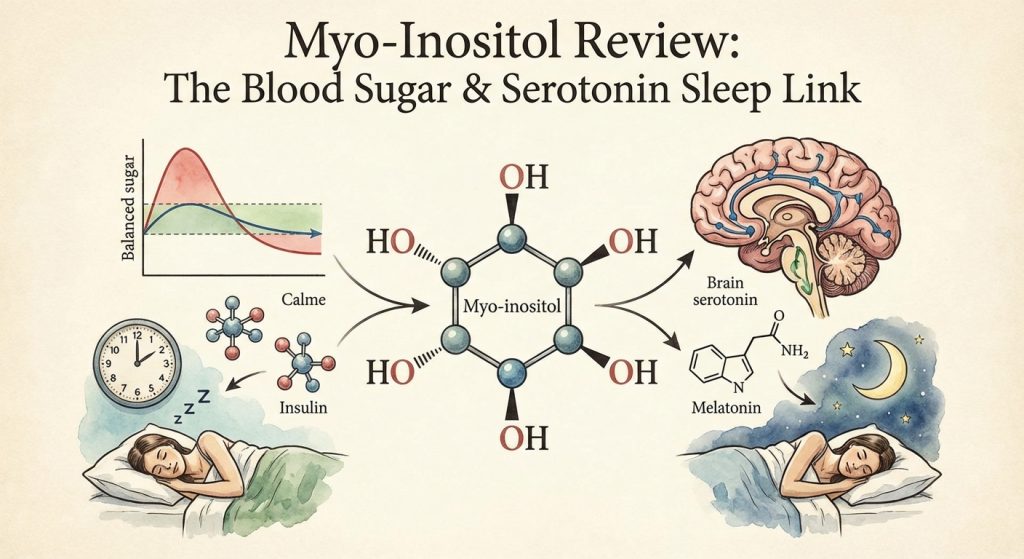
Myo-Inositol is often referred to as Vitamin B8, though technically it is a pseudovitamin—a sugar alcohol (isomer of glucose) that the body can produce in small amounts. It is found abundantly in the brain and is a critical component of cell membranes.
For the sleep-deprived, Myo-Inositol is interesting for two distinct reasons:
- 1. Metabolic Regulation: It mimics the effects of insulin, helping to stabilize blood sugar levels.
- 2. Neurotransmitter Signaling: It acts as a “secondary messenger” for Serotonin, Dopamine, and GABA.
When I was building my stack, I wasn’t looking for a sedative that would knock me out like Apigenin. I was looking for something to prevent the mid-night fragmentation. If you suffer from metabolic insomnia, your brain is constantly scanning for threats. A drop in blood sugar or a failure of GABA receptors to “catch” the calming signals can trigger a wake-up event. Myo-Inositol attempts to fix the machinery rather than just forcing the shut-down.
Metabolic Insomnia: Stabilizing Nighttime Glucose
One of the most overlooked causes of waking up at 3 AM is nocturnal hypoglycemia. You don’t have to be diabetic to experience this.
Here is the mechanism that keeps us awake:
During the night, your brain requires a steady stream of glucose. If your liver glycogen runs low or your blood sugar crashes rapidly (perhaps due to sugar before bed or alcohol), your brain perceives an energy crisis. To save you, it triggers a release of adrenaline and cortisol to liberate stored glucose.
That chemical dump saves your life, but it ruins your sleep. You wake up with a pounding heart, feeling “wired,” and often hungry.
Myo-Inositol for sleep works as an insulin sensitizer. It helps your cells use glucose more efficiently and may help flatten the glucose curve during the night.
If you are using a CGM (Continuous Glucose Monitor) like the Freestyle Libre 3, you might see a correlation between glucose volatility and your wake-up times. While my glucose was generally stable, I suspected that micro-fluctuations were still triggering my sensitive nervous system.
Natural Serotonin Booster and GABA Receptor Sensitivity
The second pathway is where Myo-Inositol gets its reputation for stopping the “racing mind.”
Many people take 5-HTP or Tryptophan to “boost” serotonin. The problem is that having more serotonin circulating doesn’t matter if your receptors aren’t listening. This is where the concept of the “secondary messenger” system comes in.
Imagine Serotonin or GABA as a person knocking on a door (the receptor). If the person inside is deaf, the knock goes unanswered. Myo-Inositol is part of the system that “opens the door.” It is a precursor to the phosphoinositide cycle, which translates the signal from the receptor to the inside of the cell.
Stop Racing Mind at Night: The GABA Link
By sensitizing receptors to GABA (the brain’s primary inhibitory neurotransmitter) and Serotonin, Myo-Inositol essentially turns up the volume on your body’s natural relaxation signals.
This is distinct from how something like Valerian Root or Kava Kava works. Those substances try to mimic GABA or force the receptors open. Myo-Inositol simply makes your existing neurochemistry work the way it was designed to. This is likely why it feels less like a “drug” and more like a gentle shift in state.
For me, the goal was to address the tired but wired symptoms. I could feel my body was exhausted, but my brain was stuck in a loop of ruminating thoughts. This is often a sign of poor GABAergic function or serotonin depletion.
Inositol Dosage for Sleep: Finding the Sweet Spot
Navigating inositol dosage sleep protocols can be confusing because the clinical studies for anxiety and OCD use massive doses—often between 12 grams and 18 grams per day.
However, for sleep optimization, the consensus among the biohacking community and recent 2025 anecdotal data suggests a much lower “sweet spot.”
- High Dose (12g – 18g): Used in psychiatry for panic attacks and OCD.
- Risk: At this level, gastrointestinal distress is almost guaranteed. We are talking about severe bloating, gas, and diarrhea. This is the last thing you want when trying to cure sleep maintenance issues.
- Sleep Dose (2g – 4g): This is the range most commonly cited for metabolic and sleep benefits.
Powder vs. Capsules
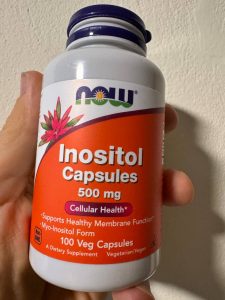
I strongly recommend using powder. Myo-Inositol is slightly sweet, like sugar, but about half as intense. It dissolves instantly in water. Taking 2 grams via capsules requires swallowing 4 large pills (usually 500mg each), which increases fluid intake right before bed—a disaster for nocturia.
I used the “Now Foods” brand powder. It is cost-effective and allows for precise titration. I started with 500mg to test for stomach upset and worked my way up to 2 grams.
Alex’s Personal Review:
My journey with Myo-Inositol was part of a larger effort to optimize my sleep architecture after I had already addressed the basics like light environment and bedding.
- The Protocol: 2 grams of Myo-Inositol powder mixed into a small shot of water, taken 45 minutes before bed.
- The Duration: 14 days consistently.
- The Baseline: Chronically waking up around 4:00 AM, often struggling to fall back asleep for 30-45 minutes. Total “Awake” time per night averaged 1 hour 15 minutes.
- The Goal: Reduce wake-after-sleep-onset (WASO).
The Subjective Feeling
The first night, I felt nothing. This is not Melatonin spray; it doesn’t hit you with a wave of drowsiness.
By night three, I noticed a subtle shift. When I woke up (because I still woke up to use the bathroom—my Pygeum Africanum had reduced trips, but not eliminated them entirely), the “texture” of my mind was different.
Usually, waking up meant an immediate flood of thoughts: Did I send that email? Is the dog okay? I need to fix the roof.
On Inositol, the silence remained. I woke up, handled my business, and climbed back into bed. My brain felt “quiet.” It wasn’t numb, just silent. I didn’t have to fight the racing thoughts. I simply closed my eyes and drifted off.
The Data (Apple Watch)
- I rely on my Apple Watch Ultra 2 for trend analysis.
- Over the two-week period, my average “Awake” time dropped from 1 hour 15 minutes to approximately 1 hour 5 minutes.
- Ten minutes might sound insignificant to a good sleeper. To an insomniac, saving 10 minutes of staring at the dark is a victory. More importantly, the stress of waking up was reduced.
My Rating: 6.5/10
Alex’s Take: “My sugar was technically in the normal range, but my brain refused to power down. Inositol is the bridge between metabolism and calm.”
I give it a 6.5 because it is not a heavy hitter. It won’t knock you out. But as a falling back asleep supplement, it provided a distinct, smooth stability that I haven’t found in herbs. It removes the jagged edges of the night.
Cons and Side Effects: The GI Distress Factor
You cannot discuss inositol dosage sleep protocols without addressing the stomach issues. Myo-Inositol acts as an osmotic laxative at high doses.
Even at 2 grams, I noticed some mild rumbling on the first two nights. If you have a sensitive gut or IBS, you need to start very low (250mg) and titrate up. Do not jump straight to the 12g doses used for OCD unless you are under medical supervision and prepared for significant bathroom urgency.
Additionally, some users on Reddit report that Inositol can cause vivid dreams. While I didn’t experience nightmares, I did notice my dream recall improved slightly, which might suggest an impact on REM sleep, potentially linked to the natural serotonin booster effect.
Community Consensus: Reddit and Forum Findings
To ensure this review isn’t just n=1, I scoured the latest discussions from SleepHQ, ApneaBoard, and relevant subreddits (r/Insomnia, r/Nootropics, r/Biohackers) through late 2025.
Here is the prevailing sentiment regarding Myo-Inositol for sleep:
- 1. The “Fall Back Asleep” King: The most consistent positive report is not about falling asleep faster, but about the ease of returning to sleep after a disruption. Users describe it as “lowering the friction” of sleep re-entry.
- 2. The Glycine Stack: A very popular trend in 2025 is stacking Myo-Inositol (2g) with L-Glycine (3g). The consensus is that Glycine handles the body temperature (physical relaxation) while Inositol handles the racing mind (mental relaxation).
- 3. Variable Effects: It is not universal. About 30-40% of users report no noticeable change. This reinforces the theory that Inositol works best for those with specific metabolic or receptor sensitivity issues.
- 4. Morning Grogginess: Unlike Melatonin XR or antihistamines like Doxylamine or Atarax, reports of morning grogginess are virtually non-existent with Inositol. Most users report waking up feeling clear-headed.
- 5. Anxiety Reduction: Many users who suffer from general anxiety report that taking Inositol at night seems to have a carry-over effect into the next morning, likely due to the long-term sensitization of GABA receptors.
Updates December 2025: Research and Biohacker Trends
Staying current is critical, as our understanding of non-prescription sleep aids evolves rapidly. Here is the latest intelligence gathered from scientific literature and the biohacking community as of December 2025.
1. Highest-Signal Scientific Update (Oxford Academic)
A 2025 narrative review published in Nutrition Reviews has finally given Myo-Inositol a dedicated subsection regarding sleep. This is a significant move from purely metabolic or fertility-focused literature.
The Verdict: The review frames Myo-Inositol as a promising “subsidiary” sleep aid. It acknowledges that human evidence is still developing compared to giants like Magnesium L-Threonate.
Objective Data: The review highlighted a neuroimaging study involving adolescents with depression and sleep disturbances. It found that higher levels of Myo-Inositol in the dorsolateral prefrontal cortex (a brain region involved in executive function) were positively correlated with Total Sleep Time (TST). This was measured via ambulatory polysomnography, providing hard data linking brain inositol levels to sleep duration.
Subjective Data: It also summarized a randomized controlled trial in pregnant women taking 2,000 mg of Myo-Inositol nightly. The study reported improvements in the Pittsburgh Sleep Quality Index (PSQI)—specifically in sleep quality, duration, and efficiency—compared to placebo. While pregnancy is a unique physiological state, the mechanism (insulin sensitivity and anxiety reduction) is relevant to the general population.
2. Biohacker & Influencer Protocols
In the 2025 updates of various “Ultimate Sleep Stacks,” Myo-Inositol has solidified its place as an add-on specifically for maintenance insomnia.
The “Standard Protocol” circulating among biohackers (echoed in discussions referencing protocols similar to those of Bryan Johnson, though not always explicitly part of the core Blueprint) has settled on a dosage range of 900 mg to 2 grams.
The positioning has shifted: It is no longer sold as a sedative. It is being marketed in the community as a “Sleep Stabilizer.” The trend is to use it to flatten the physiological stress response to waking up.
3. Community Feedback Loop (Dec 2025)
In late 2025, Reddit discussions regarding metabolic insomnia have seen a spike in Inositol mentions.
Mixed experiential reports: While many praise it, there is a vocal minority reporting that it made their sleep worse initially before getting better, or caused minor headaches.
The Consensus: If you have “sugar crash” symptoms (waking up hungry/hot) or “racing thoughts” (OCD-lite symptoms), Inositol is considered a high-value experiment. If your insomnia is purely pain-related or apnea-related (see ResMed AirCurve 10 VAuto Review), Inositol is unlikely to move the needle.
4. Eastern Medicine Observations
While Western medicine focuses on the receptor sites, recent translations of Chinese clinical trials (often discussed in niche forums) continue to link Inositol’s effects to “calming the Spirit” (Shen), aligning it with herbs like Suan Zao Ren for palpitations and anxiety-induced insomnia. The intersection of metabolic health and “Shen” disturbance is becoming a hot topic for integrative researchers.
Summary
Myo-Inositol is not a sledgehammer; it is a lubricant for your neurochemistry. If you are looking for a pill to knock you unconscious, look elsewhere (perhaps consult your doctor about Trittico or Atarax if appropriate).
However, if you identify with the tired but wired symptoms, or if you suspect that blood sugar fluctuations are jarring you awake at 3 AM, Myo-Inositol is a scientifically sound, low-risk experiment. It addresses the root causes of fragmentation—insulin resistance and neurotransmitter desensitization—rather than just masking the symptoms.
For me, the 2 grams of powder didn’t “cure” my insomnia, but it made the nights less hostile. It turned the jagged, anxious interruptions into smooth, manageable pauses. And in the war against sleeplessness, that is a tactical advantage worth having.
Next Steps for You:
If you try this, start with 500mg to protect your gut. Combine it with good sleep hygiene, ensure your room is dark, and consider whether a 24h Salivary Cortisol Test might help you distinguish between a cortisol spike and a sugar crash. Sleep well.

By: Alex Warenstein.
Bio: Alex Warenstein is a sleep biohacker and founder of Night Time Comfort. After battling chronic insomnia and circadian disruption, he now helps others optimize their sleep using data-driven protocols. Read full story.
Disclaimer: Alex is not a doctor. This content is for educational purposes only. Always consult a specialist.