The Brain’s Sewage System
I used to think of sleep as a passive state. You turn off the lights, the body goes offline, and eight hours later, you reboot. I thought the only “repair” happening was my muscles knitting themselves back together after a workout.
I was wrong.
When I started my journey to fix my chronic insomnia and low energy, I kept running into a specific feeling. It wasn’t just tiredness; it felt like my brain hadn’t fully “reset.” Waking up at 7:00 AM, I didn’t just feel un-rested; I felt heavy-headed and foggy—like my thoughts were wading through molasses.
It turns out there’s a plausible biological contributor to that “toxic” feeling: reduced glymphatic clearance — a brain waste-clearance process described by the National Institutes of Health.
For decades, textbooks said the brain lacked conventional lymphatic vessels — but that view shifted after findings published in Nature identified lymphatic vessels in the membranes surrounding the brain. The bigger question still stands: the brain burns a huge amount of energy, so where do all the by-products go?
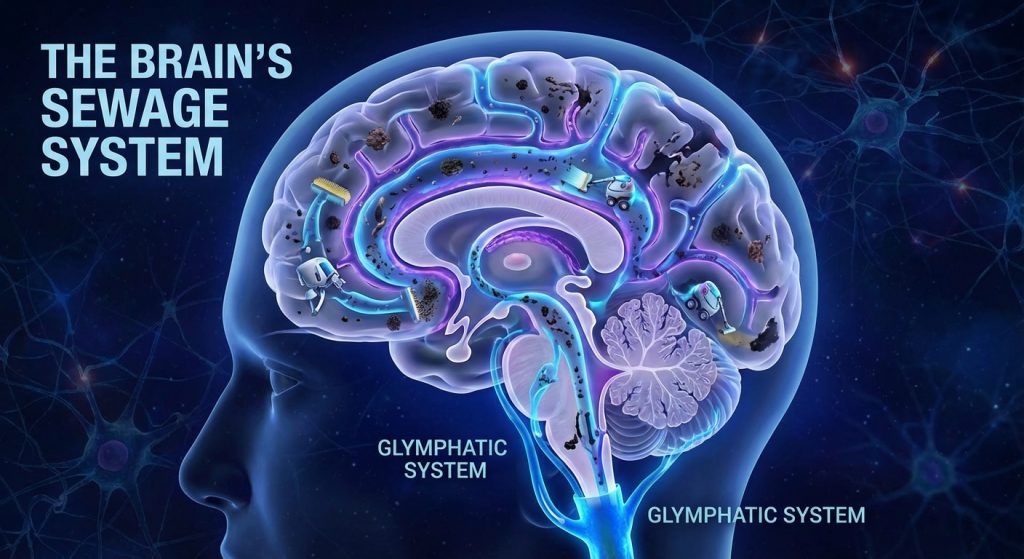
In 2012, researchers discovered the answer: the Glymphatic System. It is a hidden network of plumbing that physically washes your brain while you sleep.
But here is the catch—and the reason I was feeling like a zombie: this system appears to ramp up most during non-REM slow-wave sleep, and work in Cell highlights how low norepinephrine and slow vascular rhythms in NREM help drive that fluid exchange.
If you’re waking up groggy or foggy, one plausible explanation is that your sleep was short, fragmented, or light enough that you got less of that slow-wave “cleanup” time.
How The “Power Wash” Works
To understand why you need to protect your deep sleep with your life, you have to understand the mechanics. I’ll keep this simple, but we need to get a little technical because this is where the magic happens.
During the day, your brain cells (neurons) are packed tightly together, firing electrical signals to keep you talking, working, and driving. The space between them is minimal.
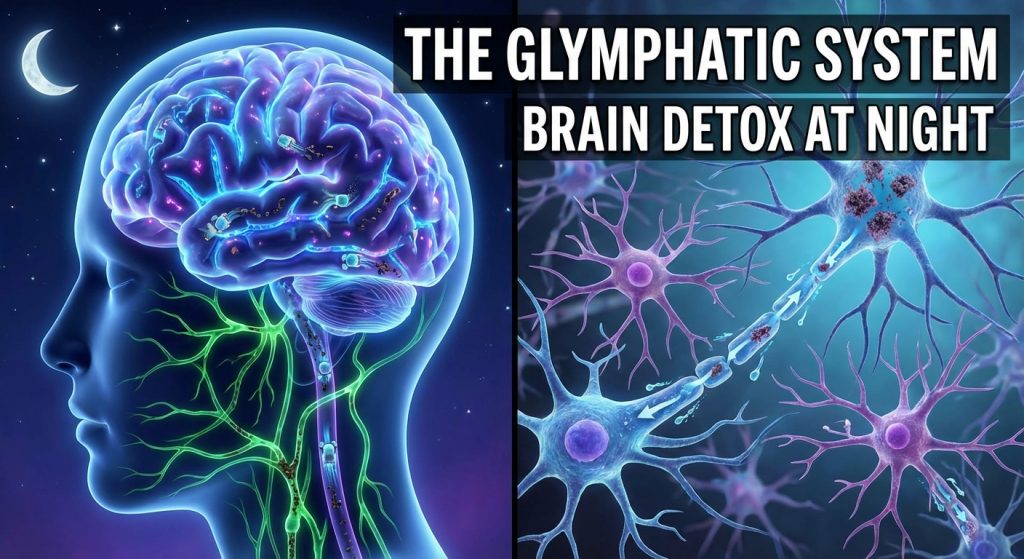
But when you enter NREM3 (Deep Sleep), something incredible happens. In classic animal experiments, the fluid space between brain cells opens up markedly during deep, slow-wave sleep, which makes it easier for CSF to move through brain tissue.
Important nuance: most of the detailed “how” comes from animal work; in humans, researchers often infer glymphatic activity using imaging markers and physiology rather than directly watching fluid wash every region in real time.
This shrinkage creates massive gaps between your neurons. It’s like the tide going out, revealing the beach. Once these channels open, Cerebrospinal Fluid (CSF) rushes in. It floods through the brain tissue, driven by the pulsing of your arteries, and washes away the metabolic waste that built up during the day.
The Valve: Aquaporin-4 (AQP4)
There is a specific protein channel that controls this flow, called Aquaporin-4 (AQP4). Think of these as the floodgates. These channels sit on the “end-feet” of the astrocytes.
During sleep, AQP4 seems to matter less as a door that “opens” and more like the lining of the plumbing: when it’s well-organized around blood vessels, fluid exchange appears more efficient. When that organization is reduced (seen with aging and certain brain stresses in research), clearance may be less efficient—one reason researchers focus on AQP4 “polarization.”
The Garbage: What Are We Flushing?
What exactly is this “waste” that makes us feel so terrible?
- 1. Amyloid Beta: This is the big one. It’s a sticky protein that can accumulate between neurons and form plaques — a well-known feature of Alzheimer’s disease, as summarized by the Alzheimer’s Association.
- 2. Tau Proteins: These form tangles inside the neurons, another marker of dementia.
- 3. Metabolic Toxins: Lactate and other byproducts of burning energy.
When my Apple Watch estimated less than 20 minutes of deep sleep per night (useful for trends, but the American Academy of Sleep Medicine notes these tools aren’t validated to diagnose sleep disorders), I didn’t conclude I was “building plaques” overnight—I concluded my sleep was likely poor enough to deserve a serious look.
The “Deep Sleep” Trigger
Here is the critical rule: glymphatic clearance appears most efficient when the brain is in a low-arousal, slow-wave state—especially NREM3 (Deep Sleep). That doesn’t mean clearance is “off” when you’re awake or in other stages; it means the deep-sleep window seems to be when the system runs at its strongest.
This explains the “Tired but Wired” feeling many of us have. You might sleep for 8 hours, but if that sleep is fragmented, or if you drink alcohol (which crushes deep sleep), you may not spend enough time in NREM3 to complete a full wash cycle. You wake up with yesterday’s waste still floating in your synapses.
Factors That DESTROY Your Brain Detox
Through my research on PubMed and by cross-checking patterns people report in communities like ApneaBoard and biohacking forums (useful for hypotheses, not proof), I identified the major blockers.
1. Alcohol: The “Rebound” Effect
- I used to drink a glass of wine to “wind down.” It can make you fall asleep faster, but it often degrades sleep quality later in the night by fragmenting sleep and suppressing restorative stages, as summarized by Harvard Health. One practical rule that matches both research and clinical advice: have any drink with dinner, not as a nightcap, and leave a few hours before bed—Cleveland Clinic suggests at least ~3 hours.
- Reviews and mechanistic work suggest alcohol can fragment sleep architecture and may interfere with brain-clearance dynamics; practically, if you do drink, keeping it earlier in the evening (instead of right before bed) tends to be the least disruptive.
2. Sleep Apnea and UARS
- You can’t reliably sustain deep sleep if your breathing repeatedly narrows or pauses. If you have untreated Apnea or UARS, your body is constantly waking up (micro-arousals) to breathe. These micro-arousals prevent you from entering the sustained deep sleep required for glymphatic flow.
- I used an O2Ring to track oxygen trends. Dips don’t diagnose anything on their own, but they can be a useful prompt to consider a formal evaluation—Mayo Clinic summarizes the common signs and why repeated arousals matter. If breathing disruptions are the bottleneck, supplements like magnesium are unlikely to compensate for repeated arousals and lost deep sleep—you still have to fix the fragmentation.
3. Chronic Stress (Cortisol)
-
High cortisol keeps your system in “fight or flight.” Biologically, your brain prioritizes readiness over maintenance. If you are stressed, norepinephrine levels stay high. Norepinephrine is the chemical that tells the glial cells to expand and close the cleaning channels.
In practice, sympathetic overdrive makes it harder to drop into the low-arousal, slow-wave state that seems most favorable for glymphatic flow.
Optimization: How to Supercharge the Wash
Okay, so you’ve quit the nightcap and you’re managing your stress. How do we actively make this system work better? Based on a mix of peer-reviewed research (much of it animal or imaging-based) and mainstream sleep-medicine guidance, here is the protocol.
1. The Position: Sleep on Your Side (Lateral)
- This is one of the most actionable pieces of advice I’ve found.
- Animal work and emerging human imaging studies suggest that lateral (side) sleeping can be more efficient for glymphatic clearance than sleeping on your back (supine).
- The theory is that gravity aids the flow of CSF through the brain tissue when you are on your side.
- The Fix: If you are a back sleeper, training yourself to side-sleep can be difficult. I used the “pillow prop” method (a pillow between the knees) to align my spine and make side sleeping comfortable. You also need the right pillow height to ensure your neck isn’t kinked, which could restrict blood flow in the jugular veins—the exit drain for the waste.
2. Omega-3s (DHA) for AQP4 Structure
- The AQP4 channels are embedded in the cell membranes of your astrocytes. These membranes need to be fluid and flexible.
- Omega-3 fatty acids, specifically DHA, are structural fats in brain cell membranes, and there’s animal evidence that omega-3s can help preserve AQP4 organization involved in clearance physiology (for example, work reported in The FASEB Journal). In humans, this remains indirect—think “supportive biology,” not a guaranteed hack.
- My Protocol: I take a high-quality Omega-3 supplement with dinner. It’s a long-term play, not a quick fix, but it builds the infrastructure for the cleaning system.
3. Exercise: Zone 2 Cardio
- We know exercise helps sleep. But specific voluntary cardio (Zone 2)—where you can hold a conversation but are sweating—has been shown to lower resting heart rate and increase the pulsatility of your arteries.
- Remember, the glymphatic system is pumped by the arterial pulse. Stronger, more elastic arteries mean a stronger “power wash” pressure during the night.
4. Intermittent Fasting (The Empty Stomach)
- Bryan Johnson and the longevity community obsess over this, and for good reason. Digestion is metabolically expensive. If you eat a heavy meal right before bed, your blood flow is diverted to your gut.
- The “Empty Stomach” Rule: I try to finish eating 3-4 hours before bed. This lowers core body temperature (essential for Deep Sleep) and ensures that energy is available for brain maintenance, not digesting a steak.
Update for January 2026:
I went back through the most relevant research and the most repeated practical takeaways since Sep 2025. Here are the six updates that actually changed how I think about glymphatic clearance.
40Hz Auditory Stimulation (New Jan 2026 Data)
Longer-duration 40Hz auditory stimulation continues to look interesting — not as “magic,” but as a way to nudge neurovascular and fluid-exchange rhythms that overlap with clearance physiology. The newest work adds detail on how sustained stimulation can shift the system over time rather than just create a short acute effect. (PubMed)
Sleep as a “Therapeutic Window” for Photostimulation
A late-2025 paper argues that sleep may be a uniquely favorable window for photostimulation approaches aimed at drainage in aging brain models — essentially, timing the intervention to when clearance pathways are already more permissive. (PubMed Central)
The “Brain Drain” Sensation
On the forums (SleepHQ and Reddit), there are a growing number of anecdotal reports about “feeling” the drainage. Users who successfully increased their Deep Sleep (often using CPAP for apnea or strict temperature regulation) report a distinct metallic taste or a sensation of “fluidity” in the mornings. While this is subjective, it aligns with the biological reality of waste clearance dumping into the throat and lymphatic system.
The 2026 “Boring Wins” Shift (Biohacker + Clinic Reality Converge)
In a January 2026 interview, Bryan Johnson framed his best “free” longevity lever as protecting sleep consistency and quality — less novelty, more discipline. In parallel, late-2025 clinical commentary emphasizes that addressing sleep apnea early (and sticking with PAP when indicated) may matter in neurodegenerative contexts — which mirrors what sleep communities keep seeing: stabilize breathing, and deep sleep finally sticks. (TIME, JAMA Neurology)
Summary
The Glymphatic System is your brain’s nightly janitor. If you fire the janitor (by skipping Deep Sleep), the office gets trashy, and eventually, things break.
You cannot supplement your way out of a broken glymphatic system, but you can facilitate it:
- 1. Prioritize NREM3 (Deep Sleep): This is the only time the door opens.
- 2. Side Sleep: Let gravity help the flow.
- 3. Stop Blocking It: Cut the alcohol and manage your airway (Apnea/UARS).
- 4. Support the Infrastructure: Omega-3s for the channels and cardio for the pump.
If you are worried about cognitive decline or just want to stop waking up feeling like you have a hangover when you haven’t been drinking, looking at your Deep Sleep numbers is the first step. It’s not just about energy; it’s about cleaning the machine.

By: Alex Warenstein.
Bio: Alex Warenstein is a sleep biohacker and founder of Night Time Comfort. After battling chronic insomnia and circadian disruption, he now helps others optimize their sleep using data-driven protocols. Read full story.
Disclaimer: Alex is not a doctor. This content is for educational purposes only. Always consult a specialist.