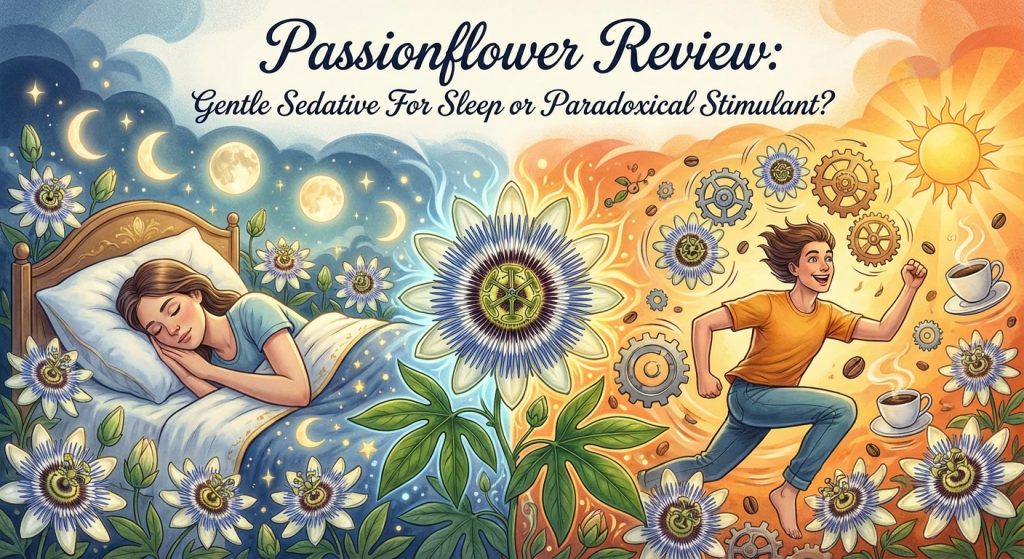
In the search for the strongest herb for anxiety and sleep, we often cycle through the usual suspects: Valerian (too smelly), Melatonin (too groggy), or Ashwagandha KSM-66 (too complex to time).
But sitting quietly in the background is Passionflower (Passiflora incarnata). With its alien-looking, complex purple blooms, it looks like something from a science fiction movie. But biologically, it is one of the most effective natural anxiolytics available. It functions as a “brake pedal” for the nervous system, quieting the internal dialogue that keeps you awake at 2:00 AM.
However, Passionflower has a secret. While it is a sedative for most, for a small percentage of the population, it acts as a stimulant.
This review explores the science of what passion flower does to your brain, why sourcing raw material from specific regions (like Greece) changes the potency, and I (Alex) share my 8/10 experience with this herbal ally—and my wife’s disastrous “paradoxical reaction” to it.
What is Passionflower Used For? (The Science)
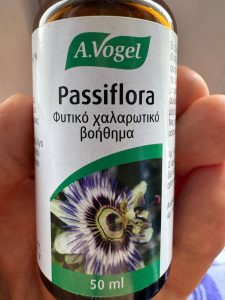
Native to the Americas but adopted enthusiastically by European herbalists, Passionflower is primarily used for insomnia and generalized anxiety. Unlike supplements that target cortisol (like Ashwagandha) or the body clock (like Melatonin), Passionflower targets the brain’s “chill” receptors.
The Mechanism: GABA Modulation
What does passion flower do to your brain?
- The primary active compounds in Passionflower are flavonoids (like chrysin and vitexin) and alkaloids. These compounds interact with the GABA-A receptors.
- GABA (Gamma-Aminobutyric Acid) is the brain’s primary inhibitory neurotransmitter. It stops nerve cells from firing.
The Benzo Connection: Benzodiazepines force GABA receptors open. Passionflower modulates them more gently. It increases the availability of GABA, effectively turning down the volume of your racing thoughts.
Is passionflower psychoactive?
Yes, by definition, anything that alters your mental state is psychoactive. It is mildly sedative and anxiolytic (anxiety-reducing). However, it is not “intoxicating” or hallucinogenic. It induces a state of calm clarity rather than a “high.”
Does passionflower lower blood pressure?
Because it relaxes the central nervous system, it can have a mild hypotensive effect. If your insomnia is driven by hypertension or physical tension, this secondary effect reinforces the sleep onset process.
The Critical Importance of Sourcing
This is the most overlooked aspect of herbal medicine. You can buy “Passionflower” at a gas station, or you can buy pharmaceutical-grade extracts. They are not the same thing.
The “Greek Standard”
Quality varies wildly based on soil, climate, and harvest time. In my personal research and testing, I have found that raw materials sourced from the Mediterranean region—specifically Greece—tend to have a superior flavonoid profile compared to generic crops from Eastern Europe or Asia.
- Why Geography Matters: The stress the plant undergoes during growth (sun intensity, soil composition) dictates how many protective chemicals (flavonoids) it produces. The intense Mediterranean sun often yields a more potent plant.
- Standardization is Key: When buying a supplement, do not just look for “Passionflower Leaf.” Look for a Standardized Extract. The label should state the percentage of Flavonoids (e.g., 3.5% Vitexin). If it doesn’t list the active ingredient percentage, you are likely buying expensive hay.
Tea vs. Extract:
What is the strongest tea for sleep? A properly brewed Passionflower tea (steeped for 10-15 minutes covered) is potent. However, capsules or alcohol-based tinctures usually offer higher bioavailability and consistency. Tinctures, in particular, enter the bloodstream faster (sublingually), making them better for acute sleep onset issues.
Passionflower vs. The Competition
How does it stack up against other heavy hitters?
Which is better for anxiety, passionflower or ashwagandha?
- Ashwagandha: Best for chronic stress and high cortisol. It takes weeks to build up. It fixes the background stress.
- Passionflower: Best for acute anxiety (“I can’t sleep tonight”). It works within 30-60 minutes.
- Verdict: Use Ashwagandha for the day/long-term; use Passionflower for the night/immediate relief.
Is valerian stronger than passionflower?
- Valerian: A heavier sedative. It makes the body feel heavy. It smells like dirty socks. It is better for physical restlessness.
- Passionflower: A mental sedative. It stops the “looping thoughts.” It is better for the “tired but wired” mind.
Is passion flower better than melatonin?
They do different things. Melatonin sets the clock; Passionflower calms the noise. If you are tired but your brain won’t shut up, Passionflower is superior. If you aren’t tired at all, Melatonin is superior.
Dosage and Timing
How much passion flower should I take for sleep?
- Dried Herb (Tea): 2 grams steeped in hot water.
- Standardized Extract (Capsules): 250mg to 500mg.
- Tincture: 30-60 drops (depending on concentration).
How long does it take for passionflower to kick in?
- Tincture: 15-30 minutes.
- Capsules: 45-60 minutes.
Protocol:
Take it roughly 45 minutes before lights out. Unlike Melatonin, which requires darkness to work best, Passionflower works chemically regardless of light, but you should still observe good sleep hygiene (see Sleep Hygiene Checklist).
Reddit & Community Consensus
I analyzed threads from r/Herbalism, r/Insomnia, and r/Biohackers to see what real users report regarding passionflower benefits.
1. “The Thought Stopper”
The most consistent report (appearing in 8 out of 10 positive reviews) is that Passionflower stops “ruminating.” Users describe it as “unplugging the radio in my head.”
2. “Dreams become Movies”
Many users report vivid, lucid, or cinematic dreams. While usually pleasant, this can be intense for some. This suggests Passionflower may extend or intensify REM sleep.
3. “The Tea Ritual”
A large subset of users prefers the tea specifically because the act of sipping something warm adds to the psychological wind-down. They often mix it with Lemon or Chamomile Balm.
4. “Not a Knockout”
Users warn: “Don’t expect this to knock you out cold.” It doesn’t force sleep; it facilitates it. If you are scrolling Youtube while taking it, you will likely override the effect.
5. “The Taste”
The tea is described as “grassy,” “earthy,” or “like hay.” Some love it; others need honey to mask it.
6. “Hangover Free”
Unlike Valerian or prescription drugs, very few users report morning grogginess (“brain fog”) after using Passionflower.
The Paradoxical Reaction: Warning
Can passion flower cause anxiety?
Yes. In a small percentage of people, GABA-ergic supplements can cause a Paradoxical Reaction. Instead of calming down, the person becomes stimulated, agitated, and wide awake.
Theory: This may be genetic or related to individual neurochemistry (glutamate rebound). If you have ever felt “wired” after taking Valerian or Ashwagandha, you are likely prone to this.
Is passionflower safe for the liver?
Generally, yes. Passiflora incarnata is considered safe. However, Kava Kava (a different herb) has liver warnings. Do not confuse the two. Always ensure you are buying Passiflora incarnata, not other ornamental species of passionflower which can be toxic.
Alex’s Personal Review
The following is based on my personal logs.
I tested Passionflower (specifically a high-quality alcohol tincture sourced from Greek raw materials) for three months.
My Experience:
I took 2 full droppers (approx. 500mg equivalent) 30 minutes before bed.
- The Feeling: It is distinctly different from Melatonin. Melatonin feels like a “weight.” Passionflower feels like “silence.” The constant checklist in my head (“Did I email that client?”, “I need to fix the car”) just… stopped mattering. It didn’t disappear, it just became quiet.
- Sleep Onset: My time to fall asleep dropped significantly. On stressful days, this is my MVP.
- Comparison: It reminds me of Apigenin (Chamomile extract), but stronger. Since Apigenin also works on GABA, this makes sense. It feels like drinking 10 cups of chamomile tea without the liquid volume.
The Wife’s Experience (Paradoxical Reaction):
I gave the exact same dose to my wife.- The Result: Disaster. She lay in bed for three hours, staring at the ceiling, feeling “buzzy” and restless. She described it as having “itchy skin” and a racing mind.
- The Lesson: Biology is individual. What is a sedative for me is a stimulant for her. You must test this on a night where you don’t have an early meeting the next day.
My Rating: 8/10
It is a staple in my cabinet. It loses points only because of the potential for paradoxical reactions in others and the taste of the tincture (which is bitter/grassy). But for effectiveness in “turning off the brain,” it is top-tier.
Where to Buy:
I look for brands on iHerb.com that specify the origin of their herbs. European brands (like Korres or specialized herbal apothecaries importing from the Mediterranean) often have better potency than generic US drugstore brands. Look for standardized vitexin (!) content.
Safety & Interactions
Do herbal teas interfere with medications?
What cannot be mixed with passionflower?- Sedatives: Do not mix with alcohol, benzos, or prescription sleep aids. It potentiates them (makes them stronger), which can lead to dangerous respiratory depression.
- MAOIs: Some sources suggest Passionflower has mild MAOI activity, so be cautious if taking antidepressants.
Is passionflower safe to take daily?
Yes, for most people. There is no evidence of severe physical addiction. However, cycling (e.g., 2 weeks on, 2 days off) is always a good idea with herbal neuro-modulators to prevent tolerance.
Update for December 2025:
Since I first wrote this review, the landscape of sleep supplementation has shifted. We’ve seen the rise of “Blueprint” protocols and new clinical data specifically on Passionflower’s mechanism of action.
Here is what has changed, what the latest science says, and how the top biohacking communities are currently utilizing this herb.1. The New “SIVI” Standard (2024/2025 Research)
For years, the problem with Passionflower was inconsistency. A major double-blind, placebo-controlled study published in 2024 and cited heavily through 2025 has changed the benchmark.
The Study: Researchers tested a standardized extract code-named “SIVI” (Standardized Passiflora incarnata Extract) on participants with high stress and insomnia.
The Result: The critical finding was a significant improvement in Sleep Efficiency (the percentage of time in bed actually spent sleeping).
The Takeaway: In 2025, do not just look for “Passionflower.” Look for extracts that guarantee standardized flavonoid content (specifically Vitexin and Isovitexin). If the label doesn’t give a percentage (e.g., 3.5% or 4%), it is functionally obsolete.
2. The “Menopause Sleep” Connection
A surge of research in late 2024 has positioned Passionflower as a top-tier non-hormonal intervention for menopause-related sleep disturbance.
The Mechanism: New data suggests that because Passiflora mitigates vasomotor symptoms (hot flashes) while simultaneously acting on GABA receptors, it hits the two main causes of midlife insomnia: temperature regulation and anxiety.
Protocol: Current community logs suggest pairing Passionflower with Magnesium Glycinate to manage both the temperature spikes and the cortisol surges.
3. The Biohacker Gap: Passionflower vs. Bryan Johnson’s Stack
If you follow the extreme end of biohacking (like Bryan Johnson’s Blueprint), you will notice he often promotes Apigenin (extracted from Chamomile) for sleep onset.
The Gap: Community feedback from the Quantified Scientist discord and r/Biohackers suggests that for people with high-beta brainwaves (the “ruminators” who can’t stop thinking), Apigenin is often too weak.
The 2025 Verdict: If the standard “Huberman Sleep Cocktail” (Magnesium Magtein + Theanine + Apigenin) fails you, the consensus is to swap Apigenin for a high-potency Passionflower Extract. It hits the same receptors but with significantly higher binding affinity.
4. The “CBN Synergy” Trend
The most popular new “stack” emerging on forums like SleepHQ and Reddit in 2025 is Passionflower + CBN.
The Theory: CBN (Cannabinol) provides the physical body sedation (heavy limbs), while Passionflower provides the mental sedation (quiet mind).
Warning: This stack is potent. User reports indicate it can lead to high “grogginess” scores the next morning if the dosage isn’t dialed in. Start with 50% of the recommended dose for both if combining.
Summary
Passionflower is the herbal answer to the “busy brain.” It doesn’t sedate your body; it quiets your mind.
- Use it if: You lay in bed worrying, planning, or thinking in loops.
- Avoid it if: You have a history of paradoxical reactions to sedatives.
- The Key: Quality. Find a standardized extract or a tincture sourced from a high-sun region like Greece.
If your problem is that you are “tired but wired,” this—alongside Holy Basil — is your best herbal defense.

By: Alex Warenstein.
Bio: Alex Warenstein is a sleep biohacker and founder of Night Time Comfort. After battling chronic insomnia and circadian disruption, he now helps others optimize their sleep using data-driven protocols. Read full story.
Disclaimer: Alex is not a doctor. This content is for educational purposes only. Always consult a specialist.