Introduction: The “Red Gold” Skepticism
If you had told me five years ago that a spice used in paella could fix my sleep maintenance insomnia, I would have laughed. Back then, I was dealing with severe sleep fragmentation, staring at the ceiling at 4 AM, and convinced that only heavy pharmaceutical artillery could knock me out.
I was wrong. But I was also right to be skeptical.
Most herbal supplements for sleep are marketed as “sedatives.” You take Valerian Root, Kava Kava, or Passionflower, and they are supposed to make you feel heavy and drowsy. For me, they rarely worked. Why? Because my insomnia—and perhaps yours—wasn’t just about being “not tired.” It was about a brain that refused to shut up. It was about background anxiety, the kind that hums like a refrigerator you only notice when the room is silent.
This led me to Saffron Extract. It is not a sedative in the traditional sense. It doesn’t bludgeon your nervous system into submission. Instead, it acts as a mechanic for your neurotransmitters, specifically Serotonin.
In this review, I will break down why this “Red Gold” (Crocus sativus) has become a staple in my biohacking stack, specifically the Affron® patented extract. We will look at the mechanism, the dosage, the 2025 clinical updates, and why the source of your saffron matters more than with any other supplement.
What is Saffron Extract (Crocus Sativus)?
Saffron comes from the stigma of the Crocus sativus flower. It is the most expensive spice in the world by weight because each flower produces only three tiny red threads, which must be harvested by hand.
But we aren’t talking about cooking here. We are talking about high-potency standardized extracts.
The magic of Saffron lies in its bioactive compounds: Crocin, Crocetin, and Safranal.
While Safranal gives saffron its distinct aroma, these compounds together act as powerful neuro-modulators. Unlike Melatonin, which signals “it is dark,” Saffron signals “it is okay.”
The “Natural Antidepressant” Claim
You will often see Saffron labeled as a natural antidepressant. This isn’t just marketing fluff. Multiple meta-analyses have shown that 30mg of standardized saffron can be as effective as pharmaceutical options (like fluoxetine) for mild-to-moderate depression, but with a much cleaner side effect profile.
For us insomniacs, this mood component is critical. If your sleep is destroyed by ruminating thoughts (the “monkey mind“), a mood stabilizer is often more effective than a sedative.
Mechanism of Action: How Affron® Affects Sleep
Why does a mood supplement help you sleep? The science is fascinating and involves three main pathways.
The Serotonin Reuptake Inhibition (The “Brake”)
Saffron extract works similarly to SSRIs (Selective Serotonin Reuptake Inhibitors), but much more gently. It inhibits the reuptake of Serotonin, Dopamine, and Norepinephrine in the synaptic cleft.
Translation: It keeps these “feel good” chemicals circulating in your brain longer. Higher serotonin levels are the precursor to natural Melatonin production. By stabilizing your mood during the day, you lower the baseline stress that usually spikes cortisol at night.
The NMDA Receptor Antagonism
This is technical, but important. Saffron has been shown to antagonize NMDA receptors. Excessive activation of these receptors is linked to excitotoxicity and anxiety. By dampening this activity, Saffron calms the nervous system without causing the brain fog associated with antihistamines like Atarax.
The Anti-Inflammatory Shield
New research (which I will touch on in the 2025 updates section) suggests that Saffron’s potent antioxidant properties reduce neuroinflammation. If your brain is inflamed—common in those of us with chronic sleep debt or UARS – it perceives this as a threat, keeping you in a state of hyperarousal. Saffron lowers this inflammatory alarm bell.
Sourcing Warning: Why Generic Saffron is a Scam
This is the most important section of this article.
Saffron is the most adulterated spice on earth. Commercial saffron is often mixed with dyed corn silk, marigold petals, or even plastic threads. If you buy a cheap “Saffron Extract” from a random brand on Amazon for $10, you are likely buying expensive yellow food coloring.
Furthermore, Saffron accumulates heavy metals from the soil. Cheap extracts from unregulated regions can be high in lead and cadmium.
The Solution: Patented Extracts
To ensure you are getting actual medicine and not a culinary scam, you must look for standardized, patented extracts on the label. The two gold standards are:
- 1. Affron®: Grown in Spain/Greece. Standardized to >3.5% Lepticrosalides® (the bioactive markers). This is the specific extract used in the majority of clinical sleep studies.
- 2. Safr’Inside™: Another high-quality French/Iranian extract with encapsulated technology to preserve the volatile Safranal.
If the bottle just says “Saffron Extract 10:1” without specifying the source or the active percentage of Lepticrosalides/Safranal, do not buy it.
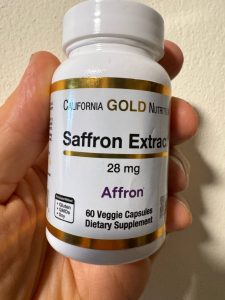
Alex’s Personal Review: California Gold Nutrition (Affron)
I don’t just read studies; I test these things on my own biology.
- Product: California Gold Nutrition, Saffron Extract (featuring Affron®)
- Dosage: 28 mg per capsule
- Frequency: Daily (cycled)
- My Rating: 7/10
The Experience
I started taking this supplement during a high-stress period at work when my Apple Watch Ultra 2 showed my HRV (Heart Rate Variability) was tanking, and my sleep latency was creeping up past 45 minutes.
I bought the California Gold Nutrition version because it uses the official Affron® raw material but costs less than some of the “boutique” biohacking brands.
The Result: It is not a “knockout” pill. If you take Magnesium L-Threonate or Liposomal Apigenin, you feel a physical wave of relaxation. Saffron is different. I didn’t feel “sleepy” 30 minutes after taking it.
However, after about 10 days of consistent use (taking it at dinner time), I noticed a shift. The usual “doom loop” of thoughts that hits me when my head touches the pillow—Did I email that client? Is my son’s car insurance paid?—just wasn’t there. The thoughts were present, but they didn’t have teeth. They didn’t trigger an adrenaline spike.
My wife, who deals with higher anxiety than I do, found it even more effective. We call it our “stress buffer.” It doesn’t solve the problems of the day, but it puts a layer of insulation between you and the stress.
Why 7/10?
I didn’t give it a 10 because it requires patience. It takes accumulation. You cannot pop a Saffron pill after a bad day and expect it to fix everything immediately. It needs at least two weeks to saturate your system. Also, it is expensive compared to basics like L-Glycine.
Alex’s Verdict: A highly effective tool for the “Tired but Wired” profile, provided you buy the certified raw material.
Dosage & Protocols
Based on the clinical literature and the consensus from the biohacking community, here is how to use it correctly.
The Sweet Spot: 28mg – 30mg
Most clinical trials, including the ones on Affron, use 28mg or 30mg daily.
- Lower dose (14mg): Some studies show benefits at 14mg twice a day, but for sleep specifically, a single 28mg dose seems superior.
- Higher dose (50mg+): Not recommended. Higher doses do not increase benefits but significantly increase the risk of nausea and paradoxical anxiety. Toxic dose: Saffron can be toxic at very high doses (5 grams is lethal), so stick to the supplements, don’t eat spoonfuls of the spice.
Timing: Morning vs. Evening?
There is a debate here.
- Morning: Best for mood stabilization and depression. If your sleep is bad because you are depressed all day, take it with breakfast.
- Evening (Alex’s Preference): New studies suggest taking it 1 hour before bed increases evening melatonin levels. I take mine with dinner or my pre-sleep stack.
Cycling
Because it affects serotonin receptors, I recommend cycling it. I follow a “5 days on, 2 days off” schedule, or I use it for 2 months and then take a 2-week break. This prevents any potential downregulation of receptors.
Safety & Side Effects
Saffron is generally safe, but because it is powerful, it has real contraindications.
Serotonin Syndrome?
This is the most common question on Reddit. “Can I take Saffron if I am on Zoloft/Lexapro?”
- The Science: Saffron is a mild reuptake inhibitor. Combining it with high-dose SSRIs theoretically increases the risk of Serotonin Syndrome.
- The Reality: Cases are extremely rare. However, you should never combine them without your doctor’s approval. If you are already manipulating your serotonin with prescription drugs, adding a natural modulator complicates the picture.
The “Vivid Dreams” Phenomenon
This is the most reported side effect on forums like r/Nootropics. Many users report movie-like, intense, and colorful dreams.
Is this bad? Not necessarily. It often indicates an increase in REM sleep intensity. However, for some, these can turn into nightmares. If you have PTSD, be cautious.
Other Side Effects
- Dry Mouth: Common.
- Appetite Suppression: Saffron is often sold as a weight-loss aid because it kills cravings (snacking). This is a bonus for us, as eating sugar late at night destroys sleep quality.
- Pregnancy: Do not take Saffron. It stimulates uterine contractions and has been historically used to induce miscarriage in high doses.
Updates December 2025: New Findings
As of December 2025, the research into Saffron has expanded beyond just “mood.” I performed a deep dive into the latest PubMed studies and biohacker forums to see what’s new.
The Gut-Brain Axis Breakthrough (2025 Study)
A pivotal randomized, placebo-controlled pilot study released in late 2025 (involving Safr’Inside) linked Saffron supplementation to the Gut-Brain Axis.
Researchers found that 30mg of Saffron didn’t just affect the brain directly; it modulated the gut microbiota, increasing the abundance of bacteria responsible for producing Short-Chain Fatty Acids (SCFAs).
Why this matters: SCFAs are critical for signaling the brain to reduce inflammation. This suggests Saffron helps sleep not just by tweaking serotonin, but by healing the gut, which produces 90% of the body’s serotonin.
Saffron vs. Placebo in Middle-Aged Insomnia
Another 2025 trial focusing on adults (40-65) with “moderate insomnia” compared 20mg vs 30mg doses.
Finding: Both doses significantly reduced the PSQI (Pittsburgh Sleep Quality Index) score.
Key takeaway: The 30mg dose showed a faster onset of action (improving sleep quality within 7 days vs 21 days for the lower dose).
Reddit & Biohacker Trends 2025
On the community side (Reddit groups like r/StackAdvice and r/Biohackers), the current trend is stacking Saffron with Inositol (Myo-Inositol).
The Logic: While Saffron handles the serotonin/mood aspect, high-dose Inositol (2-4g) seems to help with the panic/adrenaline aspect of waking up at 3 AM. Users report this combo is superior to either alone for “sleep maintenance insomnia.”
Bryan Johnson Update: While his protocol changes often, Saffron remains a component of his “Longevity Mix” (often integrated into multivitamin powders now), reinforcing its status as a safety-verified geroprotector (anti-aging compound) that protects the brain while you sleep.
The “Endogenous” Melatonin Discovery
For years, we thought Saffron improved sleep just by lowering anxiety. A groundbreaking 2024/2025 study has revealed a deeper mechanism: Endogenous Melatonin Stimulation.
The Science: Unlike taking a melatonin pill (which can downregulate your own production), standardized Saffron extract (Affron) was shown to increase the body’s natural production of melatonin in the evening.
The Shift: Biohackers are now calling Saffron a “Melatonin Generator.” It is the preferred alternative for those who feel groggy on synthetic melatonin. It doesn’t replace the hormone; it signals your pineal gland to do its job.
The “Retinal Shield” (Screen Time Biohack)
You will see Saffron in almost every “Vision Support” stack in 2025.
The Link: New data confirms that Crocin (the red pigment in Saffron) creates a protective shield over retinal cells, preventing oxidative damage from Blue Light.
The Benefit: If you stare at screens all day, Saffron does double duty: it protects your eyes during the day and sets your sleep rhythm at night. This “Retinal-Sleep” connection is unique to this spice.
Safety Update: “Cheap Saffron” Warning
A regulatory alert in late 2025 flagged cheap saffron supplements for containing toxic Sudan Dye (a carcinogenic red dye used to fake the color).
The Rule: If it’s cheap, it’s fake. Always look for third-party tested brands like California Gold, Life Extension, or Thorne.
Summary
Saffron Extract (Affron®) is not a sedative that will knock you out cold. If you are looking for a “sledgehammer” for sleep, this isn’t it.
However, if your sleep issues are rooted in stress, anxiety, and ruminating thoughts—the classic “tired but wired” profile—Saffron is one of the most effective natural interventions available in 2026.
Key Takeaways:
- 1. Source Matters: Only buy patented extracts like Affron® or Safr’Inside™. Generic saffron is a waste of money.
- 2. Dosage: 28mg – 30mg is the clinical standard.
- 3. Patience: It takes 2 to 4 weeks to fully saturate your system and lower your stress baseline.
- 4. Mechanism: It boosts Serotonin (precursor to Melatonin) and lowers neuroinflammation via the gut-brain axis.
- 5. Side Effects: Watch out for vivid dreams and do not combine with SSRIs without medical supervision.
For me and my wife, Saffron earned its place in the medicine cabinet not because it forces us to sleep, but because it allows us to feel calm enough to let sleep happen naturally.
(Next up: We will look at how Saffron pairs with L-Theanine for focus, or if you should switch to Apigenin for physical relaxation.)

By: Alex Warenstein.
Bio: Alex Warenstein is a sleep biohacker and founder of Night Time Comfort. After battling chronic insomnia and circadian disruption, he now helps others optimize their sleep using data-driven protocols. Read full story.
Disclaimer: Alex is not a doctor. This content is for educational purposes only. Always consult a specialist.