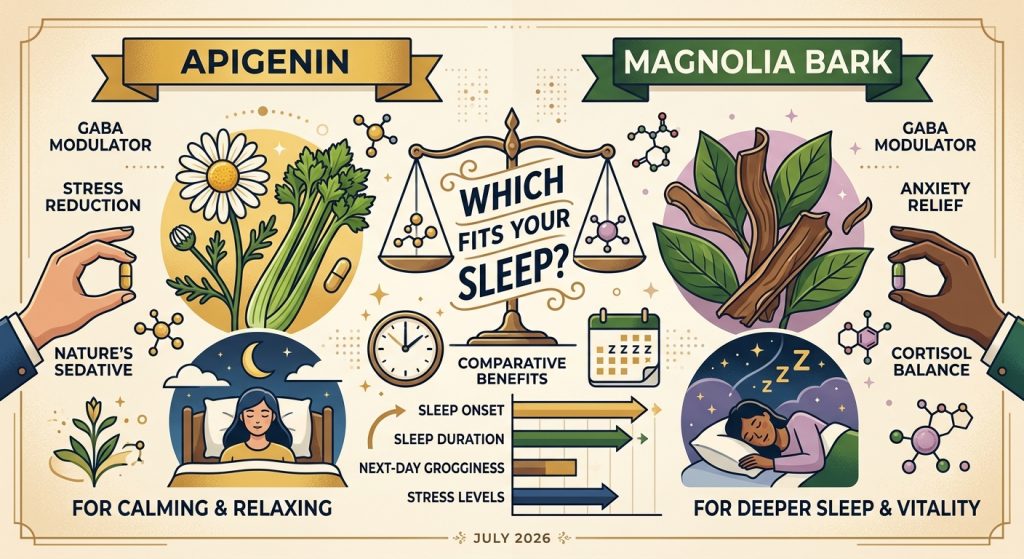
Here is the useful answer: these supplements are not interchangeable.
Apigenin is the better first experiment when your main problem is falling asleep. Magnolia bark is the more logical experiment when you fall asleep normally but wake tense or mentally switched on later.
That is a practical matching rule, not the result of a human head-to-head trial. The human evidence for both is much thinner than supplement marketing suggests.
Why both are called “GABA supplements”
GABA is one of the brain’s braking signals. It helps turn down mental noise and arousal.
Apigenin is a plant flavonoid found in chamomile. Magnolia bark contains several active compounds, especially honokiol and magnolol. Laboratory and animal work suggests all three can influence GABA-A signaling, but they do not press the same part of the brake in exactly the same way.
A 2024 scientific review describes apigenin’s sleep-related mechanisms as plausible but largely preclinical. Honokiol increased NREM sleep in mice through a GABA-A-related pathway in a sleep and EEG study. Magnolol also changed sleep in mice in a separate EEG experiment.
This sounds impressive. It is still mostly mouse evidence.
For a simple explanation of the wider pathway, see my guide to GABA.
The most important evidence gap: purified apigenin is not chamomile
Many articles present chamomile research as proof that purified apigenin works. That is too confident.
Chamomile contains apigenin, but also other flavonoids, terpenes, oils, and compounds that may work together. A 2024 meta-analysis of chamomile trials found some improvement in sleep, particularly fewer awakenings, but no clear improvement in total sleep time, sleep efficiency, or daytime function.
That does not tell us what an isolated apigenin capsule does by itself.
As of this update, I could not find a strong, published randomized trial testing purified apigenin alone against placebo for insomnia with proper sleep measurements. The newest 2026 apigenin sleep paper I found still used mice, not people.
So the honest verdict on apigenin for sleep is: a believable mechanism, supportive chamomile data, many personal reports, and a major shortage of direct human evidence.
Apigenin: best fit for sleep onset
Apigenin makes the most sense when your body is tired but your mind keeps talking. Think rumination, mild evening tension, or that “I cannot cross the line into sleep” feeling.
Andrew Huberman helped popularize 50 mg as part of his sleep stack; his published Sleep Toolkit also says to add supplements one at a time. The problem is that popularity moved faster than clinical evidence.
What about apigenin dosage?
Human insomnia trials have not established an ideal dose for purified apigenin. Commercial sleep routines commonly use 25–50 mg, while online experiments often go higher. Those are not equivalent to a proven medical dose.
Higher is not automatically better. Community reports include no effect, next-day heaviness, unusually vivid dreams, and occasional paradoxical stimulation. Test one variable, not a five-ingredient stack.
Magnolia bark: better fit for “I wake up wired”
Magnolia bark feels like the stronger, broader tool on paper. Honokiol and magnolol have sedative and anti-arousal actions in animal models. That makes it a more logical match when sleep starts normally but breaks after a few hours, especially when the awakening comes with tension.
But the phrase magnolia bark sleep hides a product problem. A bark extract is not the same thing as isolated honokiol, isolated magnolol, or Relora, which combines magnolia with phellodendron. Small human studies of mixed products have looked mainly at stress and self-reported sleep, not clean proof of sleep maintenance.
For readers searching honokiol sleep studies, the key result remains animal work: more NREM sleep and shorter sleep latency, with no convincing human insomnia trial showing that isolated honokiol keeps people asleep.
My practical view: apigenin is the lighter sleep-onset nudge. Magnolia bark is the more plausible option for stress-linked maintenance insomnia, but also the less predictable one.
Bioavailability: is the liposomal form real or marketing?
Plain apigenin dissolves poorly and is rapidly changed into metabolites. Human research confirms that absorption varies and much of what circulates is not free apigenin; see the human absorption and metabolism study.
Liposomal and nano-delivery systems can improve solubility and exposure in laboratory and animal studies. What is missing is the trial that matters to sleepers: plain versus liposomal forms, the same dose, measured in humans with EEG or polysomnography.
So I prefer the liposomal form because it works more clearly for me, not because science has proved it superior for insomnia. That distinction matters.
CD38 and NAD+: interesting, but not a reason to buy it for sleep
Apigenin can inhibit CD38, an enzyme that consumes NAD+, in cells and mice. This is why it appears in longevity discussions.
The leap from “raises NAD+ in a mouse model” to “improves human sleep through NAD+” has not been demonstrated. I treat the CD38 story as an interesting research line, not a practical sleep benefit.
Medication interactions: the CYP3A4 issue
CYP3A4 is one of the liver and gut systems that clears many medicines. Laboratory studies show apigenin can inhibit it, including a flavonoid CYP3A4 study.
What does that mean in ordinary language? Apigenin might slow the handling of some drugs and change their blood levels. The real-world risk at common supplement amounts is uncertain because the evidence is mostly laboratory-based.
This matters more if you take several medications or drugs that need stable blood levels, including some statins, heart medicines, anticoagulants, immune-suppressing drugs, and sedatives. A pharmacist can check the exact combination quickly.
Magnolia products may also add to the effects of alcohol, prescription sleep drugs, and other calming supplements.
What Reddit and long-running forums repeatedly report
The apigenin Reddit pattern is mixed but consistent enough to be useful:
- A noticeable group says it shortens sleep onset, often at 25–50 mg.
- Many combine it with magnesium, theanine, glycine, or chamomile, making it impossible to know what worked.
- Others report no effect, fading results, vivid dreams, morning grogginess, or stimulation at higher amounts.
- Some people say concentrated chamomile works better than an isolated capsule.
- Magnolia and honokiol reports sound stronger but less predictable. People more often use them for tension or staying asleep, but next-day sedation and short duration also appear.
Long-running biohacking discussions add one important lesson: users keep changing the dose, brand, timing, and stack simultaneously. That produces stories, not clean experiments.
The missing question in most competitor articles is not “Which compound touches GABA?” It is: What kind of insomnia are you actually trying to solve?
A 3 a.m. awakening may have nothing to do with GABA
If you wake at roughly the same time every night, do not automatically add a stronger sedative.
A glucose drop can trigger adrenaline. I check this with CGM and compare it with my guide to low blood sugar at night and my Freestyle Libre 3 testing.
Breathing problems can also cause repeated micro-awakenings. I screen trends with the Wellue O2Ring and look for oxygen desaturation. A supplement cannot hold an airway open.
Stress conditioning is another possibility. When the brain has learned to fear being awake, DIY CBT-I is more rational than endlessly rotating capsules.
Bottom line
For apigenin vs magnolia bark, choose by problem, not by marketing:
Cannot fall asleep: apigenin is the cleaner first experiment, especially if chamomile already works for you.
Fall asleep, then wake wired: magnolia bark is the more logical GABA-oriented experiment, but the human evidence is weaker and products vary more.
Wake at 3 a.m. with glucose or breathing changes: neither is the real solution.
My personal winner is apigenin, specifically the form I absorb and respond to consistently. It gets me across the sleep-onset line. I would not claim that it repairs deep sleep, REM, apnea, glucose instability, or chronic insomnia. The mechanism is attractive. The human evidence is still catching up.
FAQ
Is apigenin the same as chamomile?
No. Apigenin is one compound found in chamomile. Chamomile contains many other active substances, so its clinical results cannot be assigned to apigenin alone.
Which one is stronger?
Magnolia bark usually appears stronger and less subtle in community reports, but there is no reliable human head-to-head trial.
Can I take both together?
The combination has not been adequately studied for insomnia. Because both may increase calming or sedating effects, stacking them makes side effects and results harder to interpret.
Does apigenin improve deep sleep?
Animal studies suggest sleep effects, but there is no strong human evidence that purified apigenin reliably increases deep sleep.
Is a liposomal product definitely better?
Not definitely. Delivery technology may improve absorption, but superiority for human sleep has not been proven.

By: Alex Warenstein.
Bio: Alex Warenstein is a sleep biohacker and founder of Night Time Comfort. After battling chronic insomnia and circadian disruption, he now helps others optimize their sleep using data-driven protocols. Read full story.
Disclaimer: Alex is not a doctor. This content is for educational purposes only. Always consult a specialist.