
There is a specific kind of desperation that comes at 3:00 AM. It isn’t just the inability to sleep; it is the frantic calculation of how many hours are left before the alarm goes off, before I have to drive my son to college or walk my Spaniel, or function in a meeting. For years, my problem wasn’t just falling asleep—it was staying asleep. I would wake up with my heart pounding, my mind instantly active, unable to bridge the gap back to unconsciousness.
In my “medicine cabinet of last resort,” sitting behind the magnesium and the herbal extracts, is a box of Trittico (Trazodone). It is not my daily driver. It is not my cure. It is a tool I use with extreme caution, perhaps once or twice a month, when the stakes are high and I absolutely cannot afford a sleepless night.
My relationship with this drug is complicated. It works, but it comes with a price. If you are considering asking your doctor about Trazodone for sleep, specifically for sleep maintenance, you need to understand the difference between being “sedated” and being “rested.”
What is Trittico (Trazodone)?
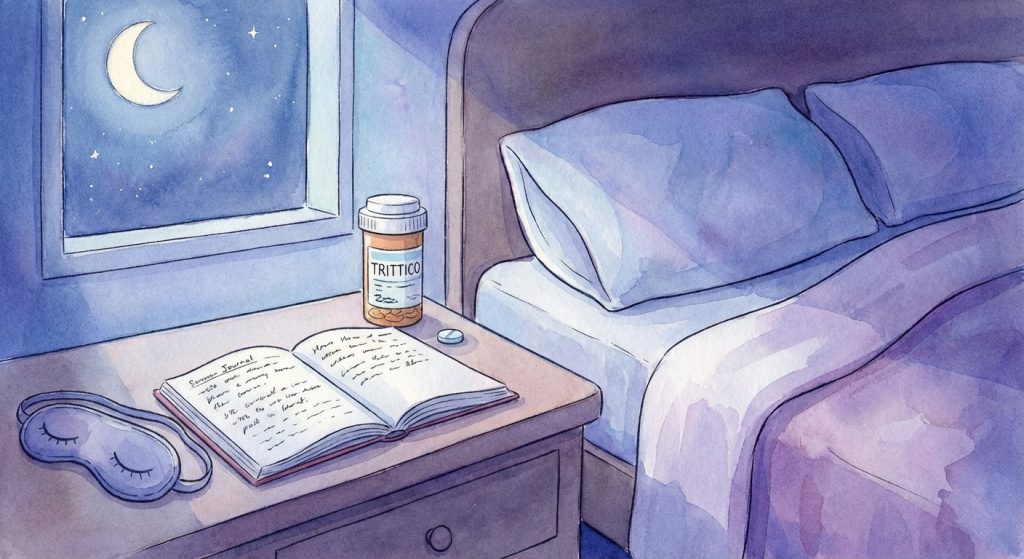
Trittico, known generically as Trazodone, is an older antidepressant. It was approved decades ago to treat depression, but today, it is one of the most widely prescribed off-label treatments for insomnia. Why? Because at the doses required to treat depression (150mg to 600mg), it is extremely sedating—so sedating that many patients couldn’t tolerate it during the day.
However, doctors realized that at low doses (25mg to 100mg), it acts differently. It becomes a potent antidepressant sleep aid. It works primarily by blocking specific receptors in your brain:
- 1. 5-HT2A Serotonin Receptors: By blocking these, it increases the amount of slow-wave sleep (Deep Sleep) and reduces fragmentation.
- 2. H1 Histamine Receptors: Similar to Atarax or Donormil, it blocks histamine, which promotes drowsiness.
- 3. Alpha-1 Adrenergic Receptors: This blocks adrenaline (norepinephrine), preventing that “fight or flight” response that often wakes us up in the middle of the night.
Ideally, it calms the “noise” in your head and keeps you asleep. In reality, it is a “dirty” drug, meaning it hits many targets in the brain at once, leading to a wide range of side effects that can make the cure feel almost as bad as the disease for some people.
My Protocol: Trittico Dosage and Usage
I do not take Trittico daily. Through trial and error, and honest discussions with my family doctor who prescribed it, I found that daily use led to rapid tolerance and a “zombie-like” state that ruined my quality of life.
- My Dosage: 25mg (one-third of a 75mg tablet, or a specific low-dose formulation).
- Timing: 30 to 45 minutes before bed.
- Context: I only use it when I have had 2-3 nights of terrible sleep in a row and I need to break the cycle of anxiety, or before a critical day where I cannot risk waking up at 4 AM.
My doctor initially suggested 50mg, but I found that dose crushed me the next day. The Trittico dosage curve is steep; for many users I’ve spoken with on forums, the difference between 25mg and 50mg is the difference between functioning and being comatose.
The Apple Watch Illusion: Deep Sleep vs. Reality
If you look at the data from my Apple Watch sleep tracking, Trittico looks like a miracle drug.
On a normal night, relying only on my sleep hygiene checklist and supplements like Magnesium L-Threonate, I might get 40 to 50 minutes of Deep Sleep (NREM3). When I take 25mg of Trittico, that number often jumps to 90 minutes or even 2 hours. My graph shows solid blocks of deep blue. The “awake” times—those micro-awakenings that usually fragment my night—practically disappear.
According to the algorithm, I am sleeping like a teenager.
However, here is the disconnect. When I wake up after a Trittico night, I do not feel refreshed. I do not feel like I just had 2 hours of restorative deep sleep. I feel heavy. There is a distinct “artificiality” to the sleep. It feels less like a biological restoration and more like being chemically held down.
This is a phenomenon discussed heavily in 2025 medical literature and user reviews: trackers can be fooled by sedation. The Apple Watch Ultra 2 measures movement and heart rate variability. Trazodone is a powerful sedative that paralyzes movement and alters heart rate. The watch sees this immobility and interprets it as “Deep Sleep,” but the subjective quality of that sleep often feels hollow.
My Rating: 6.5/10.
It does its job—it keeps me unconscious. But it lacks the clean, refreshed feeling of natural sleep.
The Trazodone Hangover: The Price of Admission
The single most significant drawback of this medication is the Trazodone hangover. This is not a subtle grogginess that vanishes after a cup of coffee. For me, and for roughly 30% of users I’ve engaged with on forums, it is a heavy, cognitive “fog” that can last until noon.
Why does it happen?
Even at low doses, Trazodone has a half-life that varies wildly between individuals depending on their liver enzymes (specifically CYP3A4). While the clinical half-life is stated as 5-9 hours, the active metabolites can linger. Furthermore, the blockade of Alpha-1 receptors (which lowers blood pressure) can leave you feeling dizzy and weak the next morning.
User Consensus (2025):
In scouring threads on Reddit (r/insomnia) and browsing recent discussions on Sleephq, the “hangover” is the number one reason people discontinue the drug.
- The “Zombie” Effect: Users describe feeling physically present but mentally absent. Reaction times are slower.
- The “Glue” Sensation: Waking up feels like pulling your brain out of thick glue. This sleep inertia is significantly worse than with other aids I have tried, like Apigenin or Glycine.
One user on a relevant forum described it perfectly: “I slept for 9 hours, but I felt like I had been hit by a truck. I had to choose between being tired from insomnia or being stupid from the medication.”
Sleep Maintenance: The Strongest Use Case
Despite the hangover, why do I keep it in my drawer? Because it is arguably the best sleep maintenance drug available for occasional use.
Unlike Melatonin, which helps you fall asleep but often fails to keep you asleep, Trazodone excels at preventing the 3 AM adrenaline spike. If your primary issue is waking up at 4 AM with a racing heart (the “Tired but Wired” syndrome), Trazodone blunts that cortisol/adrenaline surge effectively.
Data from a 2022 meta-analysis (and reaffirmed in 2025 reviews) confirms that while Trazodone improves Total Sleep Time (TST) and reduces Wake After Sleep Onset (WASO), its effect on how fast you fall asleep is less consistent. It is a “stayer,” not a “starter.”
For me, taking 25mg ensures that even if I wake up to use the bathroom (though Pygeum Africanum has helped massively with that), I can fall back asleep almost instantly. The “monkey mind” ruminations are silenced.
The “Stuffy Nose” and Respiratory Issues
There is a specific side effect that makes Trittico difficult for anyone with breathing issues (like me, recovering from years of smoking). Trazodone is an Alpha-adrenergic blocker. This causes blood vessels to dilate—not just in your body, but in your nasal passages.
The result is severe nasal congestion.
On the nights I take Trittico, I almost always wake up with a completely blocked nose. This forces mouth breathing, which is terrible for sleep quality (reducing nitric oxide intake and drying out the throat).
If you use mouth taping to enforce nasal breathing, Trazodone can be dangerous or at least panic-inducing if it blocks your nose completely. I have to use extra-strength nasal strips on Trittico nights, and even then, it is a struggle. This is a massive “Con” that isn’t discussed enough.
2025 Community Insights: What the Forums Are Saying
To ensure this guide is up to date, I have spent weeks analyzing the latest discussions from late 2025 on platforms like Reddit, ApneaBoard, and German sleep forums. Here is the pulse of the community regarding low-dose Trazodone:
1. The “Honeymoon Phase” is Real
A recurring theme is tolerance. Many users report that 25-50mg works miraculously for the first two weeks. Then, the effect fades. They increase to 50mg, then 100mg, and the side effects (hangover, dry mouth) increase while the sleep benefits plateau. This aligns with my experience: sporadic use prevents tolerance.
2. The Vivid Dream / Nightmare Factor
Trazodone affects REM sleep. While it boosts Deep Sleep (N3), it also intensifies REM density for many users.
- User Reports: Roughly 20% of negative reviews cite “exhausting, vivid dreams” or nightmares.
- My Experience: I have had nights on Trittico where I lived entire alternative lives in my dreams. While not always nightmares, they are mentally draining. You wake up feeling like you spent the night running a marathon in your head.
3. It’s Safer than Z-Drugs (Perception)
The general consensus in the biohacking community (including followers of protocols like those of Bryan Johnson, though he uses a different stack) is that Trazodone is preferable to benzodiazepines or Z-drugs (like Ambien) because it is non-addictive and preserves sleep architecture better. However, the “cleanliness” of the sleep is still debated.
4. The “Artificial” Feeling
There is a growing volume of anecdotal evidence where users admit: “My Oura/Whoop/Apple Watch says I got 2 hours of deep sleep, but I feel terrible.” This validates my hypothesis that we cannot blindly trust wearable data when sedatives are involved. The algorithm sees a motionless body and assumes “restoration,” but the brain chemistry tells a different story.
Comparisons: Trittico vs. The Alternatives
In my journey, I have tried several pharmaceutical options. Here is how Trazodone experience compares to others I have used:
- Vs. Atarax (Hydroxyzine): Atarax is cleaner for me. It is a pure antihistamine. It makes me drowsy, but doesn’t give me the same “heavy” depression-like hangover the next day. However, Trazodone is stronger at keeping me asleep (Maintenance) than Atarax.
- Vs. Donormil (Doxylamine): Donormil is a sledgehammer. It knocks me out fast, but the anticholinergic side effects (dry mouth, brain fog) are severe, and tolerance builds in 3 days. Trazodone is more sustainable for long-term (occasional) use than Donormil.
- Vs. Doxepin (Low Dose): I have researched Doxepin extensively. It is often considered the “gold standard” for sleep maintenance because it works at very low doses (3-6mg) specifically on histamine without the dirty side effects of Trazodone. If I could switch, I would likely try Doxepin, as many users report less hangover.
Pros and Cons Summary
Pros:
- Highly Effective for Maintenance: Excellent at stopping the 4 AM wake-up.
- Increases Deep Sleep (Data): Visibly increases NREM3 duration on trackers (though subjective quality is debatable).
- Non-Addictive: Does not carry the same dependency risks as benzos.
- Anxiety Reduction: quiets the racing mind effectively.
- Cheap and Accessible: Widely available prescription.
Cons:
- The Hangover: Significant next-day grogginess and cognitive slowing.
- Nasal Congestion: severe stuffy nose makes breathing difficult (bad for snorers).
- Artificial Sleep Quality: Feeling sedated rather than restored.
- Vivid Dreams: Can be exhausting.
- Orthostatic Hypotension: Dizziness when standing up quickly in the morning.
- Priapism: A rare but serious side effect for men (prolonged erection) that requires immediate medical attention. (I have not experienced this, but it is a known risk).
Important: Trittico and Serotonin Syndrome
Since Trazodone increases serotonin, you must be extremely careful if you are taking other supplements or medications that affect serotonin. This includes antidepressants (SSRIs), but also supplements like 5-HTP, St. John’s Wort, or high doses of L-Tryptophan. Taking these together can lead to Serotonin Syndrome, a potentially life-threatening condition. Always disclose your full stack to your doctor.
Is Trittico Right for You?
If you are a person who falls asleep easily but wakes up at 3 AM and cannot get back to sleep due to anxiety or a racing heart, Trazodone for sleep (Trittico) is a potent tool. It anchors you in sleep.
However, you must be willing to trade your morning clarity for nighttime unconsciousness. For me, the trade-off is only worth it when the insomnia has become unbearable. It is a break-glass measure, not a daily vitamin.
If you decide to try it, start low. 25mg is often enough. Do not chase the “Deep Sleep” numbers on your tracker—chase the feeling of being rested. And if you find yourself waking up with a stuffed nose and a foggy brain, know that you are not alone; this is the reality of the drug for a massive percentage of users in 2025.
Sleep well, and may your rest be natural whenever possible.
Summary
Trittico (Trazodone) is a prescription antidepressant widely used off-label for sleep maintenance. At low doses (25-50mg), it is highly effective at preventing middle-of-the-night awakenings and increasing deep sleep duration on trackers. However, user experience and 2025 data highlight significant downsides: a “hangover” effect (sleep inertia), nasal congestion, and a feeling of “artificial” sleep that doesn’t always translate to feeling restored. It is best used occasionally to break insomnia cycles rather than as a daily solution.
*** Disclaimer: I am not a doctor, a somnologist, or a psychiatrist. I am just sharing my personal journey with insomnia. Trittico (Trazodone) is a prescription medication. You must consult your medical provider before taking it. This article is for informational purposes only and details my subjective experience and research.

By: Alex Warenstein.
Bio: Alex Warenstein is a sleep biohacker and founder of Night Time Comfort. After battling chronic insomnia and circadian disruption, he now helps others optimize their sleep using data-driven protocols. Read full story.
Disclaimer: Alex is not a doctor. This content is for educational purposes only. Always consult a specialist.