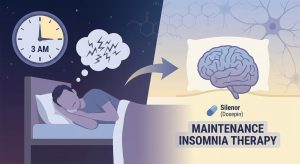
If there is one specific type of sleep torture that defines my life over the last few years, it is not the inability to fall asleep. It is the inability to stay asleep. It is the dreaded “3 AM stare.” You know the feeling. You fall asleep fine, perhaps exhausted from the day. But then, like clockwork, your eyes snap open in the middle of the night. You aren’t groggy. You are alert. You are “wired.”
In my journey to fix my sleep architecture, I have spent a lot of time analyzing my Apple Watch Ultra 2 data, looking at those fragmented bars of red “awake” time punctuating my night. While I have managed to solve a lot of my issues through a strict sleep hygiene checklist, magnesium L-threonate, and blocking blue light, I know that sometimes biology fights back.
I have not taken Doxepin yet. It remains on my list as a potential “next step” if my current stack ever stops working. However, in my deep dive into pharmaceutical solutions for maintenance insomnia (the clinical term for waking up too early), Doxepin—specifically in low doses (often branded as Silenor)—keeps coming up as the “gold standard” recommendation from modern sleep doctors. Unlike the heavy hitters like Ambien that knock you out, Doxepin seems to work differently. It doesn’t pull you down; it keeps you under.
This article is a comprehensive breakdown of everything I have learned about low-dose Doxepin as of late 2025. I have scoured the latest medical journals, the 2025 pharmacovigilance reports, and the raw, unfiltered discussions on Reddit and sleep forums to give you the reality of this drug.
What is Low-Dose Doxepin?
To understand Doxepin, you have to separate its history from its current use. Originally, Doxepin was developed decades ago as a Tricyclic Antidepressant (TCA). In the old days, it was prescribed at massive doses—75mg to 150mg—to treat major depression. At those levels, it hits a lot of receptors in the brain: serotonin, norepinephrine, acetylcholine. It was a “dirty” drug with a lot of side effects.
However, researchers noticed something interesting. Even at tiny, microscopic doses (3mg or 6mg), Doxepin retained one very specific property: it is an incredibly potent histamine blocker.
The “Silenor” Rebranding
In the context of sleep medicine in 2025, when we talk about Doxepin, we are almost exclusively talking about these micro-doses (3mg to 6mg). At this level, the drug does not act as an antidepressant. It has virtually no effect on serotonin or norepinephrine. Instead, it acts as a selective H1-antagonist.
Think of it as a sniper rifle compared to a shotgun. Histamine is one of the primary neurotransmitters your brain uses to keep you awake. It is the “wakefulness” signal. By selectively blocking histamine receptors, Doxepin reduces the “wake drive.” It doesn’t force sedation like a benzodiazepine (which increases GABA); rather, it turns down the volume on the noise that wakes you up.
Why It Is Prescribed: The Maintenance Specialist
If you go to a doctor saying, “I can’t fall asleep,” they might suggest Melatonin or CBT-I. But if you say, “I fall asleep fine, but I wake up at 4 AM and can’t get back to sleep,” Doxepin is often the first pharmaceutical line of defense.
This is critical because maintenance insomnia is notoriously hard to treat. Many standard sleeping pills have a short half-life—they work for 4 hours and then leave your system, leaving you vulnerable to that early morning cortisol spike (the inverted cortisol curve).
Doxepin has a unique pharmacokinetic profile. Its peak concentrations and half-life (roughly 15 hours, though individual metabolism varies greatly) mean it is still active in your system during the last third of the night. This is exactly when your sleep drive (adenosine) is lowest and your alert drive (circadian arousal) is kicking in. Doxepin acts as a shield against that premature awakening.
The 2025 Scientific Consensus: Does It Work?
I spent a significant amount of time analyzing the research updates from 2025 regarding this drug. The medical community has refined its understanding of who this drug is for.
1. The “Sleep Onset” Reality Check (2025 Data)
For years, the marketing for Silenor claimed it helped with sleep onset (falling asleep). However, a major pooled analysis released in 2025 clarified this. The data showed that while the 3mg dose does have a statistically significant effect on reducing sleep latency (the time it takes to fall asleep) in the very first night of use, the effect is often below the threshold of “clinical significance.”
In plain English: The math says it helps you fall asleep faster, but in the real world, you probably won’t feel it. If you are staring at the ceiling for two hours at the start of the night, Doxepin is likely too weak for you. It is not a “knockout” pill. It is a subtle anchor.
2. The Maintenance King
Where the drug shines in clinical trials—consistently, even in elderly populations—is in “Wake After Sleep Onset” (WASO). The 2025 reviews, including a comprehensive overview from the Cleveland Clinic Journal of Medicine, position low-dose Doxepin as one of the safer options for keeping patients asleep.
The studies show it improves total sleep time (TST) and sleep efficiency, specifically protecting the final hours of the night. For someone like me, who tracks sleep stages on an Apple Watch Ultra 2 and sees that crucial REM sleep often happens in those early morning hours, protecting that block of time is essential for emotional recovery and preventing tired but wired symptoms the next day.
3. Safety Profile vs. Benzos
The reason doctors love prescribing this in 2025 is the safety profile compared to the alternatives. Benzodiazepines and “Z-drugs” (like Ambien/Zolpidem) are associated with tolerance, dependence, and fall risks in older adults. The AGS Beers Criteria (a guideline for medication safety in older adults) specifically notes that Doxepin at doses of 6mg or less is safe and comparable to placebo in terms of safety profile, distinguishing it sharply from its high-dose antidepressant version.
Real World Patient Experiences: The Pros
While the studies are clean, the forums are messy. I monitor SleepHQ, ApneaBoard, and the insomnia subreddits daily. Here is what real people are saying about Doxepin in late 2025.
- 1. “It’s the only thing that keeps me asleep.”
This is the most common positive feedback. Users who have failed on Trazodone (due to stuffy nose) or Melatonin XR (due to ineffectiveness) often find Doxepin to be the missing link. One user on Reddit described it perfectly: “It doesn’t feel like being drugged. It just feels like when I wake up to roll over, I don’t fully wake up. I just drift back.” - 2. The CPAP Synergy
Interestingly, there is a strong contingent of successful users in the sleep apnea community. Even if you treat the apnea with a machine (like the ResMed AirSense 11), the brain often remembers the trauma of choking and keeps waking you up out of habit. Doxepin helps bridge that gap, allowing the brain to trust the sleep again. - 3. No “Rebound” Insomnia
Many users report that when they stop taking it (after using it for a few weeks), they don’t experience that horrific “rebound” insomnia where you don’t sleep for three days—a common curse of stopping benzodiazepines.
The Dark Side: Side Effects and Patient Complaints
I am strictly against sugar-coating anything. While the medical pamphlets say “comparable to placebo,” the patient logs tell a different story. If you are considering this drug, you need to be aware of the “Cons” that dominate the forum discussions in 2025.
-
1. The “Zombie” Hangover
- 2. The Weight Gain Debate
Here is a massive disconnect between science and reality. The clinical trials for low-dose Doxepin generally claim there is no significant weight gain. However, if you spend ten minutes on Drugs.com or Reddit, you will see a different pattern.Histamine H1 blockage is known to stimulate appetite (it’s why marijuana gives you the munchies—it interacts with similar pathways, and why old antihistamines caused weight gain).
Users frequently report an insatiable hunger, specifically for carbohydrates (sugar/carbs), appearing after a few weeks of use. “I gained 30 pounds,” is a headline I saw more than once. While less common at 3mg than at 25mg, specific individual sensitivity to H1 blockade means some people will get fat on this drug if they don’t strictly control their diet. If you are already fighting metabolic issues or nocturnal hypoglycemia, this is a risk factor to watch.
- 3. Vivid Dreams and Nightmares
Because Doxepin alters the sleep architecture and allows you to stay in REM longer (or at least, stay asleep during REM periods), many users report intensely vivid, sometimes terrifying dreams. This isn’t necessarily “bad” for everyone, but for those with PTSD or anxiety, it can be distressing. It reminds me of the feedback I’ve seen on Melatonin XR—sometimes staying asleep means being trapped in a movie you didn’t choose.
- 4. Anticholinergic Effects (Dry Mouth)
Even at low doses, Doxepin has slight anticholinergic activity. The most common physical complaint is a desert-dry mouth. If you are already mouth breathing (which you shouldn’t be—check my guide on Sleep Mouth Taping), this will destroy your dental hygiene and make your throat feel like sandpaper.
This is the number one complaint, bar none. Because Doxepin has a relatively long half-life, it doesn’t always exit your system by 7:00 AM.
A massive pharmacovigilance report from the World Health Organization (VigiBase) analyzed in 2025 highlighted “somnolence” and “hangover” as frequent adverse events.
Users describe a “heavy veil” or “cotton wool brain” that lasts until noon. One Reddit thread was entirely dedicated to the “2-Day Doxepin Hangover,” where users felt groggy for 48 hours after a single 6mg dose. This “morning inertia” can be brutal if you need to be sharp for work at 8:00 AM. It mimics the feeling of sleep inertia, but chemically induced.
Tolerance: Does It Stop Working?
This is the golden question for any biohacker or insomnia sufferer.
The clinical studies (up to 3 months) claim no tolerance build-up.
The forum reality? Mixed.
There is a distinct group of people who say it works for 2 weeks and then stops. However, looking closer at these reports, a pattern emerges. Often, “tolerance” is actually just “accumulation.” The drug builds up in the system, the hangover gets worse, the person skips a dose, sleeps badly, and blames the drug.
Conversely, there are long-term success stories (2+ years) from people who strictly cycle it or take it only 3-4 times a week, similar to how I use Trittico (Trazodone) or Atarax occasionally. They treat it as a tool, not a vitamin.
How to Use It (If Your Doctor Prescribes It)
If you decide to go down this route, there are protocols derived from user experience that seem to mitigate the side effects.
1. The “Empty Stomach” Rule is Non-Negotiable
The official FDA prescribing information is extremely clear on this, and users confirm it: Do not take Doxepin within 3 hours of a meal.
If you take this drug on a full stomach, two things happen:
- 1. Absorption is delayed, meaning it won’t help you sleep until 2 AM.
- 2. The peak plasma concentration hits you the next morning, guaranteeing a severe hangover.
You must stop eating early. This aligns well with general sleep hygiene (not eating 3 hours before bed to prevent insulin spikes), but with Doxepin, it’s a hard chemical rule.
2. Timing is Everything
Because it doesn’t knock you out instantly, you should take it 30 to 60 minutes before your target sleep time. Do not take it at 2 AM when you wake up—you will be a zombie until the next evening. It is a “preventative” pill, not a “rescue” pill.
3. Dosage Strategy
Most successful reviews start at 3mg (or even cutting pills to 1.5mg if using generic formulations, though Silenor tablets aren’t easily splittable). Jumping straight to 6mg seems to exponentially increase the “hangover” risk without doubling the sleep benefit.
Doxepin vs. Other “Tools”
How does this stack up against the other things I’ve researched or used?
- Vs. Hydroxyzine (Atarax): I have used Atarax. It is also an antihistamine. However, Atarax feels “heavier” and has a shorter duration of action in my experience. Doxepin is cleaner for the maintenance phase but requires stricter timing.
- Vs. Trazodone: Trazodone works on serotonin and adrenaline receptors. It is better for anxiety-driven insomnia (“racing mind”). Doxepin is purely for the “I just woke up” mechanical failure of sleep. Trazodone often causes nasal congestion (stuffy nose), whereas Doxepin causes dry mouth. Pick your poison.
- Vs. Natural Supplements: Before trying Doxepin, I would always suggest exhausting the natural “maintenance” stack. This includes Magnesium L-Threonate for relaxation and perhaps Apigenin. There is also Suan Zao Ren, the TCM herb which is famous for maintenance insomnia, though my personal experience with it was lackluster. Doxepin is significantly more potent than any supplement in the “Review” section of this site.
Pros (Based on Patient Consensus 2025):
- Superior at preventing 3-4 AM awakenings compared to OTC aids.
- No “rebound insomnia” reported upon cessation in most cases.
- Does not cause the memory loss or “blackout” behavior associated with Ambien.
- Safe for long-term use relative to benzodiazepines (according to Beers Criteria).
- Can be effective even when used irregularly (not every night).
Cons (Based on Patient Consensus 2025):
- Significant “morning hangover” and grogginess affecting work performance.
- Noticeable increase in appetite and carbohydrate cravings leading to weight gain (contradicting some clinical data).
- Vivid, sometimes disturbing dreams or nightmares.
- Strict requirement to take on an empty stomach (3+ hours fasting) or it fails.
- Does not help significantly with falling asleep (Sleep Onset).
Summary
Low-dose Doxepin (Silenor) represents a fascinating shift in how we treat sleep. It moves away from “sedating” the brain with heavy GABA drugs and towards “shielding” the brain from wakefulness signals (histamine).
From my exhaustive research in late 2025, it appears to be the most effective pharmaceutical option for the specific problem of waking up too early. The safety profile regarding dependency is reassuring. However, the disconnect between clinical trials and patient realities regarding weight gain and morning grogginess is too large to ignore.
If you are suffering from severe maintenance insomnia and CBT-I (Cognitive Behavioral Therapy) hasn’t worked, and your sleep hygiene is perfect, Doxepin is a logical discussion to have with your doctor. But go into it with your eyes open: watch your appetite, respect the fasting window before administration, and be prepared to lose a few mornings to grogginess while you find your dosage.
As for me? I am keeping this information in my back pocket. I haven’t pulled the trigger on asking for a prescription yet, but knowing there is a non-addictive option that specifically targets my nemesis—the 4 AM wake-up—gives me a sense of security. And sometimes, just knowing a solution exists is enough to lower the anxiety and help you sleep.
Disclaimer: I am not a doctor. I am a patient sharing research. This is not medical advice. Always consult your physician before starting any medication, especially TCA-class drugs like Doxepin.

By: Alex Warenstein.
Bio: Alex Warenstein is a sleep biohacker and founder of Night Time Comfort. After battling chronic insomnia and circadian disruption, he now helps others optimize their sleep using data-driven protocols. Read full story.
Disclaimer: Alex is not a doctor. This content is for educational purposes only. Always consult a specialist.