I created this site, Night Time Comfort, not because I am a doctor. I am not a somnologist. I am a patient. I am a man who walked through the hell of insomnia, chronic pain, and endless self-experimentation because getting an appointment with a good specialist turned out to be harder than flying to space. I waited on a waitlist for over a year. During that year, out of sheer necessity, I had to become my own doctor, researcher, and laboratory rat.
My name is Alex Warenstein. I am 47 years old. I have a supportive wife, an 18-year-old son, and a three-year-old Spaniel. To the outside world, I looked fine. But inside, I was crumbling.
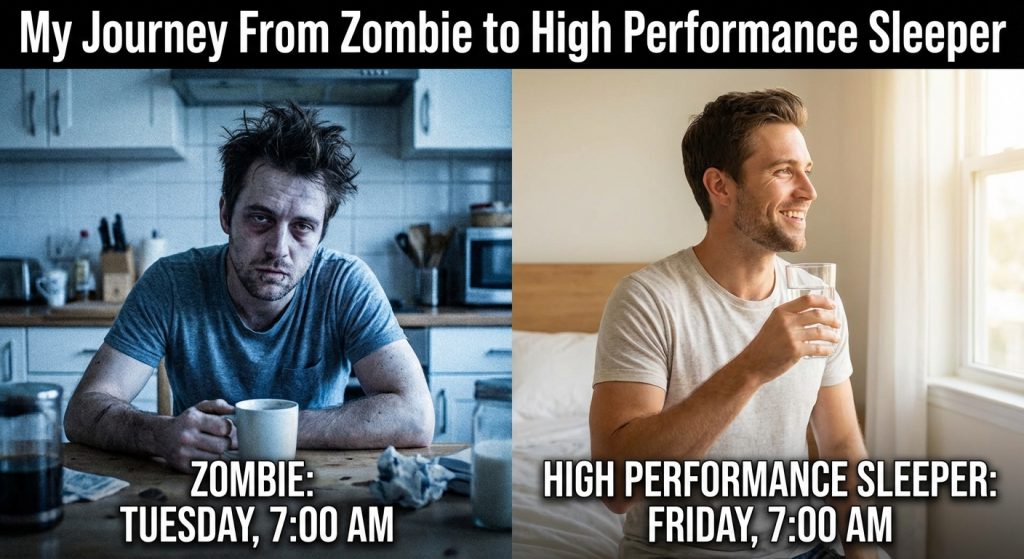
My problems didn’t start yesterday. They began years ago, creeping up on me slowly. Initially, it was just a long time to fall asleep – what doctors call Sleep Onset Latency. I would stare at the ceiling, my mind racing. Then, the pattern shifted. I started waking up consistently at 4:00 or 5:00 AM. After that hour, my sleep was incredibly superficial, a twilight state where I wasn’t quite awake but definitely not restoring my energy. Sometimes, I couldn’t fall back asleep at all. I would drag myself to work, feeling like a zombie, surviving on nicotine and willpower.
This is the story of how I took control of my nights. It involves gadgets, pillows, a lot of supplements, and a complete overhaul of my life. It wasn’t a straight line, and my biology might be different from yours. But if you are lying awake reading this, perhaps my roadmap can save you some time.
The Data That Scared Me: Apple Watch and the “Deep Sleep” Crisis
Like many, my journey into the rabbit hole began with a number on a screen. My Apple Watch tracked my sleep stages, and the data was alarming. It consistently showed that I was getting less than 20 minutes of Deep Sleep (NREM3) per night.
For a man of my age, deep sleep is critical for physical repair and metabolic health. Waking up with a soreness in my shoulder and feeling physically drained confirmed what the watch was saying. But I am a skeptic. I knew that wrist-based trackers aren’t medical devices. I needed verification.
I managed to buy a Muse S (Gen 3) Athena headband on a discount. I had read about its ability to track sleep stages via EEG (brainwaves), which theoretically offers clinical-grade accuracy compared to the optical sensors on a watch. I wasn’t interested in the meditation features; I just wanted to know if my deep sleep was truly that nonexistent.
The results were even more disheartening—or so I thought. The Muse S reported 0 to 5 minutes of deep sleep. Panic began to set in. However, after weeks of “dedicated research” (some might call it obsession) on Reddit and specialized forums, I found I wasn’t alone. The device has a notorious reputation for contact issues. The signal quality often drops without the user knowing, leading the algorithm to misinterpret the data.
I tried everything. Customer support suggested wetting the sensors with water. I tried that. I bought specialized EEG gel to improve conductivity. Nothing worked consistently. My wife and my son tried the device, and they experienced identical issues with signal loss and nonsensical data. I realized that the hardware’s inability to maintain a stable connection with the forehead skin rendered the data useless for me. I sent the device back.
The Lesson: Don’t let a gadget dictate your anxiety levels if the hardware is flawed. My information regarding the Muse S concerns strictly its sleep tracking capabilities; perhaps it works for meditation, but for a restless sleeper like me, it was not the solution.
The Pharmaceutical crutch: Atarax and the Greek Solution
Long before the gadgets, when the sleep onset issues first became unbearable, I was in Greece. A local doctor recommended Atarax (Hydroxyzine). It’s an antihistamine with strong sedative properties.
For about nine months, it was a reliable tool. I didn’t abuse it; I took it irregularly, perhaps up to three times a week, usually the night before a heavy gym session when I knew I needed recovery. It worked—until it didn’t. Eventually, the effect faded completely. My body had adapted, or the root cause of my insomnia had shifted.
I stopped relying on it and turned to Trittico (Trazodone). I simply asked my family doctor if he could prescribe it, describing my sleep issues briefly. He agreed. I use Trittico and Atarax very rarely now, perhaps once a month before a high-stakes day, just to ensure I am not a wreck. They are tools in the cabinet, not a daily routine.
The Physical Foundation: Pain, Pillows, and Mattresses
Around the time the Atarax stopped working (in 80% of cases), a new symptom appeared: morning pain in my shoulder and neck. I am a strict side sleeper. I assumed the problem was the pillow.
“Listen, Alex, it’s not just the pillow, it’s the base,” a friend told me over a beer. Back then, I was still drinking alcohol and smoking, naively thinking a glass of wine helped me sleep (it doesn’t—it destroys sleep quality).
I went on a spending spree, searching for the “Holy Grail” of pillows. I bought a Blackroll, a Tempur Ombracio, a Tempur Sonata, and a Cloudpilo.
The Tempur Ombracio was interesting, but didn’t quite support my neck height. The Tempur Sonata (Size M) was much better. However, the real breakthrough in understanding came with the Cloudpilo. Its defining feature is adjustability—you can add or remove the filling to change the height. This allowed me to experiment and find the exact millimeter of loft my neck needed.
However, the pain persisted. My friend was right. I looked at my mattress. I swapped two different mattresses before investing in a high-end Tempur mattress. The combination of the Tempur mattress and the Tempur Sonata (Size M) pillow finally did the trick. The shoulder and neck pain vanished.
But the 4 AM awakenings did not.
To ensure my sleep environment was pristine, I made tough choices. My wife and I love each other, but we realized we were disturbing each other’s sleep. So she moved to the spare room. Our Spaniel, who used to curl up on the rug, was banished to the kitchen. I engaged a blackout sleep mask and wax earplugs. My room became a sensory deprivation tank.
The Invisible Enemy: Cortisol and Light
With the pain gone and the room dark, why was I still waking up? I dove into the theory of “Tired but Wired.” I ordered a 24-hour salivary cortisol test.
The results were fascinating. My cortisol curve was inverted. Usually, cortisol should be high in the morning (to wake you up) and low at night. Mine was sluggish in the morning and refused to drop sufficiently at night.
To fix the morning anchor of my circadian rhythm, I bought a Beurer TL45 bright light therapy lamp (10,000 lux). Every morning, without fail, from 08:30 to 08:45, I sit in front of it in “Therapy” mode. This signals to my brain that the day has started, setting a timer for melatonin release 16 hours later.
I also changed my schedule strictly. Bedtime is 23:40. Wake up is 08:00. No exceptions.
The Vagus Nerve Experiment
In my search for ways to lower evening cortisol and “turn off” the fight-or-flight response, I discovered the Vagus Nerve. It is the main highway of the parasympathetic nervous system (the “rest and digest” system).
I acquired a Zenowell taVNS device (Transcutaneous Auricular Vagus Nerve Stimulation). The theory is that electrical stimulation of the ear can activate the vagus nerve and induce relaxation. I used it diligently for over 10 days.
The result? Nothing, except for a pimple that formed exactly where the Zenowell ear electrode contacted my skin. I felt no shift in relaxation, no change in sleep onset. Since I had the option, I returned the device. It didn’t work for me, but the science behind Vagus Nerve stimulation is legitimate; perhaps my nervous system just required a different key.
The Apnea and UARS Investigation
This was the most complex and expensive part of my journey. I was a smoker at the time. My Apple Watch occasionally showed blood oxygen drops to 86% at night.
I dove into `apneaboard.com` and Reddit. I learned about Sleep Apnea (OSA) and its sneakier cousin, UARS (Upper Airway Resistance Syndrome). UARS doesn’t always show up as full choking events; it’s a narrowing of the airway that causes stress and micro-awakenings—exactly what I was experiencing.
I bought a Wellue O2Ring. It’s a medical-grade Bluetooth pulse oximeter you wear on your thumb or finger. My data wasn’t terrible, but it wasn’t perfect either.
Driven by anxiety and the inability to see a doctor, I took a radical step. In Europe, it is possible to rent CPAP machines without any prescription if you pay out of pocket. I rented a ResMed AirCurve 10 VAuto. This is a BiLevel machine, often recommended for UARS (at apneaboard.com and at reddit groups about UARS) because it offers different pressures for inhaling and exhaling.
I used it for 30 days. I studied the data in the OSCAR software. I tried multiple masks, including the ResMed N30i AirTouch (I specifically tried a version compatible with a softer cushion to avoid skin irritation) and the Bleep Eclipse.
The result? I couldn’t sleep with it. I fought the machine every night. Ironically, when I managed to sleep with it, my O2Ring showed perfect oxygen levels, but my subjective sleep quality was trash because of the discomfort.
Finally, I paid out of pocket for a Polysomnography (PSG) at a private clinic. The result: No Apnea. No UARS.
It was a relief, but also a frustration. I had chased a ghost. However, I quit smoking over 12 months ago. Since quitting, my O2Ring data has improved significantly. My lungs and airways have healed, and my oxygen is stable.
The Metabolic Check: Glucose
Could it be blood sugar? Does my sugar crash at 4 AM, causing a cortisol spike that wakes me up?
I bought a Freestyle Libre 3 Continuous Glucose Monitor (CGM). I wore it for two weeks. I watched my glucose curves all night long. The line was flat and stable. The problem was not metabolic hypoglycemia.
The Biochemistry of Sleep: My Supplement Stack
Since I couldn’t get a doctor to analyze my blood work and prescribe specific meds, I turned to the world of supplements. I follow the work of Bryan Johnson, Dr. Berg, and the biohacking community on reddit closely.
I have tried almost everything. Below is a detailed breakdown of every substance I put into my body, how it is supposed to work, the general consensus from the community, side effects, and my personal experience.
Disclaimer: My dosages are what I used. This is not a prescription.
1. Magnesium L-Threonate
Mechanism: This form of magnesium is unique because it crosses the blood-brain barrier effectively. It acts on the brain’s NMDA receptors, promoting relaxation and plasticity.
General Verdict: Highly regarded in the community for sleep onset and cognitive recovery.
Side Effects: Can cause headaches or vivid dreams in some, but generally well-tolerated. Less likely to cause digestive issues than Citrate.
My Experience: (Winner). I take 147mg (elemental) / 3 capsules of L-Threonate before bed. It definitely helps me fall asleep faster. It is a permanent part of my stack.
2. Apigenin
Mechanism: A bioflavonoid found in chamomile. It binds to benzodiazepine receptors in the brain, reducing anxiety and initiating sleep.
General Verdict: A staple of the “Huberman Stack.” Considered a mild, safe sedative.
Side Effects: Very rare. Some report grogginess if the dose is too high.
My Experience: (Winner). I take 50mg. Along with Magnesium, this was a savior. It quiets the “noise” in my head.
3. Pygeum Africanum
Mechanism: An herbal extract used for prostate health. It inhibits the production of prostaglandins that cause inflammation in the prostate and bladder.
General Verdict: Widely used for BPH (Benign Prostatic Hyperplasia) and reducing nocturia (nighttime urination).
Side Effects: Gastric distress in some cases.
My Experience: (Winner). Before this, I was running to the toilet 2-3 times a night. My PSA tests were fine, so my prostate wasn’t “sick,” but the urge was there. Pygeum (420mg of 50:1 extract) reduced my trips to exactly one per night. This was a game-changer for sleep continuity. I plan to try Graminex (Flower Pollen) when my supply runs out, based on AI recommendations, but Pygeum works.
4. Melatonin (Standard & XR)
Mechanism: The hormone of darkness. Signals the body it’s time to sleep.
General Verdict: Effective for onset, less effective for maintenance.
Side Effects: Grogginess, vivid dreams, hormonal disruption if overused.
My Experience: I use a 2mg Spray (Standard). It helps me fall asleep. However, I tried Melatonin XR (Extended Release 2mg) hoping it would stop the 4 AM wake-ups. It had absolutely no effect on my maintenance insomnia.
5. L-Glycine
Mechanism: An inhibitory neurotransmitter that lowers core body temperature, which is essential for deep sleep.
General Verdict: Strong evidence for improving sleep quality and deep sleep.
Side Effects: Can cause digestive upset or vivid dreams.
My Experience: I took 1 gram. I felt the effect—it works. But, it acts as a diuretic for me. It made me run to the toilet more often, defeating the purpose. I had to stop it.
6. Phosphatidylserine
Mechanism: A phospholipid that blunts the cortisol response. Used to lower stress levels.
General Verdict: Excellent for “tired but wired” profiles.
Side Effects: Can cause insomnia if the timing is wrong or if the user is sensitive.
My Experience: I took 200mg. It definitely affected my sleep and likely lowered my cortisol. However, I found myself waking up more frequently. It created a “choppy” sleep architecture for me. I stopped.
7. Ashwagandha KSM-66
Mechanism: An adaptogen that lowers cortisol and balances thyroid hormones.
General Verdict: Powerful for stress. However, many report “anhedonia” (emotional numbness) with long-term use.
Side Effects: Insomnia if taken too close to bed; thyroid stimulation.
My Experience: I took 500mg. If I took it at night, I couldn’t sleep—it was too stimulating. If I took it in the morning or lunch, I didn’t notice a significant benefit for my sleep at night.
8. Passionflower (Passiflora)
Mechanism: Increases GABA levels in the brain, reducing anxiety.
General Verdict: A classic herbal sedative. Works well for many.
Side Effects: Dizziness, confusion. Rare “paradoxical reaction” where it stimulates instead of calms.
My Experience: I didn’t perceive a strong effect. It didn’t hurt, but it didn’t help me stay asleep. For me, it fell into the “maybe works for others” category.
9. Valeriana (Valerian Root)
Mechanism: Interacts with GABA and adenosine receptors.
General Verdict: One of the most studied sleep herbs. Known for its strong smell.
Side Effects: Vivid dreams, morning grogginess, stomach upset.
My Experience: It made me feel calmer, physically. But it didn’t knock me out or keep me asleep. A mild tool, not a solution.
10. CBD / CBN
Mechanism: Cannabinoids interacting with the endocannabinoid system to reduce anxiety (CBD) and induce sedation (CBN).
General Verdict: Highly individual. CBN is marketed specifically for sleep.
Side Effects: Dry mouth, changes in appetite, grogginess.
My Experience: I tried oils and gummies. Neither CBD nor the sleep-focused CBN had any noticeable impact on my insomnia.
11. Kava Kava
Mechanism: Kavalactones modulate GABA receptors. Known as “Nature’s Benzo.”
General Verdict: Very potent for anxiety. Concerns about liver toxicity exist with poor quality extracts.
Side Effects: Dermopathy (skin issues), liver stress, intoxication feeling.
My Experience: No effect on my sleep.
12. Saffron
Mechanism: Increases serotonin and dopamine.
General Verdict: Emerging evidence for depression and sleep quality.
Side Effects: Nausea, appetite changes.
My Experience: I took 28mg. I felt slightly calmer during the day, but it did not influence my sleep metrics.
13. Lavender Oil (Silexan)
Mechanism: Calcium channel modulation (similar to Lyrica, but much weaker).
General Verdict: Proven for anxiety.
Side Effects: “Lavender burps.”
My Experience: I took 80mg. Little to no influence on my sleep.
14. L-Ornithine
Mechanism: Reduces ammonia levels in the body, which can cause stress and wakefulness.
General Verdict: Popular in Japan for sleep.
Side Effects: Stomach upset.
My Experience: I took 500mg. I felt no effect.
15. L-Theanine
Mechanism: Promotes alpha brain waves (relaxation without sedation).
General Verdict: Great for pairing with caffeine. Mild for sleep on its own.
Side Effects: None.
My Experience: I took 200mg. It improves my focus during the day, but as a sleep aid, it was too weak for my issues.
16. Holy Basil (Tulsi)
Mechanism: Adaptogen for metabolic and psychological stress.
General Verdict: Good for general wellness.
Side Effects: Thinning blood.
My Experience: I took 500mg. The action was unclear to me. No help for insomnia.
17. L-Serine
Mechanism: Precursor to glycine and other neurotransmitters.
General Verdict: Neuroprotective.
Side Effects: Stomach upset.
My Experience: I took 500mg. No noticeable help.
18. NAC (N-Acetyl Cysteine)
Mechanism: Precursor to Glutathione. Regulates Glutamate (excitatory neurotransmitter).
General Verdict: excellent for stopping “ruminating thoughts” and OCD tendencies.
Side Effects: Histamine release, gastrointestinal issues.
My Experience: I take 600mg in the morning for general health and lung support (as an ex-smoker). It does not have a strong direct effect on my sleep.
19. Rhodiola Rosea
Mechanism: Stimulating adaptogen. Increases energy and resilience.
General Verdict: Great for fatigue.
Side Effects: Insomnia if taken late.
My Experience: I take 500mg in the morning sometimes. It tonifies me. Definitely not for bedtime usage.
20. Bacopa Monnieri
Mechanism: Increases dendritic branching. Nootropic.
My Experience: I bought it, but haven’t tried it yet. I will update the site when I do.
21. Lactium
Mechanism: Bioactive milk peptide that mimics the relaxation of breastfeeding infants.
General Verdict: Clinical studies show stress reduction.
Side Effects: Lactose intolerance issues (though usually low lactose).
My Experience: I took 150mg for 3 weeks. Despite the heavy marketing, I felt absolutely no benefit.
22. Alpha GPC
Mechanism: Choline source. Increases Acetylcholine.
General Verdict: Enhances REM sleep and dreaming.
My Experience: I haven’t taken this yet.
23. Reishi Extract (10:1)
Mechanism: Mushroom polysaccharides. Modulates the immune system and cortisol.
General Verdict: “Spirit calming” in TCM.
Side Effects: Dry mouth, upset stomach.
My Experience: I take 800mg in the morning. I am told it helps restore the cortisol rhythm. It’s part of my long-term strategy.
24. Suan Zao Ren (Zizyphus Spinosa)
Mechanism: The gold standard in Chinese Medicine for insomnia (“Liver Blood Deficiency”).
General Verdict: Highly effective for many.
Side Effects: Drowsiness.
My Experience: I tried the “Suan Zao Ren Tang Pian” formula. At 2-3 tablets, I felt nothing. At more than 3 tablets, I couldn’t sleep because it acted as a diuretic, and I ran to the toilet. It failed me.
25. GABA
Mechanism: The main inhibitory neurotransmitter.
General Verdict: Controversy exists over whether supplemental GABA crosses the Blood-Brain Barrier.
Side Effects: Tingling skin, shortness of breath at high doses.
My Experience: I took 3 grams. Despite the massive advertising, it didn’t help me at all.
Staying on the Cutting Edge
My journey didn’t end when I fixed my own sleep; it evolved into a passion for the science of rest. I actively monitor new medical publications on PubMed and follow the experiments of extreme biohackers like Bryan Johnson. While I don’t follow his strict “Blueprint” protocol religiously, I carefully analyze his findings regarding sleep hygiene and supplementation to see what applies to the average person. I value hard data over marketing, which is why I never miss an analysis from The Quantified Scientist. Beyond the high-level research, I remain deep in the trenches of patient advocacy. I am an active reader and contributor on ApneaBoard, SleepHQ, and almost every sleep-focused community on Reddit. My goal with Night Time Comfort is to aggregate this massive amount of scattered information—from clinical studies to forum anecdotes—and translate it into a constantly updated, easy-to-understand resource for you.
Note on the Community: Many of you have asked about the forum. I am currently working to restore the discussion board on this site. I had to disable it temporarily due to an overwhelming number of spammers, but it will be back soon so we can compare charts and share solutions together.
Where I Am Now
The system failed me in terms of access, but it forced me to succeed in self-education. Looking back, I realize: if I had seen a specialist immediately, I probably would have been prescribed Doxepin or an antidepressant. That would have been effective, sure. But I would have missed the nuances of magnesium, the importance of the right pillow height, and the specific relief that Pygeum offers for my bladder.
Today, I fall asleep much better. Apigenin, Magnesium L-Threonate, and Melatonin Spray are my nightly guards. Pygeum keeps me in bed instead of the bathroom. The Tempur mattress and Tempur Sonata pillow keep my body pain-free.
I still wake up sometimes. I am not a robot. But the 4 AM dread is gone. I have tools. I have knowledge.
This site is my attempt to help you find your source of the problem. Whether it’s your pillow, your cortisol, your airway, or your bladder. I am not telling you to avoid doctors—if you suspect Apnea, UARS, or severe depression, please fight to see a specialist. But while you are waiting on that list, or if you want to optimize your sleep beyond the basic advice of “drink warm milk”—this resource is for you.
Sleep is not a luxury! It is the foundation of being human. And it is worth fighting for.

By: Alex Warenstein.
Bio: Alex Warenstein is a sleep biohacker and founder of Night Time Comfort. After battling chronic insomnia and circadian disruption, he now helps others optimize their sleep using data-driven protocols. Read full story.
Disclaimer: Alex is not a doctor. This content is for educational purposes only. Always consult a specialist.