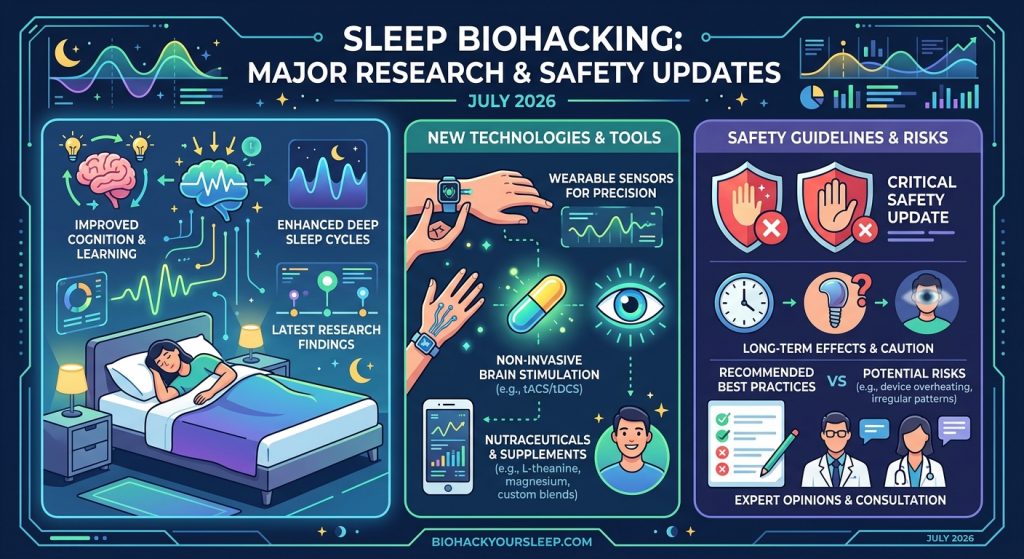
Sleep biohacking produces far more product launches and online claims than genuinely useful science. For this update, I reviewed research, regulatory alerts, expert discussions and consumer sleep technology published between April 1 and July 17, 2026.
I left out older evidence repackaged as news and supplements whose scientific position did not materially change. What remains is a concise overview of the developments that may actually affect how we understand, measure or improve sleep.
Melatonin May Help the Brain Ignore Nighttime Sensory Signals
The most interesting new melatonin study did not test another dose or extended-release formulation. It explored how melatonin may promote sleep inside the brain.
In a Current Biology study published in April, Caltech researchers used zebrafish to show that melatonin acted through MT1 receptors in the optic tectum, a brain region involved in processing visual information. Melatonin reduced the animals’ behavioral responses to changes in light, including while they were still awake.
This suggests that melatonin may not simply “switch the brain off.” Instead, it may help sleep emerge by reducing the importance of external sensory signals. That fits the concept of melatonin as a biological darkness signal rather than a conventional sedative.
For sleep biohacking, the practical implication is that timing and evening light exposure may matter more than continually increasing the dose. Taking more melatonin cannot necessarily compensate for strong light, stimulating screen content or a poorly timed circadian rhythm.
This was an animal study, so it does not establish a new human dose. Nevertheless, it offers one of the clearest recent explanations of how melatonin may make the brain more willing to disengage from the environment.
Primary research: [Melatonin promotes sleep by suppressing responses to visual stimuli via MT1 receptors — Current Biology]
Chronic Insomnia Showed Clock-Gene, Temperature and Cortisol Differences
A July study in Translational Psychiatry examined people with chronic insomnia, including participants with objectively short sleep duration.
Researchers measured sleep, activity, body temperature, cortisol and the expression of circadian clock genes. Compared with healthy sleepers, the insomnia groups showed:
- Weaker daily body-temperature rhythms
- Higher cortisol while awake before sleep
- Altered expression of BMAL1, PER1, PER2 and REV-ERB
- More pronounced disturbances in some participants who objectively slept for less than six hours
Machine-learning models based on combinations of clock genes could distinguish insomnia participants from controls and also separate insomnia subtypes within the study sample.
This does not mean that a commercial blood panel can now diagnose the cause of insomnia. The study was relatively small and requires replication. Its main contribution is conceptual: insomnia is not one uniform biological disorder.
A person with delayed circadian timing may require a different intervention from someone with elevated pre-sleep arousal, objectively short sleep or primarily conditioned sleep-maintenance insomnia.
This may also explain why the same supplement can work well for one person and fail completely for another. More sedation is unlikely to correct every insomnia phenotype.
Primary research: [Clock gene signature predicts insomnia and links to sleep/circadian phenotypes — Translational Psychiatry]
PubMed record: [PMID 42386720]
Probiotics Produced Small Sleep Improvements, Not a New Insomnia Cure
An updated systematic review and meta-analysis combined 39 randomized controlled trials investigating probiotics, prebiotics or synbiotics and sleep.
The pooled results found:
- Approximately 13.8 additional minutes of total sleep time
- Approximately 5.2 fewer minutes awake during the sleep period
- A small improvement in subjective sleep quality
- No reliable overall improvement in insomnia severity
The average reduction in the Pittsburgh Sleep Quality Index was only 0.71 points. That is below the approximately two- to three-point improvement usually regarded as clearly meaningful in clinical populations.
The studies also used different bacterial strains, formulations, treatment durations and participant populations. Evidence certainty was low for several outcomes.
This moves the gut–brain–sleep connection beyond pure speculation, but it does not turn a generic probiotic into a sleeping pill. The most plausible candidates may be people whose poor sleep coexists with digestive symptoms, stress or altered gut function.
Product-specific evidence matters. Results from one bacterial strain should not automatically be applied to every probiotic sold for stress or sleep.
Primary research: [Probiotics, prebiotics and synbiotics for sleep: updated systematic review and meta-analysis — Frontiers in Psychiatry]
Melatonin May Be More Useful When Pain Is Fragmenting Sleep
A systematic review and meta-analysis published in PAIN evaluated melatonin for chronic musculoskeletal and postoperative pain.
Across 23 randomized trials involving 2,028 adults, melatonin reduced pain by approximately nine points on a 100-point scale and also improved sleep-related outcomes.
Most studies used doses between 3 and 10 mg, but the researchers did not find a clear dose-response relationship. Higher doses were not consistently more effective.
This is particularly relevant to people whose sleep-maintenance insomnia is partly caused by shoulder, back, joint or postoperative pain. If pain repeatedly triggers micro-awakenings, reducing pain may improve sleep continuity without melatonin needing to function as a strong sedative.
These findings should not be interpreted as evidence that every person with insomnia needs 3–10 mg of melatonin. The participants had pain conditions, and most trials were relatively short.
The important update is that melatonin may have a more useful role when sleep disruption and pain reinforce each other.
Primary research: [Efficacy and effectiveness of melatonin for the management of pain — PAIN]
Creatine May Protect Cognition After an Unavoidable Bad Night
Creatine did not emerge as a new supplement for inducing sleep. Instead, it gained evidence as a possible sleep-loss resilience tool.
In a randomized crossover study, 29 healthy adults received a single dose of 0.2 grams of creatine per kilogram of body weight before approximately 21 hours of sleep deprivation.
Creatine reduced deterioration in several areas, including:
- Logical processing
- Numerical processing
- Language-processing speed
- Psychomotor vigilance
Exploratory results suggested that women may have received greater benefits in some tasks, although the study was not large enough to establish a reliable sex difference.
This confirms an important distinction:
- Sleep-promoting supplements aim to improve sleep itself.
- Resilience supplements aim to reduce next-day impairment when sleep loss could not be avoided.
Creatine belongs in the second category. It may be relevant for travel, emergency work, caregiving or occasional shift-work demands.
It does not restore normal sleep architecture, glymphatic clearance or the other biological functions lost during insufficient sleep. It should therefore be viewed as temporary cognitive support, not a substitute for sleep.
Primary research: [Single-Dose Creatine Reduces Sleep Deprivation-Induced Cognitive Deterioration — Nutrients]
Ashwagandha Safety Became Clearer—and More Contradictory
Two important ashwagandha updates appeared close together.
First, a prospective study tested 2,000 mg per day of ashwagandha root extract for 12 weeks in healthy adults.
Of 145 participants included in the intention-to-treat analysis:
- 85.5% reported no adverse events
- Nausea occurred in 5.5%
- Abdominal pain occurred in 3.4%
- Drowsiness occurred in 2.1%
- Dizziness occurred in 2.1%
Researchers reported no clinically significant changes in liver, kidney or thyroid laboratory values.
However, this was a single-arm study without a placebo control. It examined selected healthy adults for only 12 weeks and received industry support. A study of this size cannot reliably detect an adverse reaction that may occur only once in several thousand users.
Then, on July 7, Australia’s Therapeutic Goods Administration updated its safety information after receiving further reports of possible ashwagandha-related liver injury.
The agency described the risk as very rare but potentially serious. It had received 11 possible Australian liver-injury reports, including six cases in which no other likely contributing ingredient was identified. Some reported patients required hospitalization.
These findings are not mutually exclusive. Most healthy users may tolerate standardized ashwagandha, while a small minority experience an unpredictable liver reaction that a modest clinical study is too small to identify.
The practical lesson is not to treat ashwagandha as an automatic permanent component of every sleep stack. It is most rational when stress-related hyperarousal is the actual target.
Primary study: [Safety assessment of high-dose ashwagandha root extract — Frontiers in Nutrition]
Regulatory update: [Australian TGA: Ashwagandha and the very rare risk of liver injury]
Oura Ring 5 Improved Wearability More Than It Changed Sleep Science
Oura launched Oura Ring 5 on May 28, 2026.
According to Oura, the new model is:
- Approximately 40% smaller by volume than Oura Ring 4
- 6.09 mm wide
- 2.28 mm thick
- Rated for approximately six to nine days of battery life
- Supported by a charging case that can extend power availability for up to a month
The smaller design may be meaningful because comfort and adherence are critical for long-term sleep tracking. A theoretically accurate device is of limited value if it becomes uncomfortable and is frequently removed.
However, the new accuracy claims currently come mainly from the manufacturer. I did not identify an independent Oura Ring 5 validation study against polysomnography published during the covered period.
For existing Oura Ring 4 owners, Ring 5 appears to be primarily a comfort, size and charging upgrade rather than a fundamentally new method for distinguishing deep sleep from REM sleep.
Official source: [Oura: Introducing Oura Ring 5]
Contactless Radar and Low-Cost EEG Became the Most Interesting Device Trends
The most important sleep-device development may not be another ring or watch.
An April preprint evaluated the Sleepal AI Lamp, which uses 60 GHz radar to measure breathing and movement without requiring the user to wear anything.
The system was developed and tested using 1,022 synchronized radar and polysomnography recordings. It reported:
- 92.8% accuracy for sleep versus wake
- 78.5% four-stage accuracy in healthy participants
- 77.2% four-stage accuracy in a more heterogeneous population
The dataset is unusually large for a consumer sleep system. However, the paper remains a preprint and includes developers of the commercial product, so independent validation is still necessary.
A second preprint introduced the Open-Source Sleep Monitor and Modulator, a headband assembled from inexpensive components for less than €40.
In a proof-of-concept test covering 15 nights in one person, it achieved 77.6% four-stage accuracy against a validated contactless monitor.
The open-source project is far too early for broad conclusions. It used one participant and was not validated directly against full polysomnography. Still, it points toward cheaper, more transparent home EEG systems.
Together, these projects show where consumer sleep technology is moving: away from compulsory wrist and finger wearables and toward contactless sensing, accessible EEG and systems that can potentially adapt sound or other interventions to detected sleep stages.
Radar study: [Sleepal AI Lamp: contactless radar-based sleep staging]
Open-source EEG project: [Open-Source Sleep Monitor and Modulator]
The Strongest Sleep Biohacking Trend Was Simplification
The most useful trend in expert and community material was not a newly discovered supplement. It was greater attention to hyperarousal, circadian light and supplement subtraction.
In June and July, sleep scientist Matthew Walker focused on “tired but wired” insomnia and the role of strong daytime light in anchoring circadian rhythms.
The underlying message was that insomnia may involve an overactive alerting system rather than insufficient sedation. Morning outdoor light, consistent waking times and reduced pre-sleep cognitive activation may therefore be more important than adding another relaxing compound.
Current Reddit discussions also increasingly distinguish between sleep onset and sleep maintenance. Many users describe falling asleep normally but waking after three or four hours with the brain suddenly active.
Some report better results after removing supplements, changing magnesium timing or simplifying a stack rather than making it stronger. These are anecdotes rather than controlled evidence, but they can identify useful questions for personal experiments.
A practical sleep-biohacking process now looks like this:
- 1. Identify whether the main problem is falling asleep, repeated awakenings or waking too early.
- 2. Stabilize waking time and morning-light exposure.
- 3. Track caffeine, alcohol, late meals, evening fluids, pain and bedroom temperature.
- 4. Change only one supplement at a time.
- 5. Evaluate both nighttime sleep and next-day function.
- 6. Ignore isolated changes in a wearable’s deep-sleep score unless they repeat and match how you feel.
Expert source: [The Matt Walker Podcast: 2026 sleep episodes]
Community example: [Reddit discussion: waking at 2–3 a.m. and changing magnesium timing]
Final Takeaway
The April-to-July 2026 update did not reveal a new supplement that clearly outperforms established sleep strategies.
Instead, it improved the map:
- Melatonin may promote sleep partly by reducing the brain’s response to nighttime sensory information.
- Different insomnia subtypes may have distinct clock-gene, temperature and cortisol profiles.
- Probiotics produce small average sleep improvements, not dramatic ones.
- Melatonin may be particularly useful when pain is fragmenting sleep.
- Creatine may reduce cognitive decline after acute sleep deprivation without replacing sleep.
- Ashwagandha appears tolerable for most healthy short-term users, while rare liver injury remains a credible safety concern.
- Supplement-label accuracy is still a serious problem.
- Contactless radar and inexpensive EEG may become more important than another generation of conventional wearables.
- The most useful current biohacking trend is matching a simple intervention to the actual type of sleep problem.
My own rule remains straightforward:
The best sleep protocol is not the stack with the most ingredients. It is the smallest repeatable system that improves both sleep continuity and the following day.

By: Alex Warenstein.
Bio: Alex Warenstein is a sleep biohacker and founder of Night Time Comfort. After battling chronic insomnia and circadian disruption, he now helps others optimize their sleep using data-driven protocols. Read full story.
Disclaimer: Alex is not a doctor. This content is for educational purposes only. Always consult a specialist.