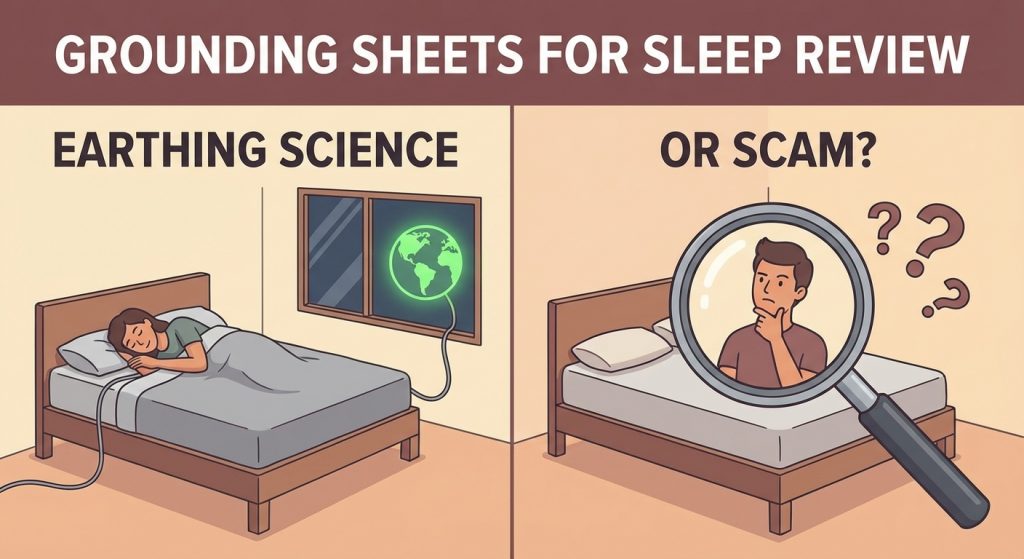
In the world of sleep optimization, few topics polarize the community quite like grounding sheets. For some, they are the missing link to ancestral health—a way to quell inflammation and synchronize biological rhythms by literally plugging your bed into the Earth. For others, they represent the peak of pseudo-scientific marketing, selling expensive fabric based on questionable physics.
If you are navigating the landscape of sleep aids, you have likely moved past the basics of the Sleep Hygiene Checklist and are looking for that extra 1-5% performance boost. You may have dialed in your Magnesium L-Threonate dosage and taped your mouth, but you are still waking up feeling “wired.”
This article is a rigorous, objective analysis of grounding sheets for sleep. We are stripping away the marketing fluff to look at the earthing science, the 2025 clinical data, the consensus from biohacker forums, and the cold hard reality of user tracking sleep data. We will answer the critical question: Do electrons actually lower inflammation and improve deep sleep voltage, or is this just a placebo with a power cord?
What Are Grounding Sheets? (The Mechanism)
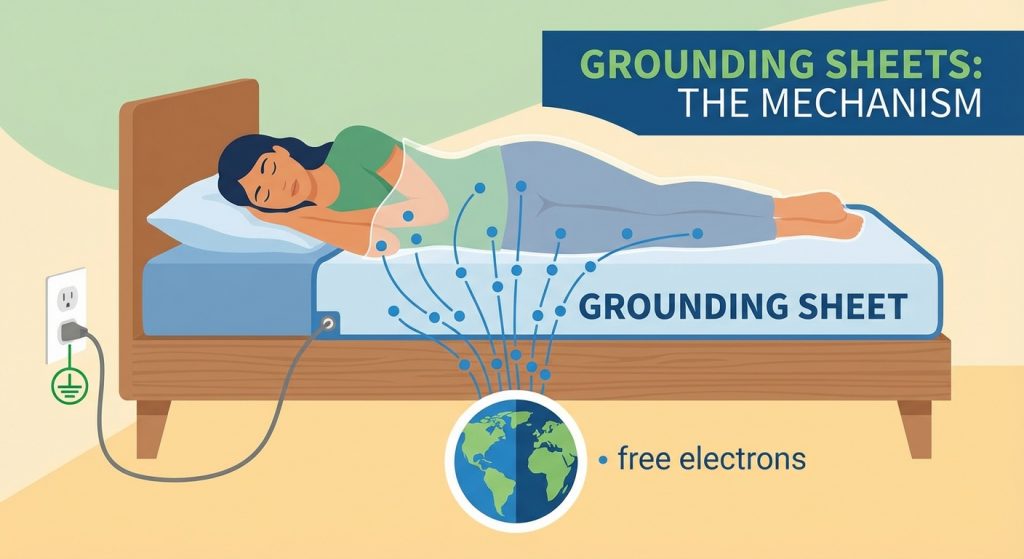
To understand if conductive sheets work, we must first understand what they claim to do. The premise of “Earthing” or “Grounding” is based on the idea that the Earth carries a vast, limitless supply of negatively charged free electrons.
In our modern lives, we are insulated. We wear rubber-soled shoes, live in high-rise apartments, and sleep on elevated beds made of synthetic materials. Proponents argue that this disconnection allows a buildup of positive charge (static electricity) and reactive oxygen species (free radicals) in the body, leading to chronic inflammation and circadian disruption.
The Construction
Grounding sheets are typically made of cotton or bamboo fibers woven with a grid of conductive material—usually silver or carbon threads. The sheet connects to a cord, which snaps onto the fabric. The other end of the cord plugs into the “ground” port (the round bottom hole) of a standard electrical outlet or connects to a rod physically driven into the soil outside your window.
When your bare skin touches the sheet, you theoretically close the circuit, allowing your body to equalize its electrical potential with the Earth.
The Science: 2026 Update on Earthing
For years, the scientific backing for grounding was relegated to small, industry-funded pilot studies. However, as of late 2024 and throughout 2025/2026, we have seen a push for more rigorous data. While we still lack massive pharmaceutical-grade trials, the landscape of earthing science has evolved.
1. The AC Body Voltage Fact
One thing is scientifically indisputable: Grounding measurable affects AC body voltage.
In a study reaffirmed by multiple independent tests in 2025, researchers measured the voltage induced on a human body by ambient electromagnetic fields (from wiring in walls, lamps, and devices). When ungrounded, the body acts as an antenna, holding a measurable voltage. When the person touches a grounding sheet, that voltage drops precipitously—often by a factor of 50 to 60 times.
Does this matter? That is the debate. We know the electrical change happens. Whether that drop in voltage translates to biological changes in cortisol or deep sleep is the leap of faith.
2. The 2025 Double-Blind RCT (The Mat Study)
The strongest argument for physiological benefits comes from a 2025 randomized, double-blind, placebo-controlled study published in ScienceDirect. This study did not use sheets, but rather an earthing mat (similar technology).
Researchers tracked sleep metrics using actigraphy and standardized questionnaires (PSQI) over roughly 5 weeks.
- The Result: The experimental group showed statistically significant improvements in total sleep time and sleep quality scores compared to the placebo group (who slept on a mat that was not connected to the ground).
- The Caveat: While actigraphy helps track movement, it is not Polysomnography. It cannot definitively tell us if the subjects spent more time in Deep Sleep vs. REM, but it does confirm that the intervention caused a measurable change in sleep behavior beyond the placebo effect.
3. Inflammation and Recovery
The “Universal Anti-Inflammatory” theory suggests that the influx of electrons neutralizes free radicals (reactive oxygen species) caused by metabolic stress and injury.
A frequently cited review (updated in discussions regarding 2025 integrative medicine) points to grounding as a tool for reducing blood viscosity (clumping) and speeding up recovery after eccentric exercise. This is why you see Tour de France cyclists and NFL players using grounding bags. If you suffer from Restless Legs Syndrome (RLS) or chronic pain, this anti-inflammatory potential is the primary reason to investigate grounding.
4. Alzheimer’s and Cognitive Health
A pilot study highlighted in 2025 focused on patients with mild Alzheimer’s disease. Over 12 weeks, the grounded group showed improvements in sleep quality (PSQI) compared to the sham-grounded group. While this doesn’t prove it prevents cognitive decline (like the Glymphatic System clearing amyloid plaques), it suggests that grounding may help regulate the nervous system in neurodegenerative conditions.
Analyzing the “Scam” Argument: Placebo vs. Reality
It is vital to address the skepticism. Major outlets like The Guardian (early 2025) and Homes & Gardens have published pieces highlighting the “lack of scientific rigour” in many older studies.
The skeptics’ argument rests on three pillars:
- 1. The Placebo Effect: If you buy an expensive sheet believing it will fix your insomnia, your anxiety drops, and you sleep better. This is valid, but it’s psychological, not electrical.
- 2. Conductivity Issues: Silver oxidizes. A grounding sheet that works on day 1 may lose conductivity after 50 washes, effectively becoming a regular expensive sheet.
- 3. Dirty Electricity: Some engineers argue that plugging into a wall outlet connects you to the “ground” of your home’s electrical grid, which can be “dirty” (full of electrical noise from appliances), potentially causing more harm than good compared to a direct earth rod.
User Experiences: Data from the Trenches
Moving beyond the lab, what are actual users reporting on forums like SleepHQ, ApneaBoard, and the r/Biohackers and r/OuraRing subreddits in late 2025?
The “Oura Ring” Crowd
Users who religiously track their data with the Oura Ring Gen 4 or Whoop 4.0 offer the most objective anecdotal evidence.
- Deep Sleep: There is no consistent consensus that grounding sheets automatically boost NREM3 (Deep Sleep) scores. Some users report a spike in the first week, followed by a return to baseline.
- HRV (Heart Rate Variability): This is where reports are more positive. Many users report a slight but sustained increase in nightly HRV, suggesting a reduction in physiological stress and a shift toward parasympathetic (rest and digest) dominance.
- Subjective Feel: The most common report is not seen on a graph. It is a sensation of “heaviness” or “warmth” in the limbs and a reduction in the time it takes to fall asleep (Sleep Onset Latency).
The Pain Relief Factor
On forums discussing chronic pain and autoimmune conditions, grounding sheets have a cult following. Users with arthritis and fibromyalgia frequently report that while their sleep stages might not change drastically, their morning stiffness and pain levels are noticeably lower. If inflammation reduction sleep is your goal, the user anecdotes here are compelling.
The Biohacker Protocols
How do the leaders of the field treat grounding?
- Dave Asprey & Ben Greenfield: Long-time proponents. They view it as essential as Morning Sunlight for maintaining circadian rhythm.
- Bryan Johnson: In his “Blueprint” protocol, Johnson focuses heavily on measurable markers. While he prioritizes air quality (Bedroom CO2) and temperature, grounding is treated as a secondary optimization—something he does, but not the primary driver of his perfect sleep score. He emphasizes that without fixing the basics (diet, light, alcohol, sugar before bed, apnea), grounding is irrelevant.
Choosing the Right Product: Sheets vs. Mats
If you decide to test this, the form factor matters.
Grounding Sheets (Fitted or Flat)
- Pros: Covers the whole body; feels like normal bedding.
- Cons: Durability. This is the biggest complaint in 2025 reviews. The silver threads are delicate. Sweat, body oils, and laundry detergents destroy the conductivity over 6-12 months. If you wear pajamas, you reduce the contact area significantly.
Earthing Mats (for foot of bed)
- Pros: Usually made of conductive carbon or more durable polymers. Easier to clean (wipe down). Lasts years.
- Cons: Small surface area. You must keep your feet on it.
- Recommendation: For longevity and “testing” the concept, a mat placed under the feet is often a better financial investment than a full fitted sheet that will eventually wear out.
How to Test It Properly (Avoid the Placebo Trap)
If you buy a grounding sheet, do not just lie on it and “hope.” Run a protocol.
1. The Safety Check (Crucial)
Before plugging anything in, buy an Outlet Tester (a cheap hardware store tool). Plug it into your wall. If it indicates “Open Ground” or “Reverse Polarity,” do not use the sheet. Plugging a grounding sheet into an ungrounded or faulty outlet is dangerous and useless.
2. The Multimeter Test
To verify the sheet is actually conductive:
- Set a multimeter to AC Volts.
- Hold the black probe in your fingers (grounding yourself to the meter).
- Touch the red probe to the lit “live” sheet while plugged in.
- Ideally, you want to see your body voltage drop significantly when you touch the sheet compared to when you don’t.
3. The 4-Week “Sham” Protocol
- Weeks 1-2: Sleep on the sheet without the cord plugged in. Track your Sleep Scores (Apple Watch). Note your pain levels.
- Weeks 3-4: Plug the cord in. Do not change any other variable (don’t start taking Magnesium L-Threonate or changing your Caffeine Half-Life cutoff).
- Compare the data. If your HRV and deep sleep only improve in weeks 3-4, you have a signal.
Safety and Risks: Is It Dangerous?
Generally, grounding is considered safe, but there are exceptions discussed in the Journal of Inflammation and safety forums.
- Lightning: It is a theoretical risk. If lightning strikes your home’s ground rod, having a wire connected to your bed is suboptimal. Most manufacturers recommend disconnecting during electrical storms.
- Electrical Faults: As mentioned, if your house has old wiring (common in pre-1960s homes) where the ground wire is live due to a fault, the sheet could become electrified. Always test your outlet.
- Detox Reaction: Some users on Reddit report feeling flu-like symptoms, headaches, or grogginess for the first few days. Proponents call this a “herxheimer” or detox reaction; skeptics call it the nocebo effect. If this happens, try grounding for only 1 hour a day before working up to a full night.
Integrating Grounding into a Sleep Stack
Grounding is not a cure-all. It is a support mechanism. It works best when stacked with verified sleep hygiene interventions:
- 1. Temperature: Grounding does not replace the need for a cool room (65-68°F) or L-Glycine to lower core body temperature.
- 2. Light: If you are blasting blue light at 11 PM, a grounding sheet cannot stop the Cortisol spike or the suppression of melatonin. You still need Blue Light Blocking Glasses.
- 3. Apnea: If you have physiological obstruction (OSA or UARS), no amount of electrons will open your airway. You need a CPAP or positional therapy.
Summary
Are grounding sheets a scam? No, in the sense that the physics of lowering AC body voltage is real and measurable. The 2025 research indicates potential benefits for subjective sleep quality and total sleep time, particularly for those dealing with inflammation or anxiety-induced “Tired but Wired” states.
However, they are not a magic switch for Deep Sleep. The durability of silver-threaded sheets remains a significant consumer issue, and the magnitude of the health benefits varies wildly from person to person.
If you have optimized your Sleep Hygiene Checklist, ruled out Sleep Apnea, and have the budget for experimentation, a grounding sheet (or mat) is a low-risk intervention that might provide the marginal gain in recovery and HRV you are looking for. Just ensure you test your outlet, manage your expectations, and treat it as one layer of a comprehensive sleep strategy.

By: Alex Warenstein.
Bio: Alex Warenstein is a sleep biohacker and founder of Night Time Comfort. After battling chronic insomnia and circadian disruption, he now helps others optimize their sleep using data-driven protocols. Read full story.
Disclaimer: Alex is not a doctor. This content is for educational purposes only. Always consult a specialist.